


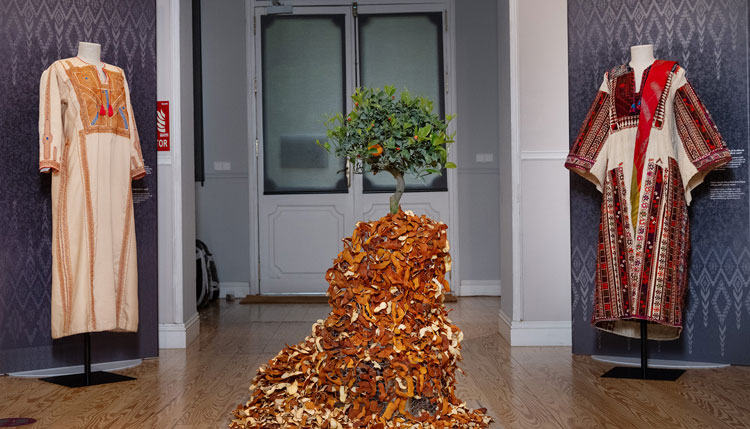
The Real Fábrica de Tapices has presented the exhibition Al’Qala. Threads of History, a showcase composed of more than 60 historical and contemporary pieces, an initiative that brings together artists of Palestinian, Lebanese, Kuwaiti, and Syrian origin.
Alejandro Klecker, general director of the Real Fábrica de Tapices, expressed at the inauguration event that the exhibition “connects directly with our own roots. Our institution is heir to a textile tradition deeply linked to the Muslim legacy in Spain. From the use of merino wool and silk in the production of tapestries and carpets, to the use of dye plants such as saffron, pastel grass, or weld, which are an essential part of our artisanal knowledge. This exhibition not only puts cultures and territories in dialogue but also highlights a shared heritage that remains alive in our looms.”
The exhibition is structured in three large sections. The journey begins with A Legacy in Threads, the staging of a 19th-century tapestry and eighteen historical dresses from the 20th century, as well as a selection of accessories, loaned by the Jordanian institution Tiraz Centre, and belonging to the private collection, Widad Kawar. These pieces come from different regions, including Bethlehem, Ramallah, Hebron, Gaza, Lydda, Ramla, Jaffa, and Jerusalem. These pieces embody ancestral heritage and Palestinian antiquity.
The exhibition continues with A Nation Between Stitches, which incorporates six embroidered panels, loaned by the Lebanese association Inaash, which aims to preserve and recover tatreez, through unique pieces embroidered by refugee women. In this case, tatreez functions as a living heritage, bearer of identity, memory, and knowledge across generations.
The third section An Heritage in Motion is presented in collaboration with the SILA Project founded by Rula Alami. It is a selection of twenty-one contemporary works by thirteen artists from Palestine, Syria, Kuwait, and Lebanon, works that open a powerful dialogue between Palestinian embroidery and contemporary artistic practice, revealing the transformative power of tatreez and its cultural depth.
Al’Qala includes the special contribution of Fadia Ahmad, whose cinematic installation Between Two Shades of Blue explores exile, memory, collective wounds, and the intimate search for belonging. Its inclusion is presented as a special recognition of Lebanon as a land that has hosted, for many years, generations of Palestinians in exile.
The exhibition is organized in collaboration with the Jordanian institution Tiraz–Widad Kawar Home for Arab Dress, the Lebanese association Inaash, and the Sila Project.