The new headquarters of UN Tourism at the Palacio de Congresos in Madrid was inaugurated last Monday coinciding with the first anniversary of the International Conference on Financing for Sustainable Development held in Seville in July 2025.
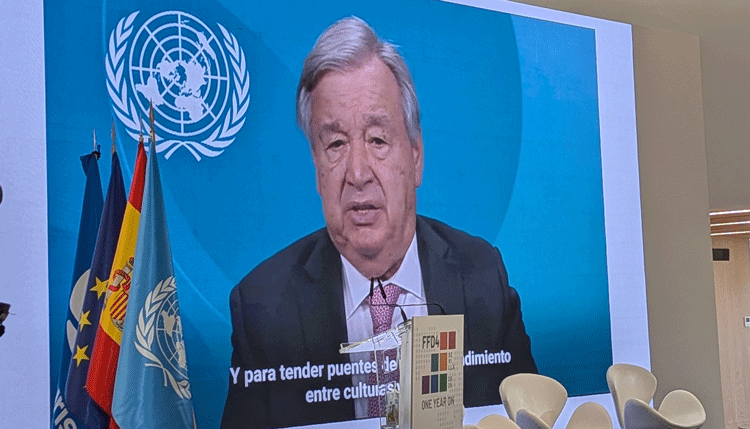
The President of the Government, Pedro Sánchez, and the Secretary General of UN Tourism, Shaikha Al Nowais, were hosts of the event, which began with a video message from the Secretary General of the United Nations (UN), António Guterres, in which he stated that “together, this moment marks the beginning of a new era defined by inclusion, equity, and sustainability. Through this journey, we can learn to love what makes us different and to recognize our shared humanity. In a moment of division and distrust, this connection is more important than ever. May this new headquarters bring our world closer and serve as a starting point for many great journeys to come.”
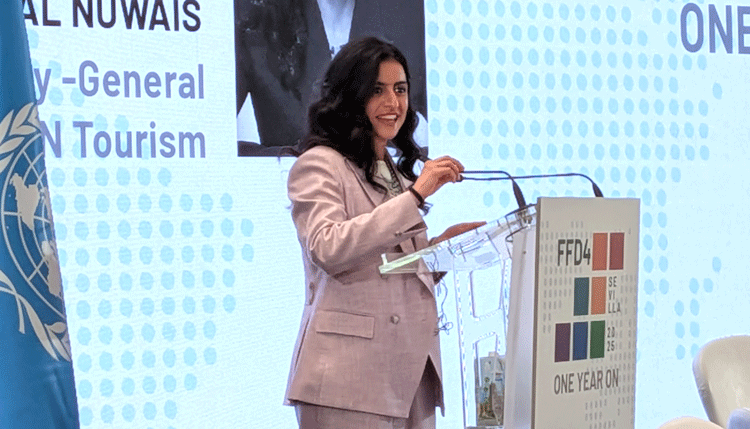
The Secretary General of UN Tourism, Shaikha Al Nowais, expressed during her speech her satisfaction in accompanying all those present, and the ambassadors in particular, “to our new home. And thank you for being with us to mark this day after 50 years. Half a century ago, the World Tourism Organization came to Madrid. We were the first United Nations agency to call this city ‘home’. And over time, Madrid became part of who we are. Today we mark a new beginning in that history.”
“And we renew a promise,” continued Shaikha Al Nowais. “A promise that tourism belongs at the heart of international cooperation. A promise that this sector, when guided by a purpose, can help build prosperity, understanding, and peace. Because tourism is one of the great meeting points of our time. Every year, more than a million people move across borders. Not as statistics, but as people. Opening economies, opening minds, creating jobs, helping people and places share their story with the world. Perhaps, to turn their travels into opportunities. And that is why this organization exists. It exists within the United Nations system.”
The Secretary General continued by stating that “when we get tourism right, we not only support a sector. We help build the kind of world that the United Nations was created to serve. And this new headquarters gives us a stronger platform to do that. To turn ideas into action. Partnerships into results and tourism.”
Shaikha Al Nowais concluded by emphasizing that “beyond its doors, Madrid becomes a genuine hub for the United Nations system, the place of tourism in the city is not symbolic. It is fundamental. We sincerely thank Spain and Madrid for that.” Words that were followed by a long applause from the attendees.
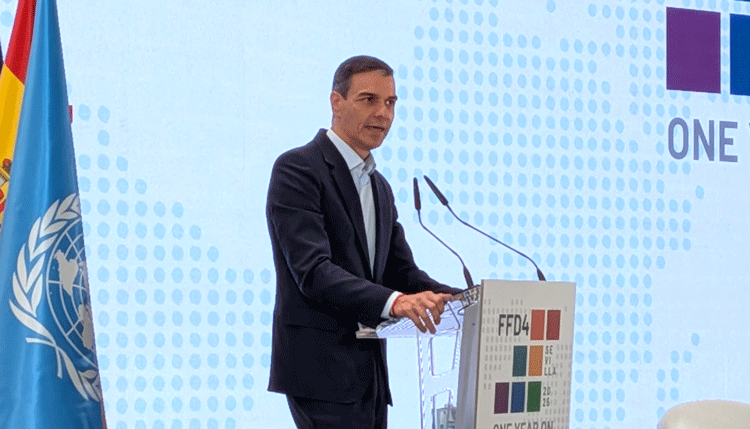
The President of the Spanish Government, Pedro Sánchez, wanted above all to congratulate I would also like to start by congratulating Shaikha Alnuwais, “the first woman to lead United Nations UN Tourism in the 50 years of the agency’s history. I believe that her appointment clearly represents a step forward in equality, but I also believe it represents something much deeper and is a sign of where we need to go.”
“21st century tourism must be built on sustainability, on inclusion, on cooperation, ultimately, on global responsibility. And there is no better place to symbolize that ambition than this building we inaugurate today. A building that clearly will not move into the future without remembering its past, this old Palacio de Congresos that for decades hosted international dialogue, is reopening to the world,” said President Sánchez.
Pedro Sánchez continued by stating that “Spain wants to be precisely a meeting space. The commitment of the Spanish Government to multilateralism is, without a doubt, not a whim, but a reflection of who we are as a society. A deeply supportive society. It is striking that 84% of Spanish society supports sending humanitarian equity, the alliance of nations, international solidarity. 77% believe that we should cooperate despite the economic cost it entails. And 8 out of 10 Spaniards believe that fighting poverty in the world should be one of the main priorities of the European Union. This places my country, our country, Spain, as one of the countries with the greatest support for international cooperation. And at the same time, it makes us perceived in the rest of the world as a country firmly committed to multilateralism. Because let’s be clear, our world does not need more selfishness or more fear, what our societies and our countries need is to step forward to reconnect in multiple ways.”
“We defend that cooperating is not a weakness but a sign of strength. We defend that building common spaces is the only way to protect what truly matters to us, which is peace, prosperity, and human dignity. That was our message to the rest of the world exactly one year ago at the Financing for Development Summit we held in Seville, a very important event for the multilateral system and also for our country. An event that showed that even in the difficult times we are living in multilateralism is still, a hope, and it is, by the way, a lot that we can do when we work together,” emphasized the Spanish president.
Pedro Sánchez highlighted the three pillars that define his government’s policy regarding multilateralism: shelter, reinforcement, and reform. “First of all, we are being a shelter for multilateralism,” he pointed out. “This wonderful building located in one of the most central and valued places in the capital of our country is. It is also the arrival and reinforcement of international institutions. The World Bank group has opened its office in Madrid. And along with the Bank, the United Nations Development Programme, the Permanent Court of Arbitration, the International Telecommunication Union, the United Nations System Staff College, the International Monetary Fund, and the Development Bank of Latin America and the Caribbean have chosen our country, Spain, to work, to grow, expanding their presence in our country during these months. Spain, therefore, wants to be that place of refuge, wants to be that place where great global debates are held as we have done over the past eight years.”
Regarding reinforcement, Pedro Sánchez pointed out that “in an international context like the current one, we must greatly value the contribution that Spain is making given its capacity, its dimension, and its resources. We have increased our official development assistance by 13%, reaching over 4.55 billion euros in 2025. We maintain our commitment to move towards that 0.7% of Gross National Income and it is not only about what we invest, but also about how we do it. Because we are betting on basic cooperation, focusing on debt sustainability, on fiscal justice which is also one of the elements that, unfortunately, has already ceased to be at the center of the multilateralism debate but which, of course, from Spain we do not renounce.”
Regarding reform, the president stated that “the world today is unfortunately not the world that was signed in the United Nations Charter. And that implies its renewal, its reform. And I say, moreover, reform with a capital R, because the world has changed, the actors are different from 80 years ago and our institutions also have to adapt. And this is not a matter of idealism, it is a matter of pragmatism. We advocate for a much more representative, more transparent, more effective system. A system capable of responding to current challenges with legitimacy. And we also advocate that global leadership must be more inclusive, that it must resemble more the world it represents. That is why we believe that the time has come for a woman to finally occupy the position of Secretary General of the United Nations. Not for correctness, not because it is politically correct, not for symbolism, but for intelligence. Not for reparation of the past, but for a necessity of the future.”
“Therefore,” emphasized Pedro Sánchez, “reforming multilateralism is not questioning it, it is guaranteeing its future, it is taking away reasons from those who want to weaken it. And Spain, logically, will be at the forefront of the reflection, together with other countries and other actors, for the action that this reform becomes a reality.”
Regarding the international context, President Sánchez emphasized that today more than ever “solidarity and empathy must prevail over hatred and rivalry,” since no global challenge can be resolved in isolation.
To conclude, the President of the Spanish Government wanted to address the members of the Diplomatic Corps present at the event, stating that “your countries will always have in Spain not only an ally but also a friend and a brotherly people. Because that is how we understand international relations, from fraternity. Because we know that the 50 million Spaniards express that desire, I am convinced of it.”
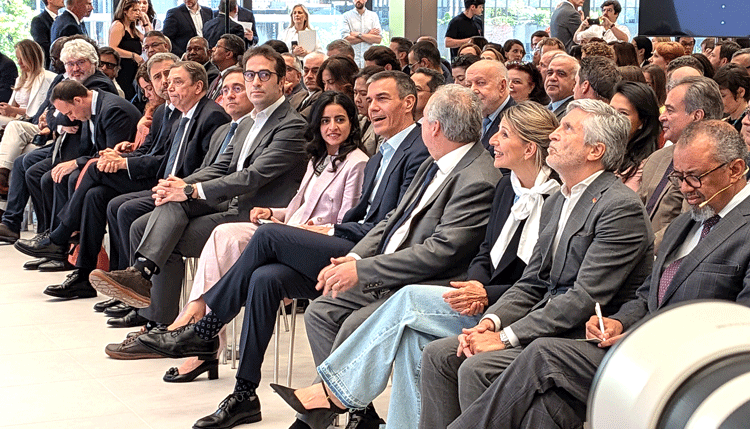
The inauguration event was attended by the Ministers of Foreign Affairs José Manuel Albares; the First Vice President of the Government and Minister of Economy, Carlos Cuerpo; the Vice President and Minister of Labor, Yolanda Díaz; the Minister of the Interior, Fernando Grande-Marlaska, the Minister of Industry and Commerce, Jordi Hereu, and the Minister of Agriculture, Fisheries and Food, Luis Planas, accompanied by various civil authorities of the State and a large number of ambassadors stationed in Spain.