


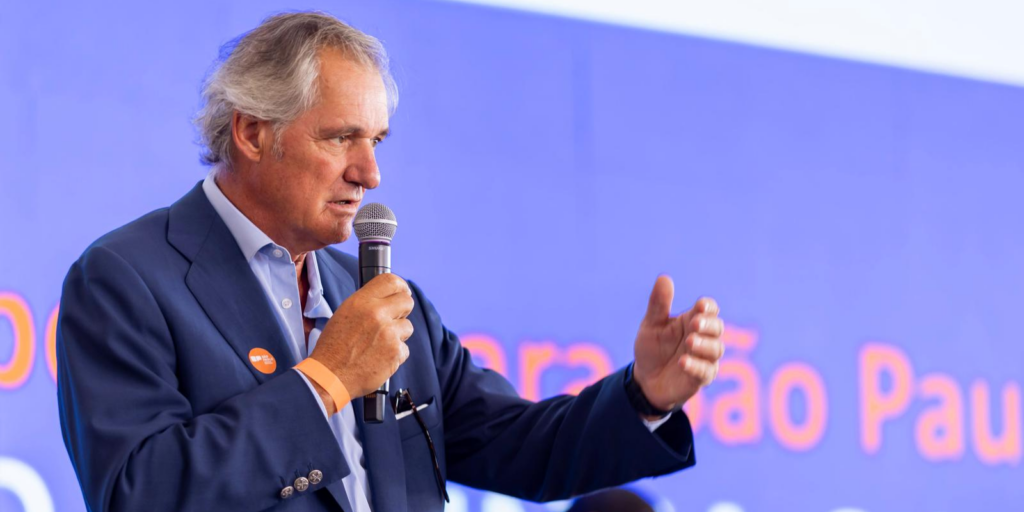
The company strengthens its strategic presence in the country following the inauguration of the first six stations of the subway and the awarding of basic sanitation projects in 85 municipalities.
In an international scenario characterized by the reconfiguration of alliances and increasing global competition, large infrastructure corporations have ceased to be mere economic agents to establish themselves as key players in international relations. Transnational investments no longer only respond to financial profitability logics, but are directly involved in the autonomy and stability of the recipient States.
The recent milestone of the Spanish multinational ACCIONA in Brazil precisely illustrates this metamorphosis by taking a definitive step in consolidating its business in Latin America with the operation of the first sections of its large infrastructure projects and the expansion of its portfolio in the water sector in the Brazilian market, considered key to the company’s growth strategy.
The group has put into service the first six stations of Line 6 (Orange) of the São Paulo metro —João Paulo I, Freguesia do Ó, Santa Marina, Água Branca, SESC-Pompeia, and Perdizes—, which will initially operate from Monday to Friday in an assisted and free manner. This project is being developed through a public-private partnership (PPP) between the Government of the State of São Paulo and the Concessionaire Linha Universidade, predominantly participated by ACCIONA. It is the largest infrastructure project currently underway in the region.
Once the layout is completely finished, the line will have a length of 15.3 kilometers and 15 stations, connecting the northern area of Brasilândia with the city center at the São Joaquim station. Official forecasts detail that the infrastructure will transport 633,000 daily passengers, reducing the total travel time from the current 90 minutes by bus to a journey of 23 minutes by metro. The rolling stock, manufactured in stainless steel by Alstom, will operate through the total automated driverless system (CBTC GoA4).
Investment of 724 million in the water cycle
In parallel to the development of the urban transport sector, ACCIONA Agua’s division has extended its operations in the country after being awarded the sanitation and sewage service for 85 municipalities located in the Paraíba region, in the northeast of the country. The contract, awarded by the Paraíba Water and Sewage Company under a public-private partnership, will extend until 2039 and includes an associated investment plan of 724 million euros to cover an estimated population of 1.7 million inhabitants.
These actions are part of the objectives of Brazil’s National Basic Sanitation Plan, which aims for universal coverage of these essential services. The group already has a strong presence in this segment following agreements signed with Sanepar in the Paraná region (324 million euros), with Cesan in eight locations in Espírito Santo (85 million euros), and the comprehensive contract formalized in December 2025 with the government of Pernambuco, which covers 151 municipalities over a period of 35 years and an investment of 2.4 billion euros.
Paradigm shift in infrastructure investment
The boost in the company’s order book coincides with the lines of action presented by the group’s president at the last General Shareholders’ Meeting. During his appearance, José Manuel Entrecanales stated that global infrastructures are facing a change in construction and financing models, conditioned by climate effects and the need to modernize transport and supply networks.
In this regard, the executive pointed out that assets related to water, clean energy, and safe transport currently act as “critical assets of strategic sovereignty and social cohesion,” being the subject of global investor consensus. The group closed the reference year with an aggregated infrastructure portfolio exceeding 120 billion euros and a record EBITDA of 3.211 billion euros, supported by the operational growth of its main international divisions.
With nearly 30 years of uninterrupted presence in Brazil, the company adds to these projects historic works such as Terminal 2 of the Açu Port in Rio de Janeiro, the cultural adaptation of the historic Júlio Prestes Station in São Paulo, and the development of integrated social action programs that, within the framework of Line 6, have had a direct impact on more than 60,000 people in the project areas.