


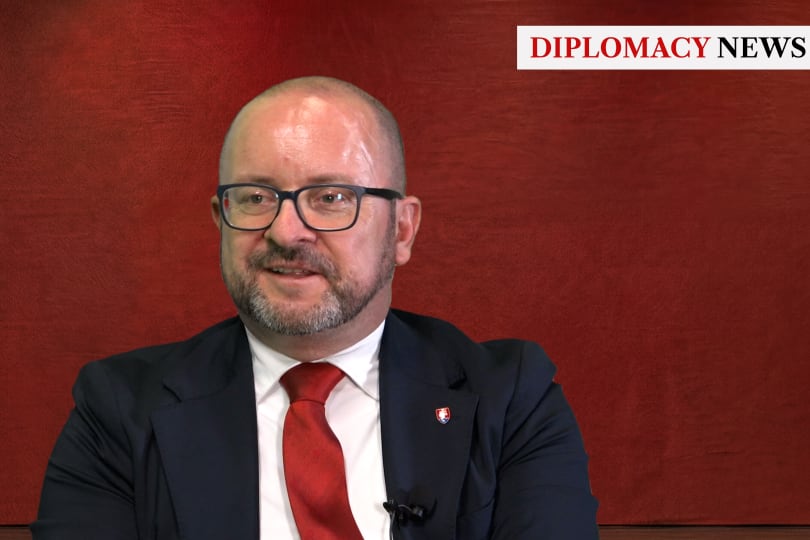
The ambassador of Slovakia in Spain, Juraj Tomaga, serves as our improvised and very special tour guide on an extensive tour of his country in the first installment of the travel interviews by DiplomacyNews. Landscapes, history, culture, gastronomy… Slovakia represents the essence of Central Europe on the banks of the Danube.
Slovakia is a somewhat unknown country because, as part of Czechoslovakia, for many years the word “Czech” overshadowed the word “Slovakia.” But the separation was not traumatic and, in fact, it is considered a model of friendly secession.
“It’s true,” the ambassador confirms during the interview (which you can watch in full at this link). “I proudly say that I was born in Czechoslovakia, like everyone who was born in ’77 or earlier.” “Czechoslovakia is still in our hearts; it’s not that we are friends, it’s that we are like brothers.”
Regarding the visit to the country, Juraj Tomaga highlights that there are 14 weekly flights from Barcelona to Bratislava, where there are also vdirect flights to and from Palma de Mallorca, Málaga, Alicante, and Tenerife. However, there are no flights from Madrid “but we are working to make it happen,” he adds, while informing that “from Málaga you can also travel to eastern Slovakia, to the second largest city in the country, an area rich in history.”
In addition to history, Slovakia boasts great natural spaces for hiking and medieval cities for urban hiking; fairy tale castles; cycling routes; and natural riches such as thermal waters with therapeutic properties.
In Slovakia, there are many ways to enjoy tourism for all tastes and ages. “There are mountains like El Pico,” he gives as an example, “which has an impressive astronomical observatory that cooperates with the one in the Canary Islands, and where you can enjoy incredible views.
Ambassador Tomaga also highlights the convenience for tourists that Slovakia, besides being a member of the European Union, is also a member of the euro area, meaning that there is no need to exchange currency “and a Spaniard will not be surprised by the prices; if anything, they will be surprised that the back of the coin has the double cross, which looks very much like the Cross of Caravaca.”
In this regard, the ambassador assures that “the prices are comparable and as affordable as those in Spain“.
Slovakia “has the largest number of national parks in proportion to its size in all of Europe. That is to say, many areas are protected, protected for animals, like bears.” “And I’m not talking about flies,” he clarifies, I’m talking about big bears, who don’t become very friendly,” he jokes.
And in terms of gastronomy, the ambassador highlights that Slovakia is a country with a “great wine culture,” where you can visit some very interesting wineries, where the white wines can remind you of those from Penedés and are an excellent accompaniment to Slovak cuisine, where you might be more surprised by the presence of a dish very similar to Madrid stew, in addition to the traditional cabbage soups and red meats.
“You can’t leave Bratislava without trying a coffee,” he tells us, because “we have a very strong coffee culture.” So, in one of the many cafes in the center of the capital, Juraj Tomaga recommends ending the journey through Slovakia by calmly enjoying that coffee and the cookies that are always served with it while we listen to legends like those of the little dwarfs that scared the miners or that of Yuri, a Slovak Robin Hood. “It’s the best way to end a meal.”