


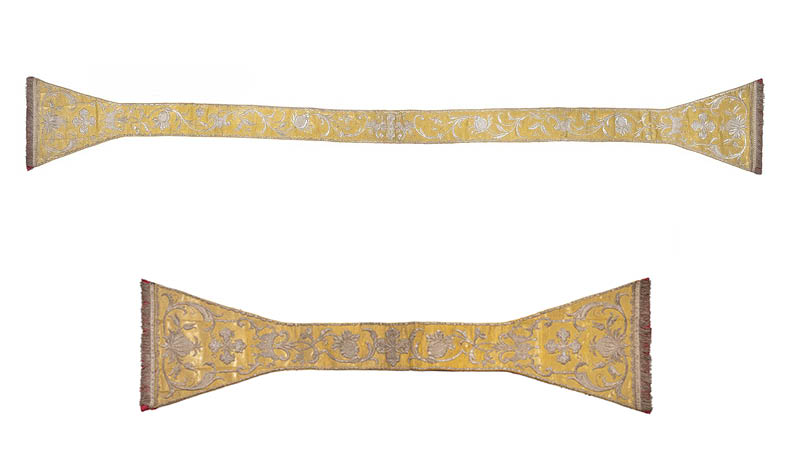
The Royal Tapestry Factory (RFT) is carrying out the restoration of a prominent set of historical textiles belonging to the Museum of the Church, in the Cathedral of Oviedo, a collection of liturgical pieces of extraordinary artistic and heritage value, spanning from the 16th to the 18th century.

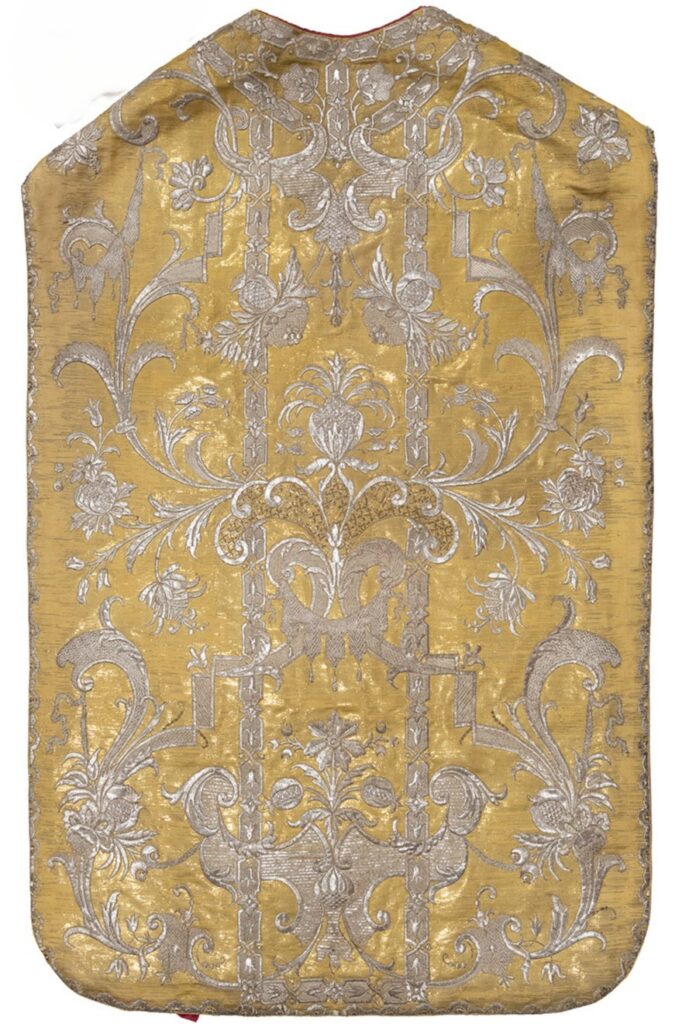
The intervention will ensure the conservation of chasubles, rain capes, stoles, and maniples made of silks, velvets, and threads of gold and silver, a testament to the richness of Asturian textile heritage.
Among the pieces being restored is a red silk velvet chasuble from the 16th century with gold and silk embroidered decoration; a set composed of chasuble, maniple, and yellow silk stole from the 18th century; a vestment, in red silk and gold relief, from 1730 composed of: rain cape, chasuble, dalmatic, as well as a stole, maniple, and collar or neck; and a light blue chasuble intended for the celebration of the Solemnity of the Immaculate along with various complementary liturgical elements.
The passage of time and its continued use have left their mark on these works, which present a delicate state of conservation. The accumulation of dirt, dehydration of textile fibers, deterioration of metallic threads, tears, and material losses compromise their structural stability and necessitate specialized intervention to ensure their preservation.
The work, carried out by the textile restoration team of the Royal Tapestry Factory, aims to halt the deterioration of the pieces, consolidate their structures, and recover their correct aesthetic reading, respecting their authenticity at all times. The intervention is conducted according to international conservation-restoration criteria for cultural goods, based on respect for the original, minimal intervention, compatibility of the materials used, and maximum reversibility of all actions.
The restoration work includes mechanical cleaning to remove accumulated dirt, alignment and stabilization of deformed fabrics, consolidation of metallic and silk threads, as well as reinforcement of the most weakened areas affected by tears or material losses. In those pieces whose textile support presents a higher degree of deterioration, specific treatments will be applied to recover their structural stability and ensure their future conservation.
With this action, the Royal Tapestry Factory reaffirms its commitment to the conservation of Spanish historical textile heritage, providing ecclesiastical and cultural institutions with the expertise of a specialized team that keeps alive a craft tradition with more than three centuries of history and applies the most advanced methodologies in the conservation and restoration of historical textiles.
The Royal Tapestry Factory is the oldest continuously operating manufacture since 1721. It plays an essential role in the conservation of Spanish textile heritage, maintaining the crafts and traditional manufacturing processes in tapestry, carpet, and upholstery, for which it uses the highest quality materials. Currently, it is a leader in the field of textile restoration, where the most cutting-edge technologies are applied.