


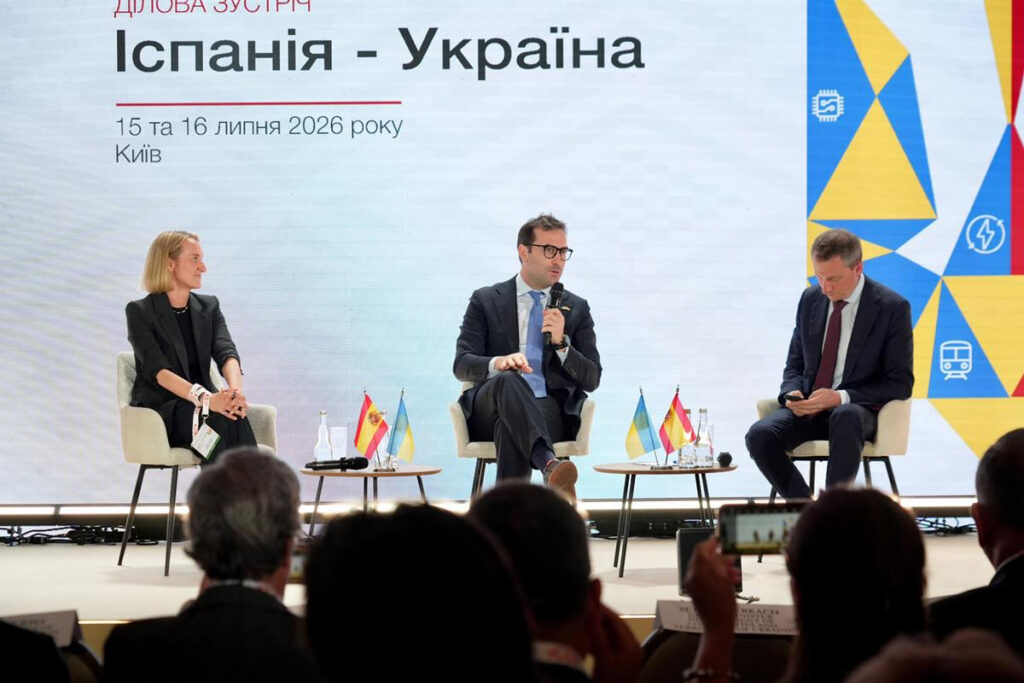
The visit of Carlos Cuerpo to Kiev last July allowed the activation of 570 million euros in financial instruments, strengthened the role of the Spanish Office for the Reconstruction of Ukraine, and brought Spanish companies closer to the main recovery projects in the country.
Spain reinforced its commitment to the economic reconstruction of Ukraine in July with a high-level institutional and business visit led by the first vice president and minister of Economy, Trade and Business, Carlos Cuerpo. The mission, held on July 15 and 16 in Kiev, marked a new step in the Spanish strategy to support the country’s recovery and open opportunities for the participation of Spanish companies in one of the most ambitious reconstruction processes in Europe in recent decades.
The visit was particularly significant for two reasons. First, due to the scale of the economic agreements reached, which mobilized up to 570 million euros in financial instruments aimed at facilitating the activity of Spanish companies in Ukraine. Second, because it was accompanied by the largest Spanish business mission sent to the country since the beginning of the large-scale Russian invasion, with nearly fifty companies represented in sectors strategic for Ukrainian recovery.
The trip coincided with the events commemorating Ukraine’s Statehood and allowed the Spanish Government’s commitment to economic recovery and modernization of the country to be conveyed on the ground. Beyond political support, the delegation sought to translate that support into concrete projects, financing, and investment opportunities for Spanish companies interested in participating in the reconstruction.
One of the main outcomes of the visit was the launch of a set of financial instruments aimed at reducing risks and facilitating the entry of Spanish companies into the Ukrainian market. The package reached 570 million euros and combined insurance, financing, and investment mechanisms.
Among the announced measures, the expansion of the risk coverage line managed by Cesce stood out, which increased from 30 to 250 million euros. This instrument is particularly relevant in the current context, as it offers Spanish companies protection against the risks arising from the war and provides the necessary guarantees to develop export and internationalization operations in Ukraine. According to the Ministry of Economy, this expansion places Spain among the European countries with the highest level of public support for business activity in Ukrainian territory.
In addition, a new financing line of up to 100 million euros promoted by COFIDES was established to support investments from the Spanish private sector with a direct impact on Ukraine. The resources will be mainly directed towards priority areas for reconstruction, such as energy, infrastructure, transportation, water management, agro-industry, and the defense industry.
An agreement between the Official Credit Institute (ICO) and Raiffeisen Bank Ukraine was formalized to enable a credit line of 20 million euros aimed at small Ukrainian companies developing projects linked to Spanish companies established in the country. The initiative also includes coverage from Cesce on behalf of the State, reinforcing the security of operations.
For its part, the Fund for the Internationalization of the Company (FIEM) increased the resources available specifically for Ukraine to 200 million euros. Among the supported projects, the development of a strategy to safely restore the air traffic management and communications system of the country’s main airport stands out, a task that will be carried out by the Spanish company ALG in collaboration with the Ukrainian state entity UkSATSE.
The Spanish Office for the Reconstruction of Ukraine
One of the keys to Spain’s growing prominence in the reconstruction process has been the work of the Spanish Office for the Reconstruction of Ukraine. This body has acted as a coordination instrument between public administrations, financial institutions, and the Spanish business fabric interested in participating in the projects promoted by the Ukrainian authorities.
During the visit to Kiev, the Office played a central role in organizing the Spain-Ukraine Business Meeting together with the Economic and Commercial Office of Spain in Ukraine, ICEX, CEOE, and the Chamber of Commerce of Spain. The aim was to facilitate direct contact between companies from both countries and generate real collaboration opportunities in priority sectors for economic recovery.
The experience of recent years has shown that the reconstruction of Ukraine will not depend solely on international public financing. It will be necessary to mobilize private investment, industrial capabilities, technology, and specialized knowledge. In this area, the Spanish Office for the Reconstruction of Ukraine has been configured as a platform aimed at identifying opportunities, supporting companies in their establishment, and facilitating access to available financing mechanisms.
An unprecedented business mission
The Spanish delegation sent to Kiev included representatives from some of the most relevant business groups in the country. Public and private companies such as Acciona Energía, Adif, CAF, Grupo Cobra, Matachana, and Renfe, as well as business organizations like CEOE and the Chamber of Commerce of Spain participated.
The composition of the mission clearly reflected the areas in which Spain can add the most value to Ukrainian reconstruction. Infrastructure, rail transport, renewable energies, digitalization, agro-industry, and healthcare are among the sectors where Spanish companies have international experience and recognized technological capacity.
During the Spain-Ukraine Business Meeting, issues such as project financing, protection of critical infrastructure, and improvement of the business climate were addressed. Likewise, Spanish companies were able to hold direct meetings with Ukrainian partners and authorities to explore concrete opportunities for collaboration and investment.
During the stay of the Spanish delegation, a Letter of Intent aimed at developing a new international financial agreement was signed, and a joint declaration for Spanish participation in the Industrial Ramstein instrument, designed to facilitate the import of equipment intended for Ukrainian companies affected by Russian attacks, was endorsed.
In addition, the Spain-Ukraine Business Council was formally established, promoted by the Chamber of Commerce of Spain. This new body aims to become a permanent channel of communication between the private sectors of both countries and ensure the continuity of the relationships and contacts established during the business mission. Also relevant was the celebration in Kiev of the V Spain-Ukraine Joint Commission, the main institutional forum for bilateral economic dialogue.
The July mission in Kiev demonstrated that Spanish interest goes beyond institutional support and seeks to translate into tangible projects that contribute to Ukraine’s recovery while generating new opportunities for Spanish companies.