


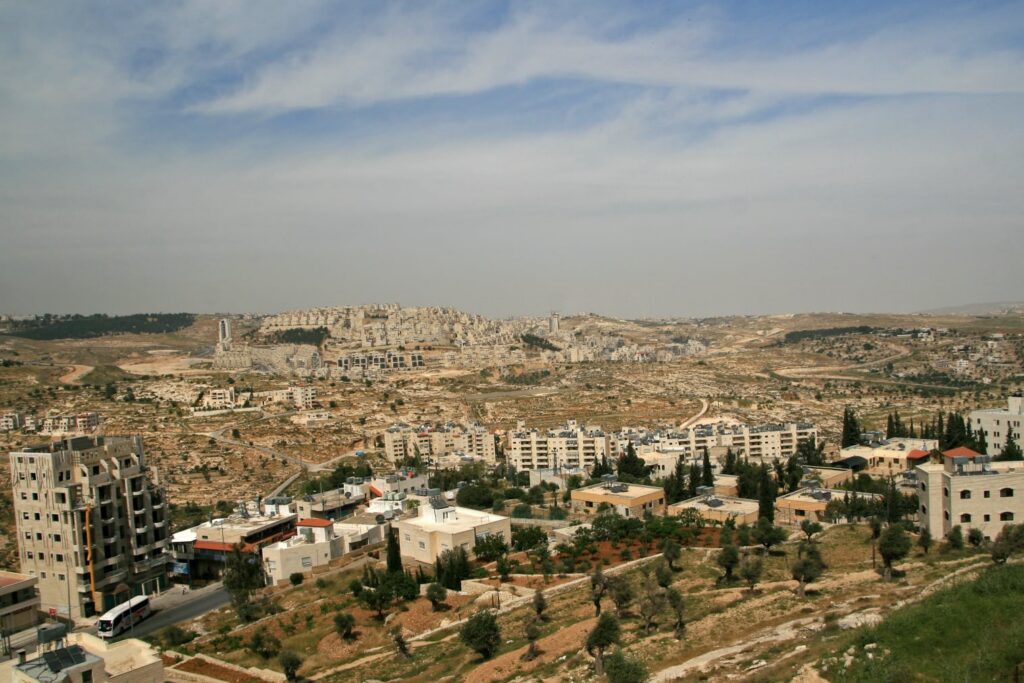
France and Saudi Arabia called on Israel yesterday to end its settlement policy and the violence of settlers in the Palestinian territories, while demanding a sustainable ceasefire in Gaza and advocating for the two-state solution, alongside the declaration in which about twenty countries oppose the construction of new Israeli settlements in the West Bank.
The call is included in a joint statement released after the meeting held at the Élysée Palace between French President Emmanuel Macron and Saudi Crown Prince Mohamed bin Salman.
The statement, which emphasizes that Israeli settlements and settler violence threaten the two-state solution, comes just two days after opposition to the E1 settlements planned by Israel in the West Bank from the leaders of the United Kingdom, France, Germany, Italy, the European Commission, the Netherlands, Canada, Norway, Australia, New Zealand, Sweden, Belgium, Spain, Austria, Greece, and Cyprus.
According to this joint statement, “the Israeli government’s decision to publish construction tenders for the E1 settlement project is unacceptable” The signatories remind that “the international community has long opposed this expansion of settlements and has expressed its serious concern both privately and publicly”
It adds that “the E1 settlement will undermine the prospect of the two-state solution by opening a gap in the West Bank and harming the territorial contiguity of the Palestinian Territories” and reiterates that international law establishes that “Israeli settlements in the West Bank are illegal.”
The signatories urge the Israeli government “to immediately revoke these plans and end the expansion of settlements in the West Bank” and request that “companies should not consider the possibility of participating in these construction tenders. They must be fully aware of the legal and reputational consequences, including the risk of being involved in serious violations of International Law.”