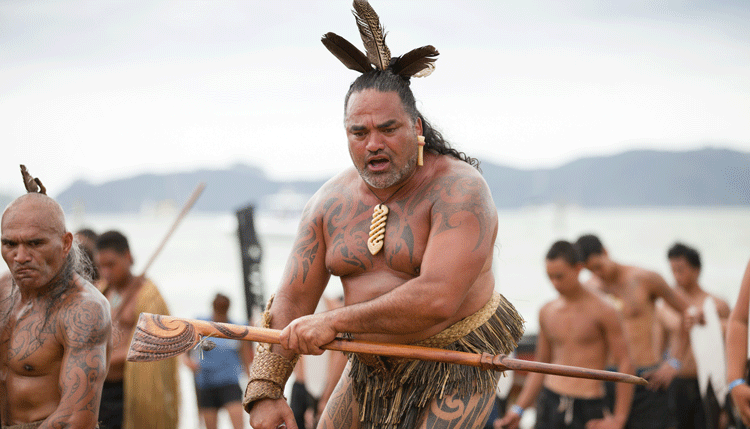
Every year, on August 9, the International Day of Indigenous Peoples is commemorated. On the same day, but in 1992, the Working Group on Indigenous Populations of the Subcommission on Prevention of Discrimination and Protection of Minorities held its first meeting. On December 23, 1994, the United Nations General Assembly decided that on that day, every year, tribute would be paid to this population
The United Nations approved the Declaration on the Rights of Indigenous Peoples in 2007, which establishes a universal framework of minimum standards for the dignity, well-being, and rights of the world’s indigenous peoples. A declaration that proclaims the suffering derived from “historical injustices (…) that have prevented them from exercising, in particular, their right to development in accordance with their own needs and interests.”
The date of August 9 aims to raise awareness about the challenges faced by indigenous peoples globally, who represent more than 5,000 distinct groups and nearly 6% of the world’s population.
There are more than 476 million indigenous peoples living in 90 countries around the world. They represent just over 6.2 percent of the world’s population. However, they account for 15 percent of the most disadvantaged and vulnerable populations. Indigenous peoples speak an overwhelming majority of the 7,000 languages estimated to exist in the world. They are nearly three times more likely to live in extreme poverty compared to their non-indigenous counterparts.
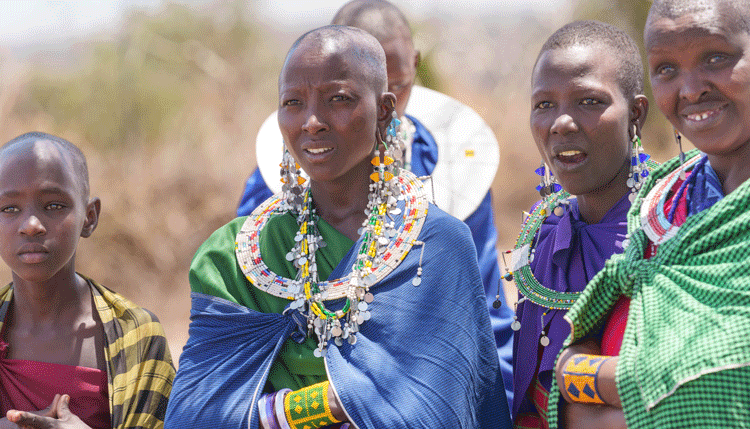
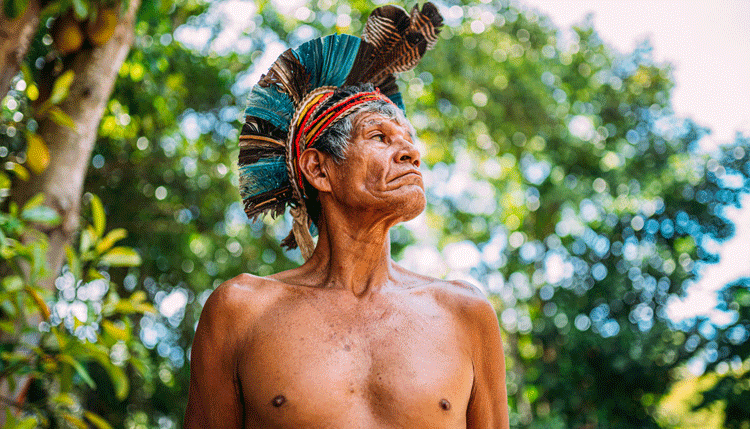
Indigenous peoples share a historical continuity with a specific region before colonization and a strong bond with their lands. They maintain, at least in part, distinct social, economic, and political systems. They have distinct languages, cultures, beliefs, and systems of knowledge. They are determined to maintain and develop their distinct identity and institutions and form a non-dominant sector of society.
According to the NGO Survivor, “isolated indigenous peoples are neither backward nor primitive relics of a distant past. They are our contemporaries and a vital part of human diversity. Almost all are nomadic and move through their territories in small extended family groups according to the seasons. When the rainy season arrives and water levels are high, those who do not usually use canoes live far from rivers in the depths of the jungle. However, during the dry season, some camp on the beaches, where they fish and collect turtle eggs. Others live in communal houses, cultivate in jungle clearings, and also hunt and fish. And some, like the mashco piro, are hunter-gatherers capable of setting up and abandoning a camp at great speed. They hunt animals, such as monkeys, with long bows and arrows.”
“The consequences of initiating contact with them are always catastrophic,” the NGO points out. “Initiating this process must be their own choice. Those who enter the territory of isolated indigenous peoples deny them that ability to choose. Entire populations are being exterminated by diseases such as flu or measles to which they have no immunity. Young people and the elderly are often the first and most likely to die.
The World Bank Group is very clear in its words: “The land on which they live and the natural resources on which they depend are inextricably linked to their identity, culture, and livelihoods, as well as to their physical and spiritual well-being. They often seek to be represented by their leaders and traditional organizations, which are distinct or separate from those of the dominant society or culture. Numerous indigenous peoples still maintain a language distinct from the official language or languages of the country or region in which they reside; however, many have also lost their native languages or are on the brink of extinction due to the eviction from their lands or relocation to other territories. They speak more than 4,000 of the 7,000 languages that exist in the world, although certain estimates indicate that more than half of the world’s languages are at risk of extinction by 2100.”
According to this World Bank Group, their life expectancy is up to 20 years lower than that of non-indigenous people worldwide. “Indigenous peoples,” they emphasize, “often lack formal recognition of their lands, territories, and natural resources, are often the last to receive public investments in basic services and infrastructure and face multiple obstacles to fully participate in the formal economy, gain access to justice, and be part of political processes and decision-making. This legacy of inequality and exclusion has increased the vulnerability of indigenous communities to the impacts of climate change and natural hazards, including outbreaks of diseases such as COVID-19.”
“Although indigenous peoples own, occupy, or use a quarter of the world’s surface, they safeguard 80% of the remaining biodiversity, and recent studies reveal that forest lands subject to collective management by local communities and indigenous peoples contain at least a quarter of all surface carbon in tropical and subtropical forests. Furthermore, they have essential ancestral knowledge and experiences on how to adapt, mitigate, and reduce climate and disaster risks,” the World Bank Group communicates.
Germán Freire, Senior Social Development Specialist at the World Bank and author of the report Indigenous Latin America in the 21st Century, published in 2015, notes that “it is estimated that around 42 million people belonging to indigenous communities live in Latin America. Among the countries with the largest indigenous populations are Mexico, Guatemala, Peru, and Bolivia, which together represent more than 80% of the regional total, that is, approximately 34 million indigenous individuals.”
The report highlights that poverty affects 43% of the indigenous population in the region, a figure that is more than double the proportion of non-indigenous people in the same situation. “Additionally,” notes the report by Germán Freire, “24% of all indigenous individuals live in extreme poverty, a proportion that is 2.7 times greater than that of non-indigenous people in that same condition. This inequality is exacerbated, as simply being born to indigenous parents significantly increases the likelihood of growing up in an impoverished home, thus contributing to a cycle of poverty that hinders the full development of indigenous children.
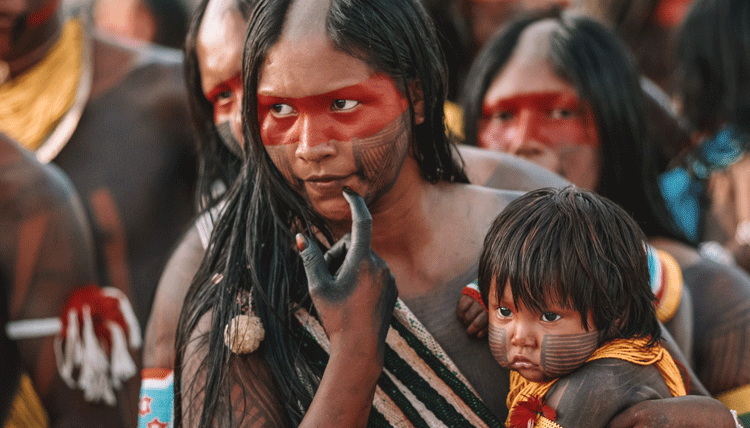
Indigenous languages, a legacy in extinction
Half of the languages that exist today worldwide will become extinct during this century, also states specialist Germán Freire. In the case of Latin America and the Caribbean, one in five indigenous peoples has already lost their native language: in 44 of those peoples, they now speak Spanish, and in 55, they speak Portuguese.
The main causes are related to their levels of poverty, social exclusion; also due to political conflicts, lack of legal recognition, and efficient enforcement of indigenous rights.
With the disappearance of languages, their identity and collective memory diminish, but there is also a danger that goes unnoticed by many: a loss of knowledge that has been and will be key to the future of the region.
The World Bank specialist comments in his report that, for example, how ethnobotanical knowledge is encoded in the way speakers of a language describe and classify nature. “Without that information, it is likely that significant indigenous contributions to medicine, such as quinine, which was the first effective treatment for malaria and is still the preferred treatment for resistant malaria, would not have been made, as that knowledge was associated with indigenous languages of the Amazon,” he explains.
Around 70% of current medicines derive directly from botanical and ethnomedical knowledge of indigenous peoples (such as aspirin, which originates from willow bark).
Indigenous population by continents:
Asia: The largest concentration, with about 273 million people.
Africa: Approximately 50 million.
America: Around 39.7 million.
Oceania: About 7 million.
Europe: Approximately 250,000.
Although they make up a vital part of global cultural diversity, they face great challenges: they represent around 19% of the extremely poor and are nearly three times more likely to live in extreme poverty compared to the non-indigenous population.
A life full of violence and killings
Violence against indigenous peoples is a historical and structural problem that manifests in past systematic killings and alarming murder rates today. On May 1, Givaldo Santos, a Guarani-Kaiowá leader, was murdered in the Taquaperi reserve. His death is not an isolated incident: it is part of a century-long continuity of invasions and theft of indigenous lands by those who have prioritized their own benefit over the lives of the peoples who already lived on those lands, ignoring the enormous damage that this racist and greedy colonization has caused to indigenous peoples worldwide. This colonization continues today.
The Guarani Kaiowá people have been suffering for generations from the effects of “Western civilization.” After decades of violent invasions and forced displacements from their territory, their situation was desperate. The theft of their lands resulted in the loss of their identity, triggering a mental health catastrophe and one of the highest suicide rates in the world.
Despite representing a global minority, these communities suffer a disproportionate impact of lethality due to the defense of their lands, resources, and cultures. Over the centuries, the expansion of colonial empires and nation-states has led to the massive eradication of indigenous communities under logics of forced assimilation and territorial dispossession.
At least one day a year, on August 9, the world spends a second of its daily life thinking about these human beings who have the same rights as the “civilized” and who are also kin that should be loved as ourselves.