


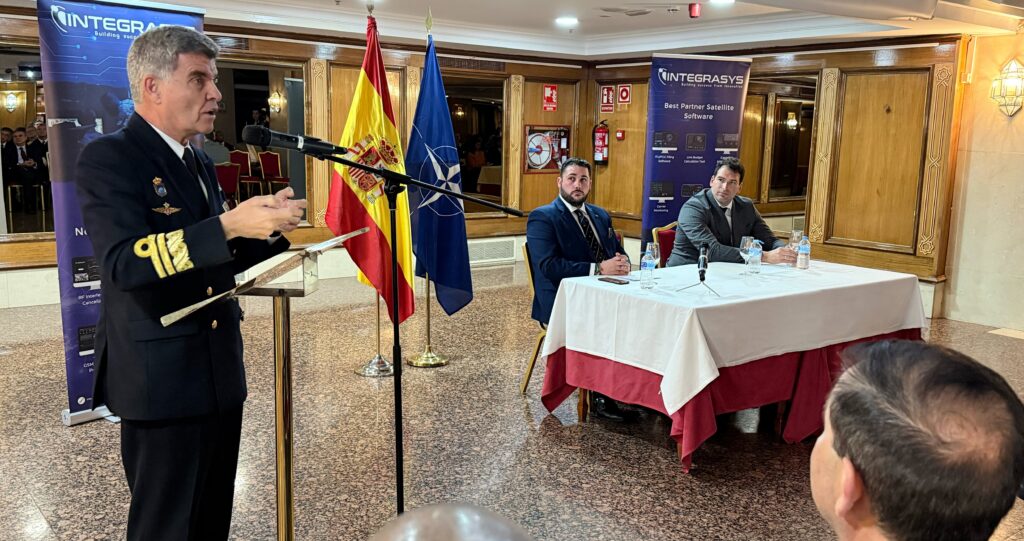
The head of the MCCE analyzed the new electronic warfare scenarios at a conference organized by the Diplomatic Forum of the Principality of Asturias and Integrasys
“In cyberspace, few people with few resources can do a lot of damage to many people,” said the commander of the Joint Cyber Command (MCCE), Vice Admiral Javier Roca, to describe one of the main characteristics of the new technological battlefield that is rendering traditional defense systems of states obsolete.
In the context of the new international order that is also being forged, technology is changing the paradigms of war as it was known until now. Roca identified one of the most important: “In cyberspace, it is easier to attack than to defend”, contrary to what has been commonly accepted for conventional wars, where the attacking army’s strength had to exceed that of the defenders by at least 3 to 1.
“We cannot fully imagine what we are facing,” said the head of the youngest unit of the Spanish Armed Forces, during an event sponsored by the company Integrasys —one of the main technology companies in the Defense sector— and organized by the Diplomatic Forum of the Principality of Asturias at the Alcázar Military Residence. Furthermore, this new battlefield, camouflaged in a cyberspace still not well known and plagued by ‘hackers’, develops and changes at a dizzying speed —“what used to happen over 10 years is now reduced to one”— so he warned that “we must be prepared for the worst.”
In this regard, he stated that “the weapons of the past will not be useful against the threats of the future” in a context of rapid changes in all areas. To illustrate this, he said that “currently, every two years as much information is generated as throughout the rest of history.”
Therefore, in the session organized by the Diplomatic Forum of the Principality of Asturias, he emphasized that in cyber warfare, the quantity of resources is not as necessary as their quality and that of the personnel working in the defensive systems of cyberspace, where anonymity is another crucial factor that complicates the detection of an attack by a foreign power.
“We cannot fully imagine what we are facing”, said the head of the youngest unit of the Spanish Armed Forces at the Alcázar Military Residence. Furthermore, this new battlefield, camouflaged in a cyberspace still not well known and plagued by ‘hackers’, develops and changes at a dizzying speed —“what used to happen over 10 years is now reduced to one”— so he warned that “we must be prepared for the worst.”
Regarding the possibility of practicing a ‘preventive war’ against external threats, instead of maintaining a defensive attitude, the commander of the MCCE assured that his unit has that offensive capability but it is not used since a higher order is necessary for that. However, he added that such operations “are practiced even though they have not been used.”
Another important question raised by Vice Admiral Roca was “Who commands now in cyberspace?”. And the answer he provided was forceful: “The big technology companies.” And for that reason, he asked “When will it be necessary to have an ambassador to Google or Amazon?”, to cite two of the largest corporations.