


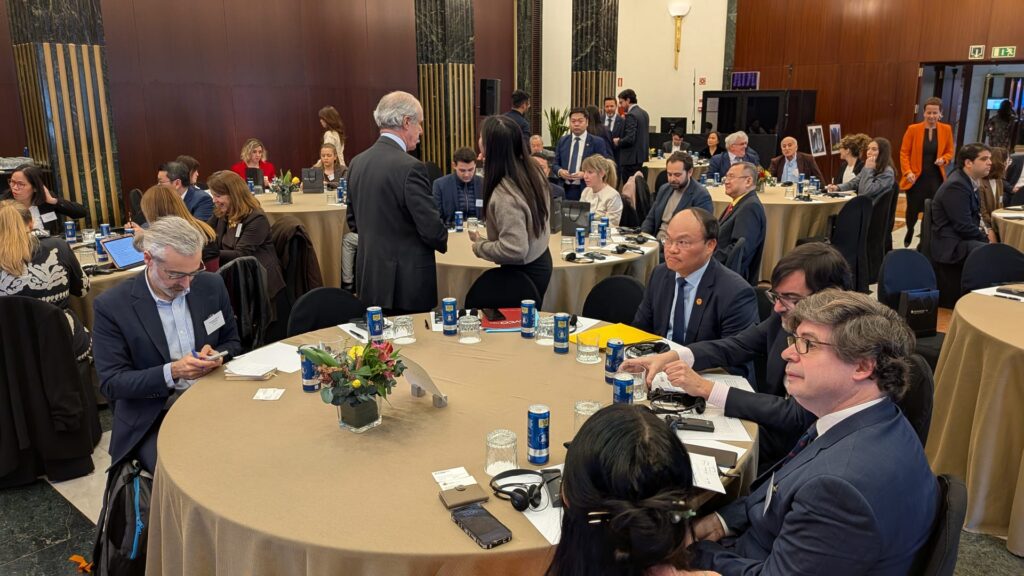
The ambassador Doan Thanh Song inaugurated the Cooperation Forum ‘Building bridges between innovation and culture’, attended by around a hundred companies and investors
A dynamic and rapidly expanding market, a reliable partner with the capacity to serve as a bridge for investments in Southeast Asia and an emerging center for innovation and technology. With this business card, Vietnam presented its business opportunities this week at a cooperation forum held in Madrid, attended by nearly a hundred companies and investors.
Under the motto ‘Building bridges between innovation and culture’, the forum organized by the Embassy of Vietnam in Spain aimed to explore areas of bilateral cooperation in technology, innovation, digital transformation, tourism, and cultural exchange.
The Vietnamese ambassador to Spain, Doan Thanh Song, described his country as “one of the most dynamic economies in Southeast Asia” and emphasized that, in addition to being “an active member of ASEAN, it is in a privileged position to be a reliable partner and an excellent avenue to expand Spain’s cooperation with all countries in the region.”
Doan Thanh Song also referred to the interest of Vietnamese companies in Spain. He cited the case of two tech companies, FPT and Viettel, “which have significantly contributed to our international economic integration.” “The Vietnamese company,” he said, “can look to Spain as a bridge to the European Union, benefiting from its advanced research ecosystem, a global brand, and high standards in governance and sustainability.”
However, he clarified, “innovation is not just about technologies, but also about people, talent, and cultural understanding.” Therefore, he made a strong commitment to also strengthen “tourism and cultural exchange” with Spain, “whose success is based on its advanced infrastructure, its national branding strategies, and its leadership in sustainable and smart tourism.”
In general terms, the diplomat emphasized his country’s digital economy —which is expanding at around 38% annually, according to its data— and e-commerce —among the top 10 fastest-growing in the world— as the most interesting sectors for foreign investors. “We are,” he said, “one of the most promising emerging centers in Asia for innovation and technology”.
Doan Thanh Song referred to the Innovation and Capital Report of Vietnam, prepared by Boston Consulting Group and the National Innovation Center, to highlight that “Vietnam is attracting increasing investment in artificial intelligence, semiconductors, renewable energies, and high-tech industries.”
“At the same time,” he continued, “we maintain our strong commitment to sustainable development and ecological transition, which constitutes the national promise to achieve carbon neutrality by 2050.” The Hanoi government expects that by 2030 Vietnam will become a developing country, with a modern industry and a middle-high income status. Meanwhile, its forecast for 2045 is that it will already be a developed and high-income nation.
Vietnam, like China, has managed to adapt to the market economy without abandoning communist postulates and the single-party system. The ambassador recalled that thanks to this transformation, Vietnam “is today a dynamic and highly open economy, with a population of over 100 million people, a young workforce, and an increasingly attractive business environment.”
Since the beginning of its economic reform in 1986, Vietnam’s GDP has grown at a sustained rate between 5 and 8 percent, except during the pandemic years when its growth was reduced to 2% annually. Its GDP per capita has also multiplied by 10, although the 4,192 euros of 2024 still place it at the lower end of the global ranking. These figures, along with a debt (34%) and a public deficit (1.72%) that are quite contained, position the Asian country at 34th in the world in terms of GDP and 70th in the Doing Business ranking.
The forum was attended by Juan Luis Gimeno, general director of Economic and Commercial Intelligence of the Ministry of Economy; and Álvaro Schweinfurthh, deputy director of the International and Multilateral Organizations department of CEOE. During the day, various experts participated in two sessions: Tourism-A Bridge between Cultures, where it was analyzed how Vietnam can position itself in high-end tourism; and Strategic Partnership Vietnam–Spain, a debate on the possibilities of cooperation in the technological environment.