


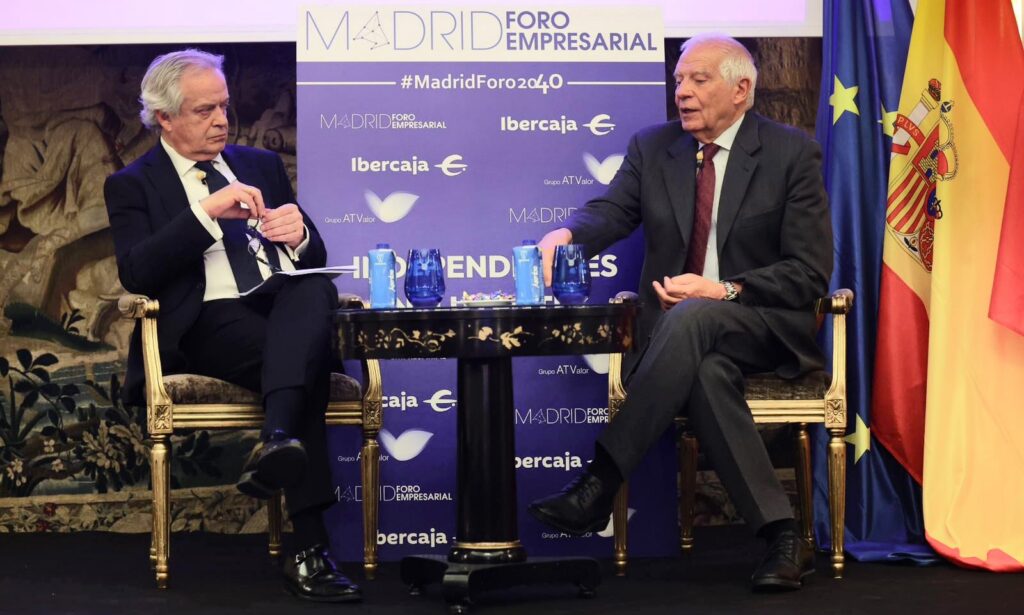
The former high representative for EU Foreign Policy analyzed the national and international political context at a meeting organized by Madrid Foro Empresarial
“If Europeans want to be autonomous, they will have to invest a lot in their defense capabilities,” warned the former high representative of the EU for Foreign Affairs, Josep Borrell, during a meeting organized on Tuesday by Madrid Foro Empresarial as part of the cycle ‘New challenges, new responses’ attended by more than 300 businesspeople.
Europe, according to Borrell, must strengthen its strategic autonomy if it wants to have any weight in the international order. Currently, Europe’s structural dependence on military and energy matters prevents that independence as he explained, “we import 65% of our armament and there is no European army capable of doing half of what the United States can do by itself.”
Borrell also warned about the global energy vulnerability: “The Achilles’ heel of the world is oil. We have electrified many things, but there are others that cannot be electrified and that is why we remain so vulnerable.”
During the dialogue, moderated by Hilario Alfaro, president of Madrid Foro Empresarial, the main political, economic, and geopolitical challenges facing Spain in an increasingly complex international context were also addressed.
The former high representative of community Foreign Policy defended Spain’s role in the European context, rejecting comparisons with other countries: “It is unfair to place Spain at the level of Hungary. Spain is pro-European, cooperative, and does not evade any of its responsibilities.” In contrast, “Orban maintains a different position on almost everything: he does not want to punish Russia nor support Ukraine. That does not make us equal.”
On the other hand, he also highlighted Spain’s capacity for influence in the European sphere: “Spain has the potential to influence European decisions because it plays a different tune in areas like energy.”
During his speech, Borrell was particularly critical of the unequal approach to international law: “It does not distinguish between good and bad, but the world sees that we have a double standard. That discredits us.” Regarding current conflicts, he noted that global perception is changing: “Little by little, other countries will follow Spain’s stance”. And he agreed with Pedro Sánchez’s public stance regarding the attack on Iran by saying that “this is not our war.”
In relation to the Middle East, he recalled the historical origin of the Palestinian conflict: “We wanted to believe that Palestine was a desert, but millions of people lived there. The lack of recognition of an identity is the origin of the conflict.” And he warned about the risks of global escalation: “You don’t have to be very smart to know that Iran is not going to surrender easily. We could have an energy price problem for a while.”
National politics and institutional stability
On a national level, Borrell emphasized the importance of consensus in foreign policy, referring to Pedro Sánchez’s government and the opposition led by Alberto Núñez Feijóo: “Any country that wants to influence needs internal unity. It feels like in Spain it is impossible to agree on anything between the government and the opposition, and that is bad.”
He also added: “Disagreement is possible, but in foreign policy, consensus is extremely important“. Regarding institutional stability, he defended that “it is also measured by the permanence of governments. Spain has had continuity, while other countries have constantly changed leadership.”
The former high representative also addressed the territorial issue and political agreements with parties like the Basque Nationalist Party or Esquerra Republicana de Catalunya: “The Spanish State is the strongest in the world: it has been trying to destroy itself for 200 years and has not succeeded,” he recalled the famous phrase attributed to Bismarck. However, he warned about the effects of certain political agreements: “It is not so much the agreement as the literature that accompanies it. Those agreements later come with a cost.”