


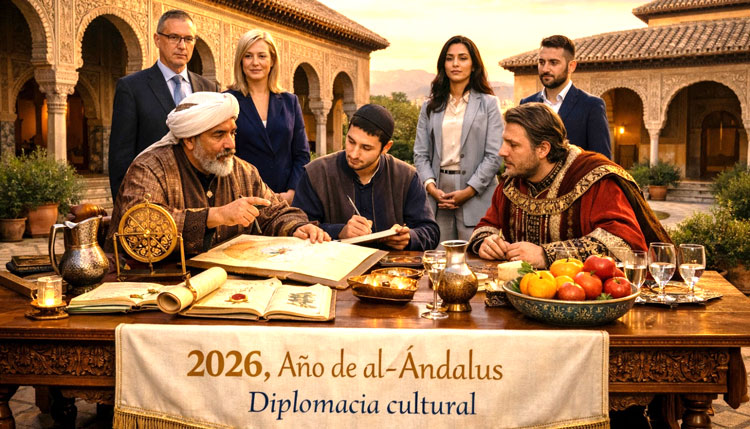
The new research and in-depth analysis of the Andalusian era lead us to a field that, despite its vast influence, remains hidden at first glance: cultural diplomacy. This article aims to highlight this essential pillar to rescue the Andalusian legacy from the traditional narrative that reduces it to a period of permanent conflict, revealing instead a sophisticated system of exchange and hegemony that transformed the Mediterranean.
Talking about al-Andalus often invokes images of battles, shifting borders, and epic chronicles of conquest. However, behind the noise of swords, there existed a much more persistent and silent force: cultural diplomacy. This was not only a tool of political survival but the engine of a cultural hegemony that transformed the Iberian Peninsula into the central node of exchange between East and West.
While Europe went through a long period of stagnation, the Andalusian courts—from Córdoba to Granada—designed a model of civilization based on refinement, knowledge, and a unique aesthetic. This identity was projected outward not only through peace treaties but also through a ‘state brand’; an architectural rationality that radiated order, stability, and prosperity.
Andalusian diplomacy understood, long before many modern powers, that true influence is exercised through the senses and intellect. From scientific studies to the sophistication of its gardens—symbols of technical mastery over water—through the export of new flavors and table protocols, al-Andalus sought not only to be respected but also imitated. This ‘soft power’ enabled its legacy to be more than a mere footnote in history, but the backbone of Mediterranean culture that we now recognize as universal.
Far from being a mere formality, Andalusian cultural diplomacy constituted a comprehensive strategy that operated where weapons could not reach. Its success lay in turning its way of life into the standard of excellence for the entire Mediterranean. Andalusian refinement, or Adab (education in Arabic), became a universal code of conduct for the elites. Figures like Ziryab contributed to exporting social norms that we now consider basic: the strict order of dishes on the table (starter, main course, and dessert) and the substitution of metal for glass.
The diplomatic gifts—ivory boxes, silks with Kufic inscriptions, and precision astrolabes—were much more than gifts; they were technological demonstrations that forced recognition of al-Andalus’s technical superiority. Moreover, in contrast to the constructive diversity of other kingdoms, al-Andalus projected a coherent and rational visual identity. Cultural diplomacy materialized in the urban landscape: the use of square plants and two or four-pitched roofs, avoiding the ostentation of domes, communicated an image of state stability and balance. Geometry, fundamental in Andalusian art, symbolized divine order. These regular forms allowed for a symmetrical and subdivided distribution, facilitating habitability.
This aesthetic was not imposed but admired and imitated, becoming the architectural DNA of the Mediterranean and, later, of Ibero-America. Thus, the cultural diplomacy of al-Andalus not only configured a hegemony of knowledge but left an indelible mark on Western civilization, confirming that true power resides in the ability to influence through knowledge and culture.
Knowledge in al-Andalus was the bridge that war could not dynamite, consolidating its position as the great ‘data server’ of the time. Beyond the armed conflicts that fragmented territories, cultural diplomacy wove a network of intellectual exchange, where scholars and manuscripts circulated as valuable treasures. Treaties not only agreed on lands but also on the transfer of medical, botanical, and astronomical knowledge, creating an intellectual dependency between neighboring kingdoms that transcended physical borders. The scientific method and observation were thus grounded in a universal language, cementing a common mental space where culture and science prevailed over violence.
The Andalusian hegemony found its most enduring expression in the management of the environment. The gardens and complex irrigation systems designed were not merely functional; they were living symbols of a civilization that had learned to dominate nature in harmony. The introduction of crops such as citrus fruits, rice, or saffron resulted from a true botanical diplomacy, capable of transforming the diet and economies of the known world. This silent conquest, achieved through gastronomy and hydraulic engineering, allowed the Andalusian legacy to endure centuries after the wars ceased, still present in tables and landscapes.
One of the paradigmatic examples of this knowledge diplomacy was the Treaty of Dioscorides, signed in 947 between the Córdoba of Abderramán III and the Byzantine Empire. The sending by Emperor Constantine VII of a copy of ‘Materia Medica’ was not just a diplomatic gesture but the beginning of a deep technical collaboration. The lack of specialized translators in Greek led Byzantium to send the monk Nicolás, who worked alongside Andalusian scholars to adapt botanical knowledge to the peninsular context. This initiative transcended the elites: the translation boosted the professionalization of the pharmacopoeia and the creation of networks of pharmacies and public hospitals, elevating the health and life expectancy of the population. Thus, diplomacy materialized in concrete advances in social welfare.
The so-called ‘Green Revolution’ was another fundamental chapter. Through acclimatization treaties and an active network of botanical exchange with the East, the Andalusian embassies returned not only with political agreements but with cuttings and agronomic knowledge. The reception of delegations like that of Otto I was a complete staging of civilizational superiority: orderly cities, square plants, and artisanal roofs impressed visitors, who took that model of urbanity back to their lands. This ‘state marketing’ spread concepts of urban hygiene, lighting, and administrative organization, imposing as a symbol of modernity and efficiency that transcended political boundaries.
Moreover, peace treaties were accompanied by the exchange of musicians, poets, and artists, forging a cultural lingua franca in the Mediterranean. The Andalusian refinement in dressing, protocol, and lyricism generated a community of tastes that united elites of different faiths, fostering mutual respect based on aesthetic admiration. The ‘Andalusian’ became synonymous with cultural excellence, ensuring that this legacy was absorbed and protected by succeeding cultures.
Arabic, as a scientific, commercial, and administrative language, facilitated this cultural diplomacy, also leaving a palpable linguistic legacy in the Arabisms integrated into neighboring languages. Terms related to hydraulic engineering (aljibe, acequia), architecture (tabique, albañil), or administration (alcalde, aduana) evidence how the Andalusian model became a reference. It was not just about adopting vocabulary but advanced systems of management and knowledge.
Finally, Andalusian diplomacy introduced refined integral formulas that transformed European political communication. The use of honorific titles and formal structures elevated the tone of international relations, transforming them into acts of high culture and mutual respect. Thus, while weapons altered maps, cultural diplomacy redrew the mental map of the time, ensuring a hegemony based on knowledge and aesthetics that has endured to this day.
Possessing knowledge of Arabic or using Arabized terms in Christian courts was a prominent symbol of intellectual distinction during the Middle Ages. This practice facilitated the permeation of Andalusian culture into everyday thought, leaving a linguistic and cultural mark that endures centuries later as a living testimony of that technical and social superiority. It was not just about words but a profound exchange of knowledge that enriched all of Europe.
Today, this invisible heritage still surrounds us and manifests in multiple aspects of our daily life, where perhaps it is most strongly perceived is at our table: every ingredient of the Mediterranean diet, every hospitality protocol, is a living echo of those botanical and social treaties that once traveled in the saddlebags of Andalusian ambassadors.
The lesson conveyed by this ‘positive diffusion’ is clear: knowledge and beauty constitute the most powerful diplomatic tools of humanity. al-Andalus was not a historical parenthesis but a catalyst that allowed the West to rediscover science, hygiene, and the art of living well. Its legacy is not a ruin to be viewed with melancholy but a living structure upon which we continue to build our collective identity. Recognizing this cultural hegemony implies admitting that peace and the exchange of knowledge leave a much deeper and lasting mark than any military victory. After all, al-Andalus was not just a territory; it seduced its surroundings through a standard of living that the world chose to imitate.
Andalusian cultural diplomacy was a sophisticated state strategy that transcended military pacts to consolidate a hegemony based on the prestige of knowledge and refinement. Through the exchange of scholars, scientific manuscripts, and botanical treaties, al-Andalus managed to export its model of civilization, turning its aesthetics and advanced hydraulic engineering into the standard of excellence for the Mediterranean. In essence, it was an intellectual triumph that allowed the Andalusian legacy to be permanently integrated into the cultural DNA of the West, surviving long beyond its political borders.