


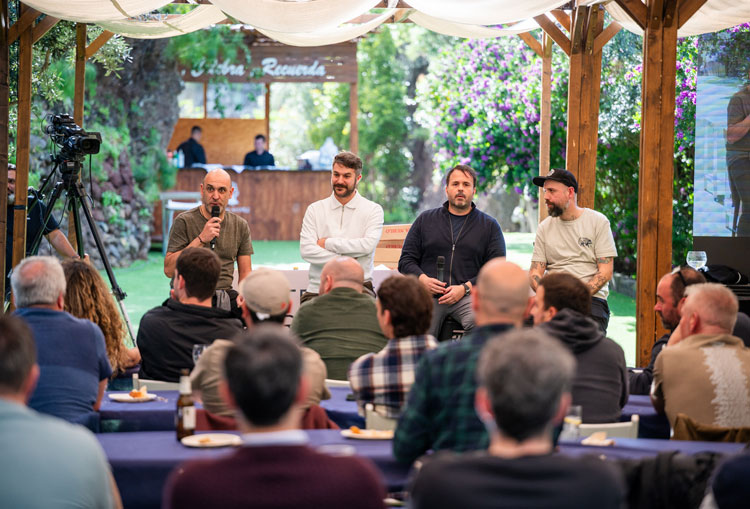
More than 60 chefs from Spain, Portugal, Italy, and Andorra defended their commitment to protecting the primary sector in rural environments.
Terrae, the IV International Meeting of Rural Kitchens held in Gran Canaria served again as a space for reflection and advocacy for rural chefs.
At this meeting, the chefs defended the need to keep a common network alive, expand their capacity for influence, and demand greater involvement from administrations in the protection of the territory, trades, and local production.
The last session of the event brought together more than 50 rural chefs in a common dialogue. The first to speak was Luis Alberto Lera (Restaurante Lera*, Castroverde de Campos, Zamora), elected ‘mayor’ of rural chefs two years ago, who highlighted the consolidation, over the four editions of the meeting, of a true “rural cooking movement.” Lera thanked the support and closeness shown by the Ministry of Agriculture through José Miguel Herrero, general director of Food, for his attention to the world of rural gastronomy and the award granted to the group of rural chefs, the Extraordinary Alimentos de España 2025 award.
For his part, José Miguel Herrero, encouraged chefs to continue working in community and to keep pushing for the involvement of administrations. In that same vein, Lera recalled that in the previous three editions a list of claims and needs for rural cooking had already been drawn up, but emphasized that the main challenge is not only to reach concrete agreements but to prevent the collective momentum from fading. “The important thing is to move forward and not let the movement die, that this feeling of unity does not stop and we continue weaving this network,” he defended.
Also, Juan Carlos García (Vandelvira*, Baeza, Jaén), in his capacity as “councilor” of rural chefs, insisted that, despite the advances of the congress after four years, the structural problems remain the same. He acknowledged that institutions have listened to some of their demands but warned that the sector cannot give up its autonomy or its identity. “We must exercise our insubordination in our homes by doing what we carry inside. No list, no guide, no journalist, nor anyone should tell us how we should be,” he stated.
One of the most repeated messages during the meeting was the value of the community created around Terrae. Nacho Solana (Restaurante Solana*, La Bien Aparecida, Cantabria) argued that, since the meeting in Zafra in 2019, the main advance has been precisely the brotherhood among chefs from different territories. “We have a common voice and I believe this is a movement that can grow,” he pointed out. Edorta Lamo (Arrea!*, Campezo, Vizcaya) expanded on this idea by highlighting that the sector has achieved “the most difficult thing,” which was to unite, weave bonds, and share a common rural sensitivity. In his opinion, this union should also serve to defend the small producer and to convey to the urban world a more complex and real vision of the rural environment.
In his speech, Lamo brought up issues such as hunting and its role within the ecological and food balance of certain territories. He called for a better social understanding of this reality and advocated for the creation of game meat centers in each community to take advantage of a resource that, in many cases, ends up being discarded despite its gastronomic and natural value.
The meeting also emphasized the need to broaden the movement beyond cooking. Solana proposed to strengthen ties with chefs from Italy, Portugal, and Andorra, and called for opening this space to artisans, producers, gatherers, bakers, and pastry chefs. In his opinion, one of the major problems of the rural environment is the disappearance of trades without generational replacement, so he considered it essential to also give visibility to those who sustain the food chain from the origin.
Among the main practical claims, the intervention of Borja Marrero (Muxgo*, Las Palmas de Gran Canaria) stood out, who called for simplifying the bureaucracy that today “limits and hinders” those who raise animals, cultivate, or make cheeses, and proposed unifying headings and procedures to facilitate the activity of small producers.
The international dimension of the meeting reinforced the idea that rural problems transcend borders. Vítor Adão (Plano, Lisbon, Portugal) explained that in Portugal there are similar limitations in areas such as river fishing or hunting, and advocated for the need to have their own representatives, as traditional hospitality associations do not express the specific needs of rural chefs. Giuseppe Iannotti (Krèsios**, Telese Terme, Campania, Italy) also expressed his discomfort with a regulation that, he claimed, sometimes forces the exclusion of products deeply linked to the territory. In contrast, he asserted that the industry may leave, but those who cook from the villages, the mountains, or the sea are an inseparable part of that landscape and that identity.