


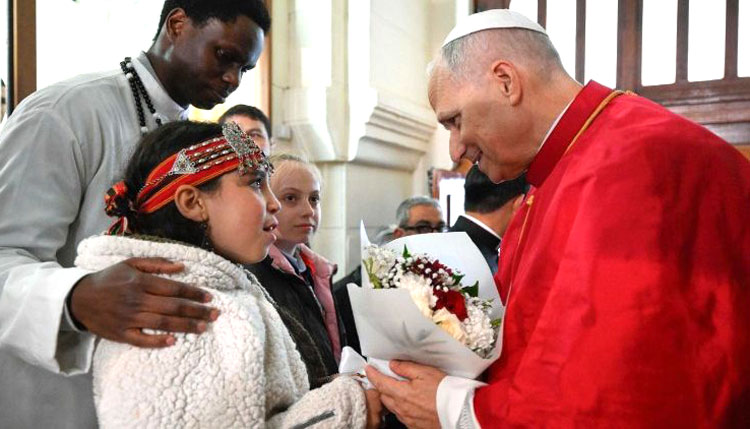
The visit of Pope Leo XIV to Algeria – part of an African journey in which he will also visit Cameroon, Angola, and Equatorial Guinea – has been historic for many reasons. Not only because he is the first pontiff to visit the largest country in Africa, but also for what it represents in terms of openness to Islam and a return to the history of the Church.
Algeria is the land where none other than Saint Augustine (354-430) was born, exercised his papacy, and died, a native of Tagaste, bishop of Hippo and Doctor of the Church since 1295. As an Augustinian, the Pope must have felt that, in some way, he was returning home while walking on the second day of his visit through the ruins of Hippo Regius, glimpsing in the distance the basilica dedicated to the saint and Father of the Church.
In fact, Algeria is a very special place for any Catholic.
Here was born and fought the Emir Aldelkader (1808-1883), who bravely fought against the French invasion, ended up exiled in Damascus with thousands of Algerians who accompanied him, and starred in one of the most heroic episodes of modern history: in 1860, during the massacres of Maronite Christians, Emir Abdelkader along with his Algerians protected, with arms in hand and at the risk of his own life, thousands of Christians, welcomed them into his home and in other safe places, and organized escorts that accompanied them until they were safe. Here was born the Society of the Missionaries of Africa, founded in 1868 in Maison Carree (currently El-Harrach), in the outskirts of Algiers. Here lived and died Saint Charles de Foucauld (1858-1016), whose life demonstrates that the desert is, in reality, full of the presence of God and that is enough. Here gave their lives the martyrs of Tibhirine, kidnapped and murdered by terrorists in 1996, during the terrible years when the Armed Islamic Group flooded the country with the blood of Algerians. As Leo XIV said in the Basilica of Our Lady of Africa, “the love for brothers is precisely what has inspired the testimony of the martyrs we have remembered. In the face of hatred and violence, they remained faithful to charity even to the sacrifice of life, along with so many other men and women, Christians and Muslims.”
It has been precisely in Algeria, the home of a people who fought a brutal war of nearly eight years (1954-1962), where Leo XIV has raised his voice to ask for peace and forgiveness. In the visit to the monument of the martyrs Maqam Echahid, he spoke with clarity and courage: “In this place we remember that God desires peace for every country; a peace that is not just the absence of conflict, but an expression of justice and dignity. This peace, which allows us to face the future with a reconciled spirit, is only possible with forgiveness. The true struggle for liberation will only be definitively won when peace has finally been conquered in hearts. I know how difficult it is to forgive. However, while conflicts continue to multiply around the world, resentment cannot be added to resentment, from generation to generation. The future belongs to the men and women of peace. In the end, justice will always triumph over injustice, just as violence, beyond all appearances, will never have the last word.”
In the Great Mosque of Algiers, he said that “this afternoon I pray for you, for the people of Algeria, for all the peoples of the earth, that the peace and justice of the Kingdom of God may also be present among us, and that we all become increasingly convinced of the need to be promoters of peace, reconciliation, forgiveness, and what is truly God’s will for all His creation.”
In his visit to the home for the elderly of the Little Sisters of the Poor, he warned that “the heart of our Father is not with the wicked, with the arrogant, with the proud; the heart of God is with the little ones, with the humble, and with them He carries forward His Kingdom of love and peace, every day. As you try to do here in daily service, in your friendship and in community life.”
In the message to journalists at the beginning of his journey, His Holiness expressed the purpose of his trip: “to promote peace, reconciliation, respect, and consideration for all peoples.”
Algeria has been a perfect place to embark on that path.