


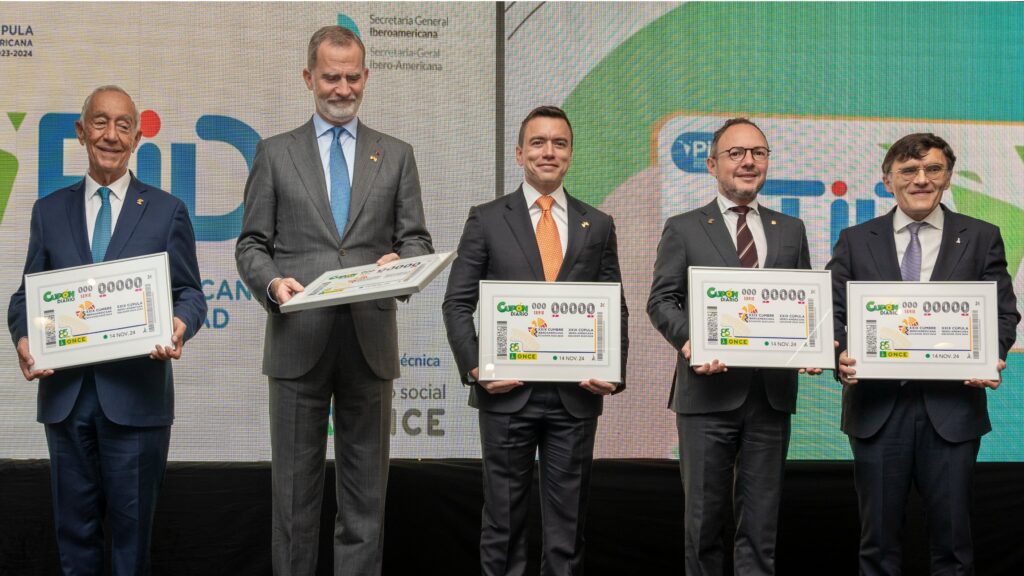
If the Ibero-American summits need to be revitalized, it cannot be done without Mexico. The country that hosted the first of these meetings in Guadalajara 35 years ago has always been, along with Spain, an essential pillar to keep an organization —wobbly in recent years— alive, which on many occasions has served more to air grievances and old enmities than to create a true community of shared interests.
Let’s do a little history. In the early 90s, Spain was regaining its role on the international stage while Mexico was experiencing a few years of economic boom. For both countries, it was a good idea to group the entire Ibero-American continent around a kind of ‘Commonwealth’, in the British style, that would energize political relations but above all economic ones.
The first years looked promising. The young Ibero-American community excited its members and provided a launching pad for Spanish companies —especially, but not exclusively— that began to enter Latin American economies, bringing development and services at the same time.
Everything was working, within the predictable, until the ideological clashes arrived —which gradually reduced the attendance of leaders, in what increasingly looked like a schoolyard— and the great crisis of 2008, after which attendance at the summits never exceeded 16 leaders, out of 22 possible. It will be difficult to surpass the absolute negative record set at the Cuenca Summit (Ecuador, 2024), where only 4 heads of state or government attended (see the photo that illustrates this article).
The tour that has taken Minister José Manuel Albares this week to Puerto Rico, the Dominican Republic, and Mexico had, therefore, a very clear and fundamental objective for Spain’s foreign policy. It can be said that, at least in part, he has achieved it.
Partly, I say, because the Mexican president, Claudia Sheinbaum, received the Spanish chancellor just a few days after attending Pedro Sánchez’s ‘progressive summit’ in Barcelona. And she has also thanked the King’s words about the ‘excesses’ of the conquest. And it can be said that Mexico and Spain are on the way to fixing what began to break with Andrés Manuel López Obrador. That is a great achievement, without a doubt.
And if Spain needs Mexico, Mexico also needs Spain when, among other things, it daily sees that on its northern border it no longer has a trading partner, but a bully that bases any external relationship on threat and force. Pedro Sánchez’s government has already shown itself to be the most critical of the Europeans with the U.S. Administration. And at the meeting in Barcelona, it was possible to see that the harmony between both executives is strengthening.
But Sheinbaum has not confirmed that she will attend the conclave in Madrid. Certainly, it is still early, as the head of Spanish diplomacy has pointed out. And he is right. The Madrid Summit, the thirtieth in the Ibero-American calendar, will be held on November 4 and 5, and there is still time. And the problem is that on those same dates, the APEC Summit is also taking place. And the leader has already expressed her intention to go because China is a priority for Mexico. Therefore, Albares’s tour should be seen as a diplomatic success, but there is still work to ensure that, at least, the Mexican representation is at the highest possible level.
Because beyond the attendance of the leaders, there is something that these summits —the Ibero-American Community— urgently need: content. Real content. If the diplomatic teams preparing the meetings have to continue showcasing limitless imagination to give a motto to each summit, this cannot last much longer.
Let’s simply take a look at the mottos that appear in this list and count how many times the concepts ‘inclusion’, ‘sustainability’, or ‘education’, for example, are included, to verify that the Ibero-American summits have become a forum without substance. Because those concepts, all very commendable, have rarely been accompanied by a firm political commitment and even less by solid economic backing. That said, the mottos have looked nice. Nothing more.
A quick review of the consistent achievements of the summits so far makes their shortcomings clear. Since 1991, Ibero-American countries have created the Ibero-American General Secretariat (SEGIB) and other multilateral secretariats; they have launched Ibermedia (film), the Youth Iberorchestras, and human milk banks. Some progress has been made in gender equality policies, academic mobility —perhaps where it has been most noticeable, in the exchanges of students and professors— and protection of vulnerable groups; the shared strength of the Spanish and Portuguese languages has been enhanced; scientific and educational cooperation of university and research networks between the regions has been promoted; and business excellence has been boosted through the Ibero-American Quality Award.
So, at this point, Spain, which contributes approximately 60% of the cost of maintaining this entire framework, cannot afford the luxury of letting its creation die. But it also cannot allow it to continue living under these conditions, close to a flatline.
Especially because the Ibero-American System of nations has already demonstrated that it could energize economic relations between countries on both sides of the Atlantic, to which for years have been added the Philippines and several African states. However, a cooperative economic community that extends beyond the services sector has not been achieved.
We are talking about mineral and energy resources, rare earths, raw materials that China, Russia, or the United States have been heavily betting on for some time. One cannot compete directly against the giants, but Spain may have the opportunity to establish a collaboration system in which the European Union should also be very interested.
The note from the Ministry of Foreign Affairs emphasizes at all times that ‘through this tour, Albares will have the opportunity to convey the importance that Latin America and the Caribbean have for Spain, a sister region, with a shared language and deep historical, political, economic, and cultural ties.’
It is true, all that and more. But it is also true that we are talking about the economy. And there are no friends when it comes to competing for resources, for contracts. What there should be, must be, are proposals that add value to the counterpart. For example, are we talking about raw materials or manufactured products?
‘Ibero-America. Together we build our Community. Together we project it towards the future and the world.’ That is the motto of the next Summit in Madrid. Will it mean a new boost for Ibero-America, a beneficial change of course for all? Can we once again be left out of the game? Albares’s tour is a first step in the right direction. But there is still much work to be done.