


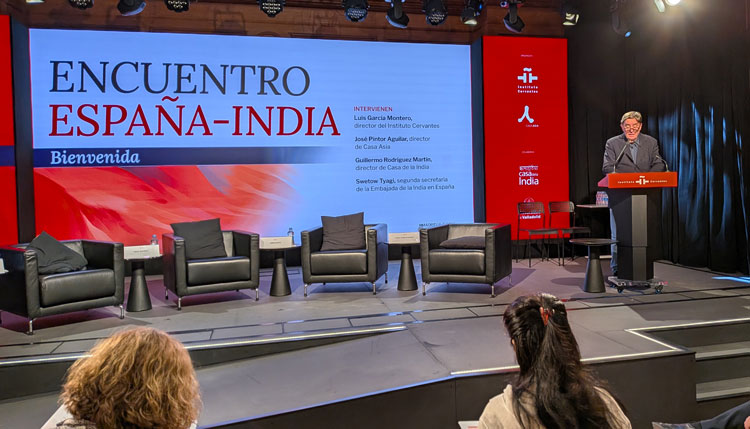
Yesterday, Wednesday, an India-Spain Encounter took place at the Instituto Cervantes in Madrid, organized together with Casa Asia, the Casa de la India, and the University of Valladolid, where Indian Hispanists and Spanish Indologists dialogued on the occasion of the celebration of the Dual Year Spain-India.
The first to speak was Luis García Montero, director of the Instituto Cervantes, who praised the work done by the Instituto Cervantes in New Delhi and its director, María Gilburman, “who, he pointed out, performs excellent work at the helm of one of the most important centers in our network in terms of the number of students and Hispanist activity.” She was the one who proposed the realization of this meeting between Spain and India.
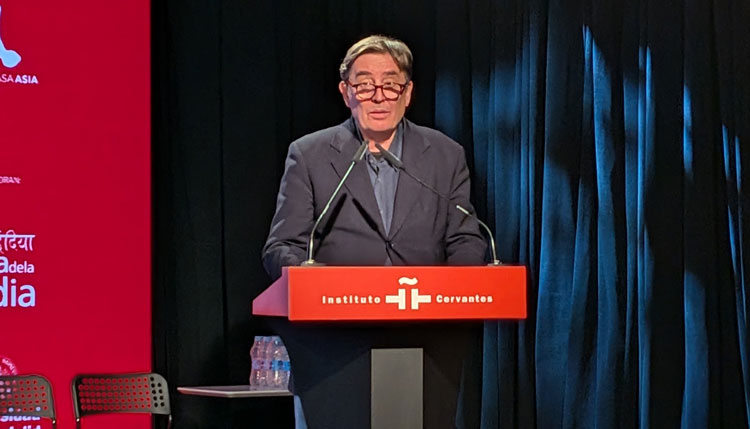
“The program of the day,” continued the director of the Instituto Cervantes, “reflects with extraordinary clarity that vocation for encounter between our two countries, a plural, open, and deeply contemporary celebration. From the platform of Indian Hispanism, which will follow this inauguration, to the two discussions on the studies of India in Spain and the teaching of Spanish in India. From the tribute to Professor Vibha Maurya, whose legacy will be deposited in our Caja de las Letras, among the celebrated Hispanists from the headquarters of the Instituto Cervantes, to the reading of poems by Miguel Hernández, Ángel González and Rabindranath Tagore, in multiple languages of the subcontinent,” he emphasized.
Luis García Montero emphasized that this meeting is held “in the context of the celebration, throughout the year 2026, of the 70 years of diplomatic relations between our two countries, which our center in New Delhi has been able to promote with various activities, including the presentation of an anthology translated into several Indian languages at the Bombay Poetry Festival and, in collaboration with the Ministry of Culture, the Manorama Hortus Festival and the Serendipity Festival in Goa, where an artistic residency will take place.” Joint projects between Spanish and Indian creators are also being promoted, according to García Montero, including a collaborative concert organized together with the Embassy of Spain and various Indian institutions. In visual arts, Cervantes participates in the India Art Fair with the exhibition and collection Candela Soltevilla and a round table with Indian collectors and artists and with the joint project of contemporary illustration Las Paredes Hablan.
“Cinema also has a prominent role in this dual year,” he noted, with Spanish participation in important festivals in the northwest of the country. During the month of March, some cycles dedicated to female directors of Indian and Spanish cinema have already been held, and in June, Ibero-American and Indian queer cinematography will have a leading role in the context of Pride Month. In the performing arts, many activities will also take place, including an adaptation of Don Quixote to the context of Puyac created by Caimbalay Play, which will premiere in December at the X International Congress of the Spanish Association of Interdisciplinary Studies on India, where the teaching of Spanish and Hispanism will again be protagonists. Because if there is one thing that characterizes our cultures, it is precisely their ability to integrate, reinterpret, and dialogue. Spain and India are each in their own way territories of diversity, mestizaje, and historical encounters that have left indelible marks on their languages and ways of understanding the world. In this sense, it is particularly pertinent to recall some words of Tagore who stated, ‘I do not want my house to be surrounded by walls on all sides nor my windows to be bricked up. I want the cultures of all lands to blow over my house with the greatest possible freedom.’”
The director of the Instituto Cervantes concluded by stating that “learning a foreign language, and especially Spanish in India, is not only a tool for communication, it is above all an act of closeness, of recognition, even of hospitality. Every word learned in another language is in a way a gesture of trust towards the one who speaks it, which is why encounters like this are not only spaces for academic reflection but also laboratories of cultural coexistence. Here networks are strengthened, new lines of collaboration are opened, and intellectual friendships are consolidated that will undoubtedly bear fruit in the years to come.”
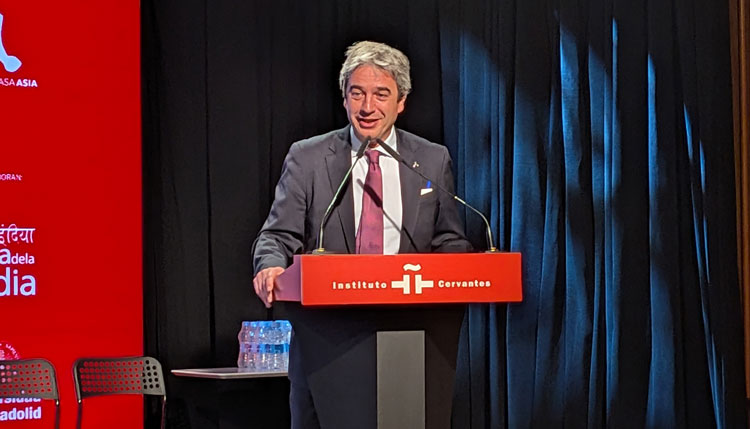
The floor was taken by José Pintor Aguilar, director of Casa Asia, who pointed out: “I believe there is a premise that all of us here undoubtedly agree on, and that is the conviction that unites all institutions and all the people who have gathered here today about the importance of continuing to create, to continue feeding, to continue strengthening these spaces for dialogue and cooperation between Europe and Asia and, in this case, between Spain and India, among all those who ultimately aspire to have a voice of their own, an identity, and a relevant role in an international order that, as you all know, is undergoing reconfiguration. It may seem obvious, but it is not always so; this mutual understanding, comprehension, dialogue, these terms we always talk about do not appear spontaneously and require that institutions help create those conditions to encourage curiosity, to practice active listening, to maintain this sustained effort and this permanent commitment over time.”
“We must join efforts to fight against this giant that is ignorance, which we must combat. I believe that cultural and academic exchange is ultimately the most fertile ground on which to sow these spaces for dialogue that we need today more than ever, especially to finally reinforce that such an important asset, that intangible asset which is becoming increasingly scarce, but also increasingly precious, which is trust, the trust we must sow between our countries,” indicated José Pintor Aguilar.
“I believe,” said the director of Casa Asia, “that this act should also be a recognition of all those who have opened that path and also an act of reclamation to continue asking institutions, universities, cultural centers, all of us who participate in this framework to remember the need to continue contributing to that effort, to continue reclaiming the importance of these meeting spaces and to continue looking towards these parts of the world and to recognize each other reciprocally with the historical importance, as the director said, that our cultures have and also with the diversity, with the richness that accompanies us.”
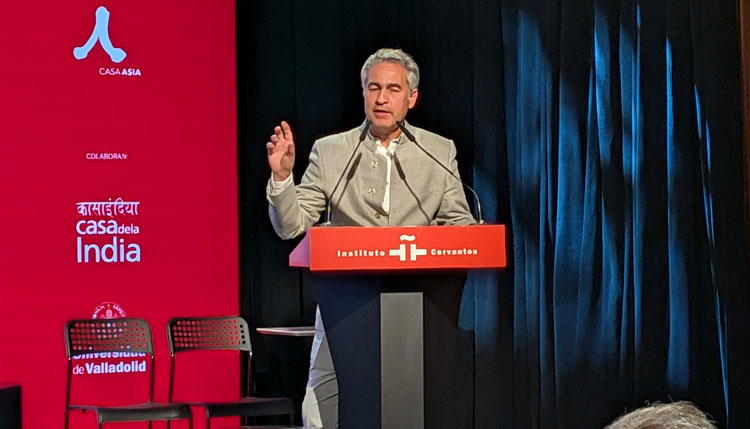
For his part, Guillermo Rodríguez Martín, director of the Casa de la India in Valladolid, emphasized that “this meeting seems very symbolic and important because the very word, encounter, is a demonstration that cultural cooperation is bidirectional, that is, we who dedicate ourselves to making another culture known and put our grain of sand in making known, in this case, India in Spain, or Spain in India, need these figures that act as bridges, that allow that encounter to take place in a House, a Casa Asia, a Casa de la India, in our Houses, in the homes of artists, of writers, of the minds that translate one culture to another, so that the magic of what we call intercultural dialogue can occur, which is nothing more than getting to know ourselves better through another culture.”
Rodríguez Martín emphasized that “for me it is very encouraging to see how the Instituto Cervantes has grown in India, how Hispanism, the teaching of the Spanish language, and interest in Spain in India have increased exponentially and Hispanism is in good health. However, with a somewhat bitter taste, I have to see that there is an asymmetry. We lack, and we can analyze it in today’s session, a comparable good health of the studies of India in Spain. For various reasons, we have been distanced from India in these studies. I believe that is the great pending task. We hope that with new efforts and new impetus, we can carry out something among several universities and the Dual Year can allow that impetus, but we should reflect on how we can bring that knowledge, that research on India to Spain that needs it, and believe me, companies need it too.”
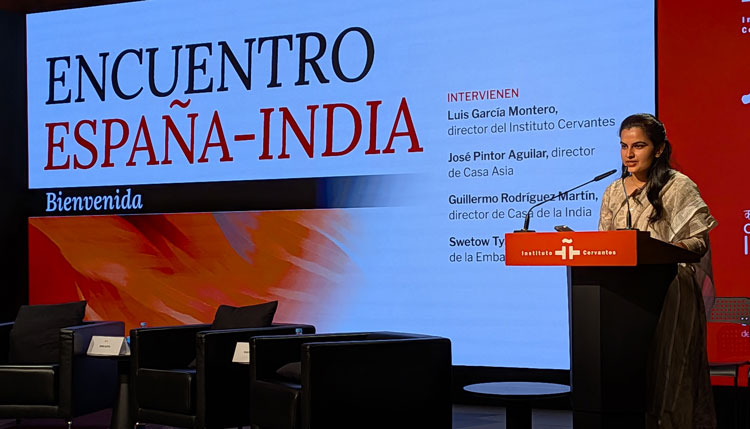
To conclude the presentation of the meeting, the second secretary of the Embassy of India, Sewtow Tyagi, spoke on behalf of the ambassador, Jayant Namdeorao Khobragade, to express her “gratitude to Casa Asia for bringing us together in this conversation. Meetings like these are more than formal exchanges; they are moments of connection,” she noted.
“In that sense,” Sewtow Tyagi pointed out, “today’s event is not just an academic dialogue, but a reaffirmation of the deepening and growing bonds between India and Spain. Our bilateral ties are deepening more and more. High-level exchanges and visits in recent months are a testament to this movement. The year 2026 has a special significance for our partnership. India and Spain celebrate the dual year, the year of culture, tourism, and artificial intelligence, which is a period dedicated to intensifying our action across political, cultural, economic, academic, and people-to-people sectors. Throughout this dual year, a wide variety of activities are organized, and each of these initiatives seeks to extend our boundaries and bring us closer.”
Subsequently, round tables took place where Hispanists and intellectuals from Spain and India reflected on various topics, such as Indian Hispanism, the figure of Vibha Maurya, Spanish in India and India in Spain, the teaching of Spanish in India, along with the presentation of the publication The Creation of Kijote Kathakali.