


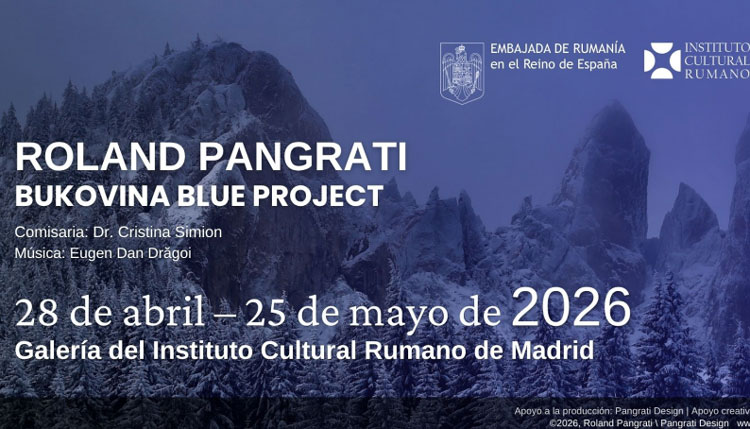
The exhibition Bukovina Blue Project by Roland Pangrati continues until May 25 at the Instituto Cultural Rumano in Madrid, sponsored by the Romanian Embassy.
The exhibition, which combines minimalist abstract expressionism with ancient painting techniques nihonga, is accompanied by introductory seminars on this technique, taught by the painter and aimed at amateur artists, students, and the general public interested in artistic movements inspired by traditional Japanese techniques.
The works of the Bukovina Blue Project series illustrate representative landscapes of Romania, connected not only by the Japanese painting technique nihonga, the materials, and the paper support used, but also by the azurite blue, which establishes a historical and artistic bridge between six-century-old church painters and Pangrati’s contemporary art. Furthermore, these works convey an emotion that transcends the landscape as a pictorial genre.
Roland Pangrati graduated from the Faculty of Decorative Arts and Design at the National University of Arts in Bucharest in 1999, where he obtained a degree in Plastic and Decorative Arts. After completing several internships in Tokyo, where he studied traditional Japanese painting techniques nihonga, he developed his own style, straddling the figurative and the abstract. His works, often poetic and conceptual, have been presented in solo and group exhibitions in Europe and Asia, and have been appreciated in Japan and South Korea. The artist uses “washi,” a tear-resistant paper made from fibers of the kozo tree and declared a UNESCO World Heritage in Japan, which is glued onto interconnected panels, resulting in impressively sized works.