


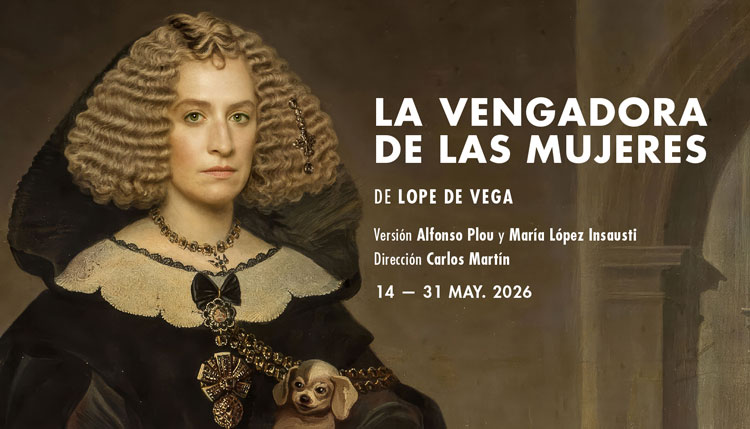
Until the next May 31, the Teatro de la Comedia (calle del Príncipe, 14) hosts the premiere of La venganza de las mujeres (The Avenger of Women), by Lope de Vega, a little-known comedy, but deserving of impact and relevance within his great dramatic production.
To its evident qualities in the beauty and quality of its verses is added a plot in which we discover, from the very title, an author sensitive to the claim of a certain female empowerment: Laura, the protagonist, is aware of the need to convince her surroundings of the values of women, of their physical and intellectual capabilities, which in no way diminish those of men, in a society that was still not prepared for it. Her goal is to establish a school for women to correct centuries of literary ignominy that questions the moral and intellectual capacity of women. Furthermore, hidden behind her fencing mask, she will demonstrate, by winning the tournament against her suitors, the worth and physical capability of women. Although the need for social convention leads her to conclude in the play that love conquers all, the plot raises a claim for women that can well be considered a germ of feminism.
Edited during the author’s lifetime in Part XV of his theatrical works in 1621 by Fernando Correa, it clearly belongs to a mature period of Lope. Perhaps inspired by his own life in which – despite the abundant love affairs, descendants, and polyamorous relationships – he did not stop living in his last years, despite his priesthood, more among women than in celibate or masculine situations. Thus, dealing at home – as also happened to his enemy Cervantes – more with women than with men, and personally experiencing a good part of his claims. From this autobiographical side, it is believed that this proto-feminist work emerges, which is brought to the stage on this occasion.
To place the comedy, in this adaptation directed by Carlos Martín, we move out of the 17th century and its jousts on horseback to bring it to a closer time. Inspired by the beginnings of the feminist movement, in the early 19th century, we find an inspiring figure in Teresa Castellanos Mesa, a prominent fencer and pioneer of women’s physical education, her work was fundamental in promoting sports activity among Spanish women, challenging the norms of the time and paving the way for future generations. Tickets can be purchased at this link.