


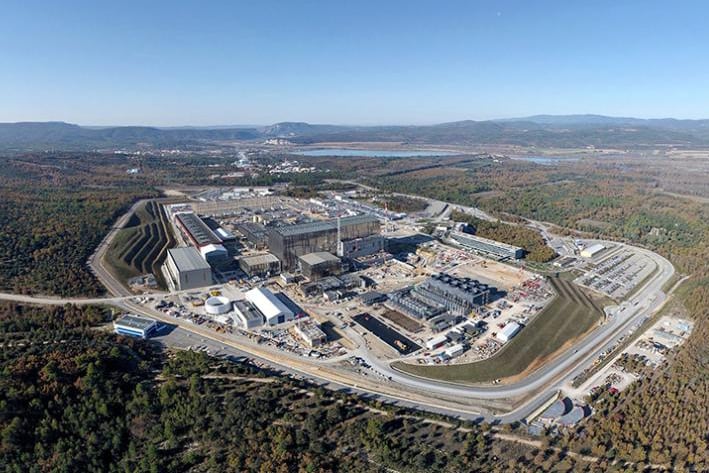
In the south of France, at the Cadarache complex, one of the most ambitious scientific projects on the planet continues to advance in an increasingly fragmented international context. ITER, the largest nuclear fusion experiment ever built, brings together the European Union, the United States, Russia, China, India, Japan, and South Korea in a consortium designed more than two decades ago.
At that time, technological cooperation among great powers was part of a shared strategic logic. Today, that framework remains operational despite the imposition of broad international sanctions on Russia following the invasion of Ukraine.
The uniqueness of ITER lies not only in its scientific objective —to demonstrate the viability of fusion as a source of clean energy— but also in its institutional structure. The project is based on an international agreement signed in 2006 that distributes industrial responsibilities among the members: each party manufactures and delivers specific components of the reactor, from superconducting magnets and vacuum systems to segments of the containment vessel. The European Union assumes approximately 45% of the costs and acts as the host, while the other partners contribute in kind through critical components manufactured in their own countries.
This contractual design explains why, since 2022, ITER has been in a legally ambiguous zone regarding sanctions. The agreement does not foresee mechanisms for expelling a partner without jeopardizing the entire project, and many Russian components were already in advanced production or even delivered when the sanction regimes were activated. Disrupting that supply chain would have resulted in substantial delays, complex litigation, and the need to redesign highly specialized parts that cannot be quickly replaced.
In practice, cooperation with Russia has not remained intact, but it has been carefully limited. Political contacts have been reduced to a minimum, communication is channeled almost exclusively through the ITER organization, and technical teams work under strict protocols. Russia continues to supply contractually committed components and participate in specific technical bodies, but there has been no political normalization or expansion of its role. It is a functional, segmented cooperation that is aware of its limits.
This approach has generated discomfort and criticism, especially in Europe. The European Parliament has debated several times the coherence of maintaining collaboration with Russia in a project of this magnitude, and some member states have advocated for a thorough review of the ITER framework. However, both the European Commission and the main partners have opted for a pragmatic risk assessment: breaking one of the few existing global frameworks for technological cooperation is considered, in the medium term, more costly than managing a strictly limited collaboration.
From an operational standpoint, ITER has not been immune to tensions. The project has accumulated significant delays and cost overruns that cannot be attributed solely to the geopolitical context, but which have been exacerbated by it. Logistical difficulties, rising prices of critical materials, and the complexity of coordinating industrial chains spread across increasingly distrustful blocs have tested the project’s governance. Nevertheless, key decisions —such as the assembly sequence of the reactor or testing schedules— continue to be made collectively.
ITER thus illustrates a specific form of scientific cooperation in times of sanctions. The collaboration is not maintained out of affinity, but because dismantling it proves extraordinarily costly and, in some respects, technically unfeasible.
This case also shows the limits of automatically transferring the logic of sanctions to the realm of large scientific infrastructures. In projects where knowledge, components, and experience are deeply intertwined, total rupture is not always a realistic option. The alternative, as ITER demonstrates, is to contain, limit, and supervise that cooperation, assuming that science, in certain contexts, cannot completely detach itself from the interdependencies it has generated.
Sources: ITER Organization, institutional documentation; Euractiv, coverage on Russian participation; Politico Europe, analysis on ITER after the invasion of Ukraine; European Parliament, parliamentary questions on the project; Science|Business, reports on risks and governance.