


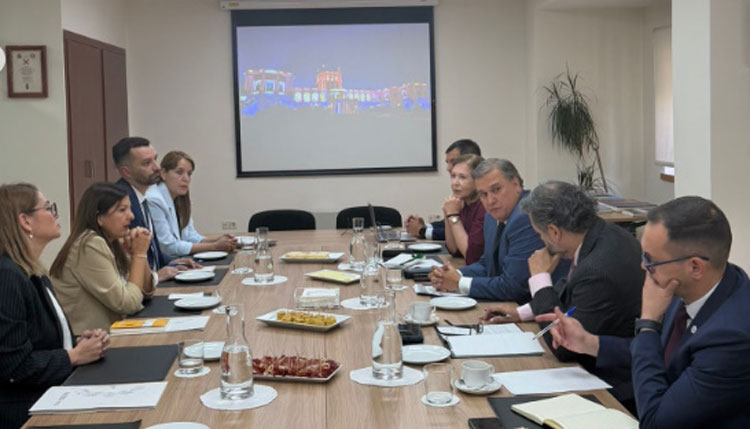
As part of the visit to Madrid, the Minister of Women of the Government of Paraguay, Alicia Pomata, held a meeting with the Paraguayan ambassador, Justo Apodaca, with whom she discussed issues of common interest related to the protection and promotion of the rights of Paraguayan women residing in Spain.
During the meeting, they addressed aspects related to prevention and response to violence, human trafficking and possible joint actions aimed at strengthening support and assistance to the Paraguayan community in Madrid. The meeting also allowed for the exchange of experiences and exploration of coordination mechanisms that contribute to providing a more effective response to the needs of women residing in Spain.
This visit takes place within the framework of the Program for the Prevention and Response to Violence against Women in Paraguay, executed and co-financed by the Spanish Agency for International Development Cooperation (AECID) and the European Union, and executed by the Foundation for the Internationalization of Public Administrations.
As part of these actions, the Paraguayan minister also met with key institutions of the Spanish model for prevention and response to gender-based violence. The visit allowed for firsthand knowledge of the functioning of key institutions and tools of the Spanish model for prevention, protection, and assistance to victims.
During the first day, the Paraguayan delegation held institutional and technical meetings at the Ministry of Equality of Spain, including meetings with the Institute of Women and the Government Delegation against Gender Violence, led by Carmen Martínez Perza. These sessions allowed for the understanding of various tools, coordination models, and public policies promoted by Spanish institutions in this area.
“Promoting equality in all areas of life is probably the best strategy to prevent male violence,” stated Cristina Hernández, director of the Institute of Women, during the meeting with the Paraguayan delegation.
The meeting with the Government Delegation against Gender Violence delved into the Spanish model of institutional coordination and the strategies promoted to improve prevention, protection, and comprehensive response to violence against women.
During the second day, the delegation visited the VioGén system of the Ministry of the Interior, the Spanish model for comprehensive monitoring of cases of gender-based violence, which articulates coordination between Security Forces, the judicial system, social services, and public institutions to improve the prevention and protection of victims. During the technical session, Paraguayan authorities learned firsthand about the functioning of risk assessments, action protocols, and institutional coordination mechanisms developed in Spain over the past years.
The agenda also addressed the growing impact of digital violence against women and the challenges it poses for public institutions. Officials from the Ministry of the Interior shared experiences about new forms of control, harassment, and violence exercised through digital environments, as well as the incorporation of indicators of digital violence in police protocols and risk assessment systems.
The Paraguayan delegation also held a meeting with representatives of the FIAP to discuss the progress of the cooperation program that the FIAP and AECID promote together with the Ministry of Women of Paraguay.
“We need strong, coordinated public institutions capable of providing a comprehensive response to gender-based violence. Sharing policies, tools, and experiences between countries is essential to advance the protection of women’s rights,” stated Francisco Tierraseca, director of FIAP.
This institutional visit is part of the public cooperation model promoted by FIAP, based on the exchange between public institutions and peer learning to strengthen capacities and advance the development of more effective, coordinated public policies focused on women’s rights.
After the agenda developed in Spain, the delegation now continues its study visit in Italy, where it will hold meetings with institutions in the Tuscany Region, the Comune di Firenze, universities, and specialized centers in the prevention and response to gender-based violence.