


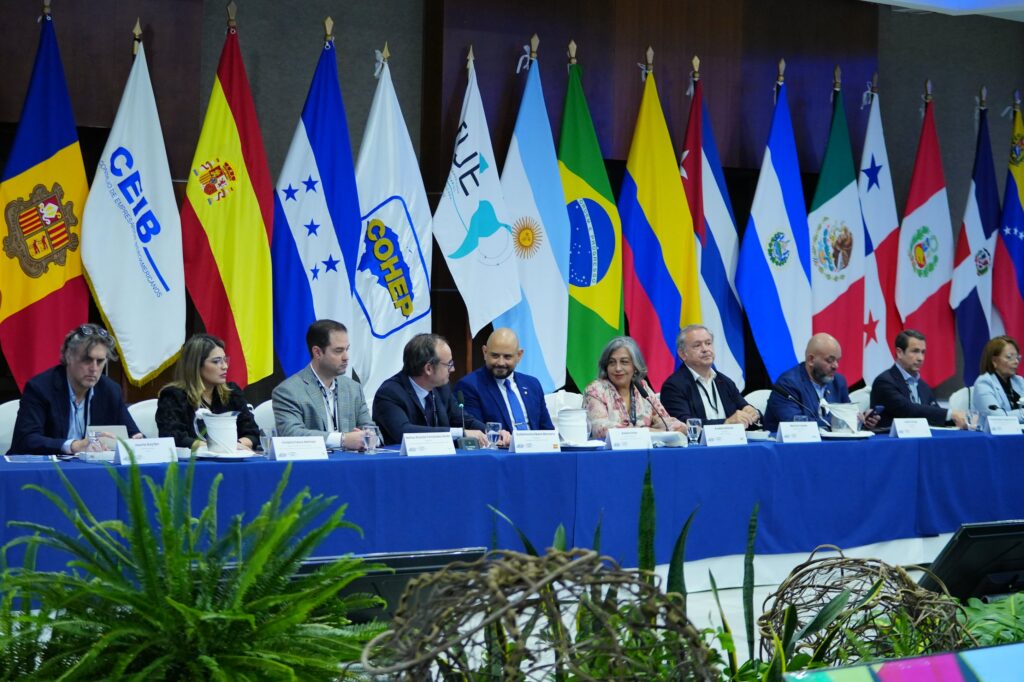
The great challenge of the Latin American tourism sector in the next decade will be to strengthen the capabilities of its destinations to coordinate actors, sustain public policies, train talent, incorporate tourism intelligence, and manage increasingly complex environments, according to the conclusions of the III Ibero-American Tourism Forum, which was held this week in San Pedro Sula (Honduras).
Facing a historically growth-centered phase of visitors, the main actors in the sector agreed that the tourism of the future must advance without compromising the resources of the territories and that sustainability must be addressed from a comprehensive perspective, incorporating economic, social, environmental, and institutional dimensions.
Financing, the digital transformation of small and medium-sized enterprises, the incorporation of artificial intelligence, and the strengthening of value chains were identified as key factors to improve the competitiveness of destinations.
On the second day of the forum organized by CEIB, the Secretary of Tourism of Honduras, Andrés Ehrler, highlighted that “Ibero-America has the conditions to consolidate itself as a space for development, stability, and well-being capable of offering the world safe and attractive destinations.” For his part, the Spanish ambassador in Honduras, Guillermo Escribano, said that “the current complex international context makes Ibero-America a more valuable space for cooperation than ever” and defended the need to continue strengthening regional ties through concrete initiatives and agreements.
The Forum kicked off on Tuesday with a closed-door technical meeting between representatives of the public and private sectors from across the region to analyze the main challenges currently facing Ibero-American tourism and advance in the construction of a joint agenda.
The conclusions reflect that tourism today faces challenges such as increasing pressure on territories, technological acceleration, labor market transformation, institutional fragmentation, and the need to strengthen resilience and adaptation to increasingly frequent crises. In this context, the competitiveness of destinations will increasingly depend on their ability to anticipate changes, coordinate actors, and transform information into effective decisions.
One of the most repeated messages during the meeting was that the main concern of the tourism ecosystem is no longer the lack of projects, but the capacity to sustain coordination processes, institutional continuity, and collaboration among actors.
The most competitive destinations will not necessarily be those with more resources, but those capable of generating stable collaboration structures, institutionalizing long-term strategies, and using knowledge to guide their development.
More than half of the participants (53.3%) place public-private coordination as the main priority for the future of the sector. In addition, 36.7% highlight the need to ensure the continuity of tourism policies beyond political cycles, and 33.3% point out the importance of strengthening multi-level governance. Additionally, 30% identify institutional limitations to use data and tourism intelligence in decision-making.
The president of the Honduran Council of Private Enterprise (COHEP), Anabel Gallardo, defended the need to move towards governance models capable of articulating common agendas and transforming diagnoses into concrete actions.
The organizers agreed that the Forum must consolidate as a permanent platform for regional work and cooperation. In this sense, the permanent secretary of the Ibero-American Business Council (CEIB), Narciso Casado, pointed out that the goal is to turn the conclusions of this forum and subsequent ones into an action plan that can be conveyed to both tourism authorities and Ibero-American cooperation agencies.
Tourism continues to be one of the industries with the greatest capacity for territorial distribution of wealth and generation of opportunities. However, participants agreed that its growth will only be sustainable if supported by an adequate combination of connectivity, infrastructure, accommodation, gastronomic offerings, entertainment, professional training, and territorial planning.