


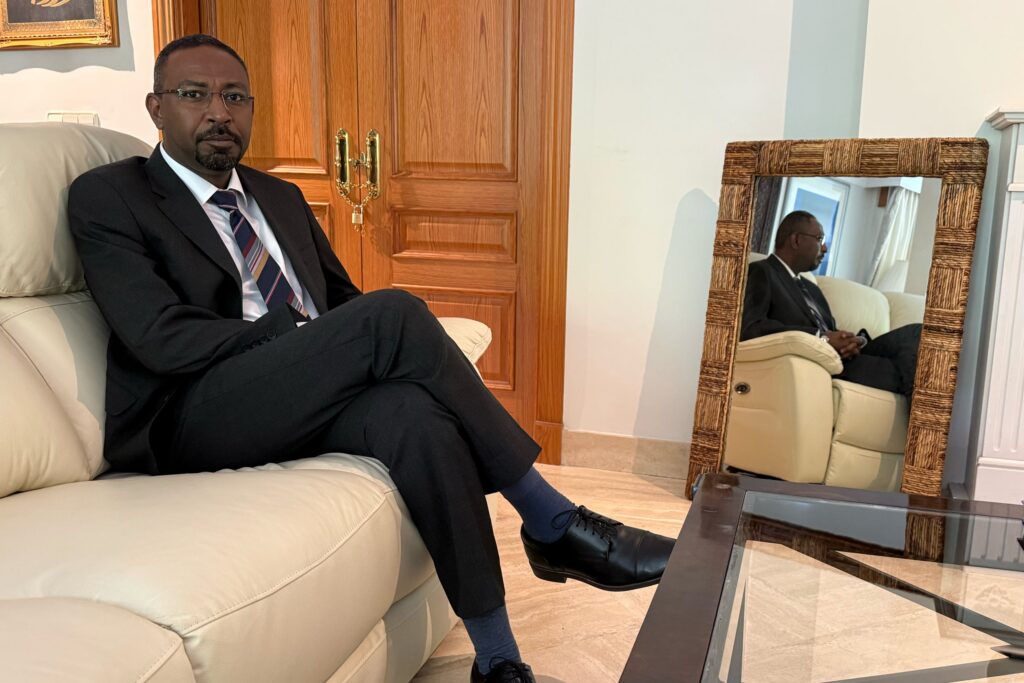
The Government of Sudan is seeking support from abroad to end the war that has plagued the country since 2023. Amgad Fareid Eltayeb Idris, the main advisor to the president of Sudan, Abdelfatá al Burhan, was in Spain all of last week gathering support—political and economic—to end the war and to rebuild the country. Two complicated objectives that could open the door of Sudan to Spanish companies.
Why Spain?
Spain is one of the main voices in defense of international law and humanitarian principles. And that is exactly what we need in Sudan, for all countries to help us comply with international legislation. Because if a law does not apply to everyone, it is no longer a law. And I believe that Spain has shown that it is an important player in that aspect.
You talk about political support, but you also met with the CEOE, the main Spanish business organization. What did you discuss?
It is that besides needing political support, Sudan is entering a phase of rehabilitation. The war has not ended, unfortunately still, but it will. But then, people will need services, electricity, education, health. They will need job opportunities. And Spain is one of the main economies in Europe and the world. So we also want to extend our invitation to Spanish companies.
What does that invitation consist of?
We have met with the CEOE, which has representatives from different sectors of the business community. And we have invited them to come to Sudan to participate as founding partners in the reconstruction of the country. We want to take advantage of the fact that in the economic aspect we also have a very special official relationship with Spain, since our governments have had a cooperation agreement since 2010 that includes regular political consultation between the two countries.
I was not aware of those consultations.
Well, it has not been carried out since 2019. But on this visit, I had a very interesting meeting with the Secretary of State for Foreign Affairs, Diego Martínez Belío, and his team, including the Director General for Africa. And we have decided to resume the political consultation between the two countries, because we believe that Spain is a great reference to tell us what we can do better. We always receive appropriate advice. Our Government is trying to serve the Sudanese people and for that, we need a partner like Spain.
After that meeting, do you feel optimistic about possible intergovernmental cooperation?
Yes. We have talked a lot about security, the situation in Sudan, the implications in the region, and security in the Red Sea, where Spain plays a major role with the European mission against piracy near the Somali border.
So basically, yes. It is not mere optimism regarding our relationship but also about resolving the situation in Sudan and in the region through the European Union. And Spain is one of the great countries of the EU, which can help us push things in the right direction, based on the facts on the ground.
I see that you trust the European Union.
We trust Spain. The European Union consists of 27 countries. And they are a bloc. But it is also true that we trust some countries more than others. And Spain is at the top of that list.
Do you trust that the EU will pressure to achieve a peace agreement?
Yes, we are looking for a positive role from the European Union, the African Union, the UN, and all those who can help us end this situation in Sudan. This war has to end. It has to stop. The Sudanese people have suffered and continue to suffer a lot. We want friendly countries of Sudan around the world to help us end this situation, so that lasting peace and stability can settle in Sudan.
If that peace is achieved, would Spanish companies participate in the reconstruction?
Yes, exactly. That is why we extended the invitation to Spanish companies and the business community to come and work in Sudan. We have untapped resources. We showed them a geological mineral map of Sudan, which is known for gold, but it is not the only mineral here.
We also presented the great opportunities that exist for the agri-food industry that can provide benefits both to Sudan and to any investor. To that, we add the benefits that the government of Sudan can offer to those who come to work.
We also extended the invitation to fertilizer manufacturers. We have contacted entrepreneurs who would be willing to build a fertilization plant in Sudan. As I said, we are planning with the Spanish side the visit of a delegation as soon as possible.
Let me point out something. Many Sudanese are returning to the country after the Rapid Support Forces (RSF) caused the largest displacement crisis in the world. That is why we also have a great need to create jobs. The Government cannot do it alone. We need foreign investments. We want the private sector to come to work, make profits, and also benefit the Sudanese economy by creating more jobs in the rehabilitation process.
I suppose you are aware that the trust of entrepreneurs will depend on how the war evolves. What stage is it in?
I know that some people look at the news and only see that there is a war in Sudan. But my country is very large, five times the size of Yemen. And I assure you that there are areas in Sudan that are completely safe.
Our army is making great progress liberating areas controlled by the terrorist militias of the RSF. And in this, I believe that Spain will understand us because it went through a civil war and a transition, faced fascism, and emerged victorious. It is an experience that we have very much in mind in our fight against the RSF, which is a fascist militia.
There are media reports saying that the RSF are advancing. Is that true?
They are using fear and terror as one of their weapons. It is true that their forces are besieging one of the largest cities in Sudan, El Obeid, the capital of the north. And we have already warned of the atrocities that could occur if the RSF took El Obeid. But our army is resisting.
What does not help is that still in the international community, atrocities are equally blamed on the RSF militia and the Government troops. Who is committing those atrocities? This humanitarian crisis has been caused by the RSF militants who commit homicides, sexual violence, rape, and ethnic cleansing. And despite all that, they still have some support in the international community. By not designating the RSF as a terrorist organization, they are prolonging the war. We hope that the European Union can listen and see the truth. And prevent further genocides.