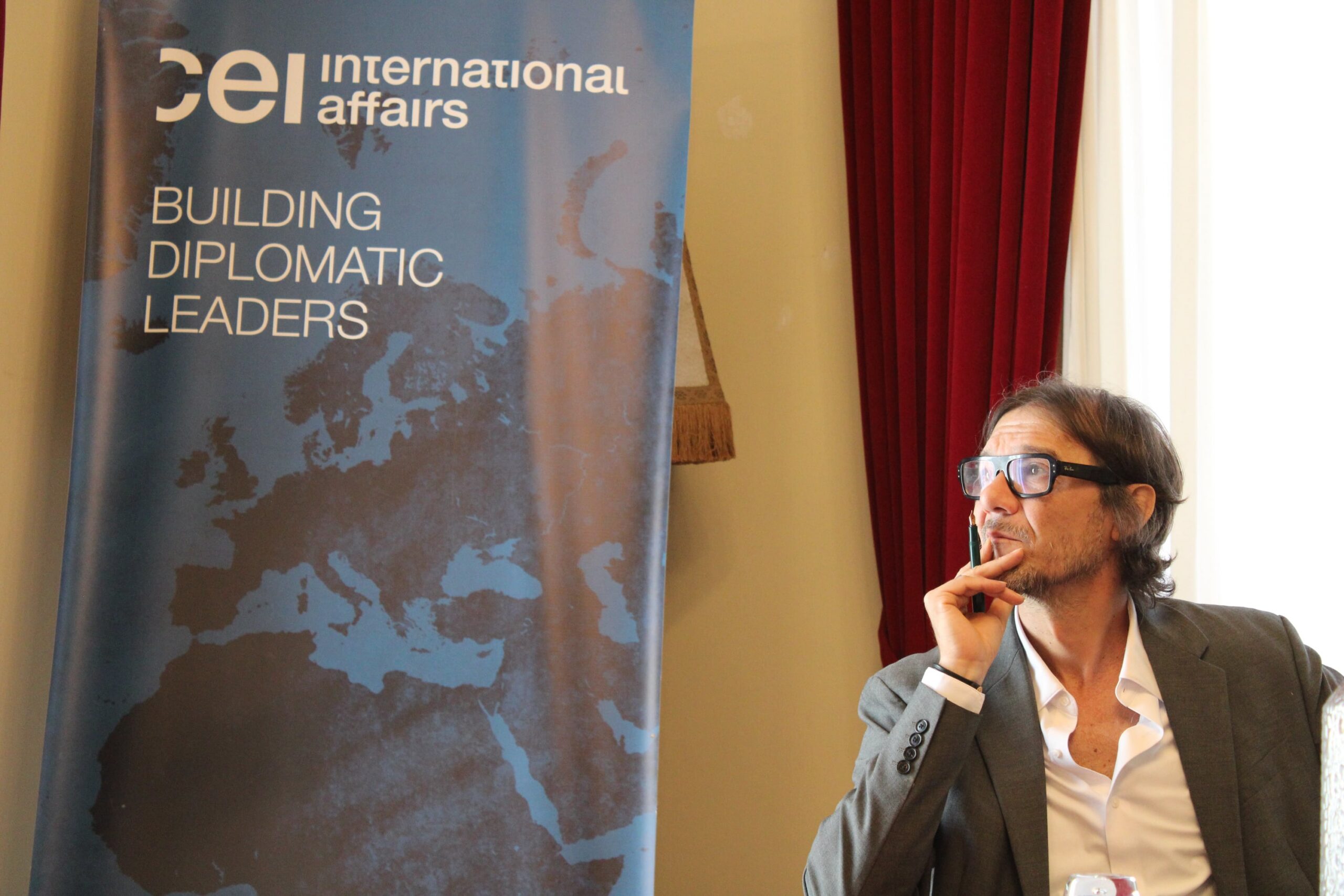
The approval of the new European framework for scientific diplomacy has reinforced the importance of training in this field. The Center for International Studies (CEI) in Barcelona promotes, together with the Organization of Ibero-American States (OEI), one of the few specialized programs available in Spanish.
We spoke with Andrea Noferini, PhD in Economics from the Università degli Studi di Firenze, Master’s in Political Science from the Universitat Pompeu Fabra, professor at this university and Academic Director of the CEI, about the growing importance of scientific diplomacy, the new professional profiles demanded by this field, and the challenges of training future diplomats in an environment increasingly conditioned by science and technology.
Why has scientific diplomacy gained increasing importance on the international agenda in recent years?
Scientific diplomacy is not a new phenomenon, although it may seem so. International scientific cooperation has historically accompanied relations between states and has contributed to building trust even in times of high political tension. What has changed is the place that science occupies on the international agenda.
Currently, science and technology have become determining factors of economic competitiveness, security, and international influence. The COVID-19 pandemic highlighted the importance of integrating scientific knowledge into decision-making, while the acceleration of artificial intelligence, energy transition, and the growing technological competition between the United States and China have placed innovation at the center of geopolitics.
The European Union has responded to this transformation by incorporating it as a strategic element of its external action and its research and innovation policy. Both the approval of the European Framework for Science Diplomacy and the Draghi and Letta reports agree that Europe needs to strengthen its investment in science, technology, and innovation to maintain its competitiveness, reduce strategic dependencies, and face major global challenges.
Scientific diplomacy is a transversal tool of external action. For a long time, it was understood mainly as a way to facilitate collaboration between researchers from different countries. Today, science helps to guide public decisions, strengthen international relations, and reinforce the position of countries on the global stage.
How has the CEI adapted to the transformations that external action has undergone in recent decades?
For more than four decades, the CEI has accompanied the evolution of Spanish external action by training diplomats, specialists in international relations, and professionals linked to cooperation and international institutions. Today, it continues to have the same function, although the international context has changed significantly.
21st-century diplomacy no longer depends exclusively on embassies, foreign ministries, and national governments. Major global challenges —climate change, global health, artificial intelligence, energy transition, or technological security— require the participation of universities, research centers, companies, regional governments, and cities, along with traditional actors in foreign policy. This evolution has led the CEI to progressively expand its training offerings with new areas such as scientific diplomacy, global governance, and the internationalization of institutions and territories.
What needs did you identify that justified the creation of a specialized program and what profiles are currently demanding this type of training?
While scientific diplomacy gains prominence on international agendas, the training offer remains very limited, especially in Spain and the Ibero-American sphere. There is extensive training for scientists and another for diplomats, but there are still few spaces where both profiles learn to work together and understand their respective languages, timings, and ways of acting.
The program developed jointly by CEI International Affairs and the Organization of Ibero-American States was born to respond to this need. More than training specialists in a specific field, the goal is to build a community of practice capable of integrating scientific knowledge into external action, public policies, and international cooperation. The program combines conceptual foundations with the analysis of real cases and the participation of diplomats, researchers, and institutional leaders from different Ibero-American countries.
The profile of the participants precisely reflects the transversal nature of scientific diplomacy. Alongside members of diplomatic services, other ministries, and public administrations, we find researchers, university managers, heads of international project offices, innovation agencies, cooperation bodies, and professionals from the technology sector. Although they come from very different fields, they all seek to better understand the relationship between science, diplomacy, and international cooperation.
What skills do you consider essential today for professionals in external action?
Diplomatic work has always required negotiation skills, knowledge of international law, and a solid understanding of the geopolitical context. These competencies remain essential, although today they are applied in a much more complex environment.
A large part of the major international challenges today has a scientific and technological dimension. Diplomats must be able to interact with scientific communities, interpret technical evidence, and translate it into the decision-making realm. At the same time, these challenges require working with very diverse actors and coordinating interests and capabilities from different fields.
Therefore, in addition to preparing excellent negotiators, training diplomats today means training professionals capable of connecting science with public policy, working in international knowledge networks, and effectively navigating multidisciplinary environments.
Based on the cases analyzed in the training, what characteristics do the most effective scientific diplomacy initiatives usually share?
The most successful scientific diplomacy initiatives arise to respond to challenges that no country can face alone. Challenges such as climate change, pandemics, or food security require sustained international cooperation and trust mechanisms between governments, the scientific community, and society.
Scientific diplomacy also serves to strengthen international dialogue. Scientists often collaborate easily because they share methodological standards, peer review mechanisms (the review of results by other experts), and international practices for knowledge exchange. Cooperation among them tends to be maintained even in contexts of political tension and helps preserve communication channels when other diplomatic avenues face difficult moments.
However, for this cooperation to have a real impact, it is necessary to overcome an exclusively state-centric view of diplomacy. Scientific diplomacy is, by nature, a multi-level and multi-actor diplomacy, in which institutions of very diverse nature participate.
At the CEI, we understand that this will be one of the major areas of development for external action over the next decade. Training professionals capable of connecting science, politics, and international institutions means preparing a new generation of leaders to face an increasingly complex international scenario.