


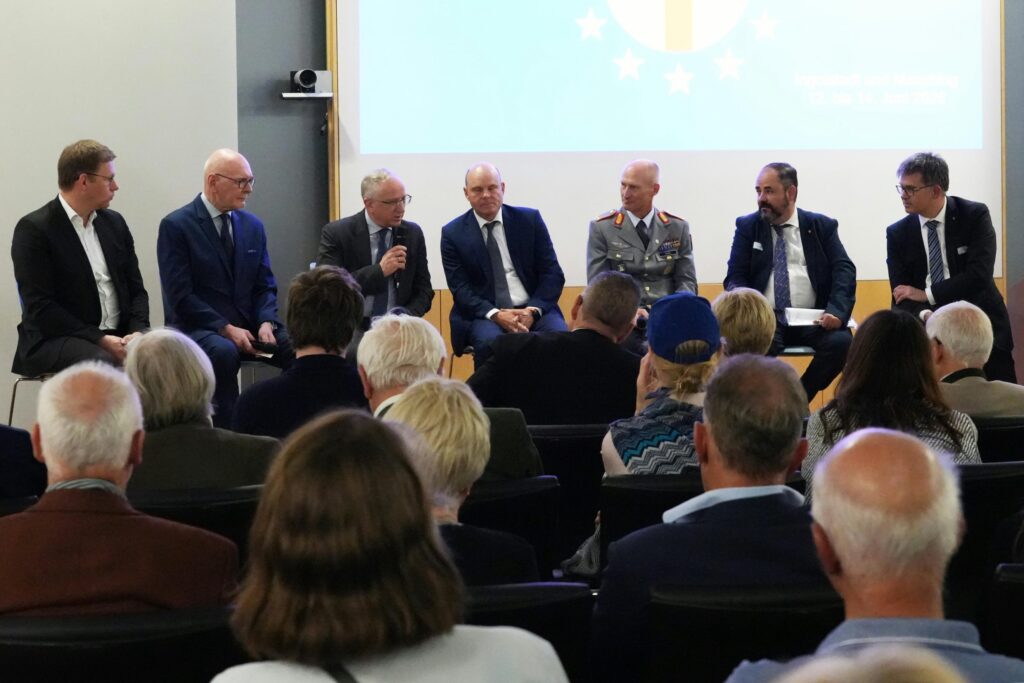
The LII Paneuropean Days have just been celebrated in Ingolstadt (Germany), which took place under the slogan «Paneuropa: union instead of collapse» and brought together political representatives, academics, military members, and members of the paneuropean movement to discuss the future of Europe, the war in Ukraine, common European defense, and cooperation in the Danube region.
One of the main protagonists was Bernd Posselt, president of the Paneuropean Union of Germany, who criticized the German government’s tendency to act through “coalitions of the willing” instead of strengthening the institutions of the European Union. He pointed to the negotiations on Ukraine held in London as an example, where both important EU countries and the High Representative for Foreign Affairs, Kaja Kallas, were marginalized. Although he acknowledged that in emergency situations actions outside the usual procedures may be necessary, he defended that this should not become a permanent practice.
Posselt called for a gradual plan leading to a much deeper integration of Europe, even towards hypothetical “United States of Europe,” with a first step being a European Defense Union. He also advocated for the elimination of the veto power of member states in foreign and security policy, taking advantage of the political change in Hungary following Viktor Orbán’s electoral defeat. Internally, he called for a firmer response to the AfD and other nationalist movements, even suggesting the possibility of banning the formation if necessary to protect European democracy.
Sebastian Roloff, leader of the Bavarian SPD, stated that the historical message of the paneuropean movement remains valid: “Europe is the answer.” He highlighted the enormous potential of the EU as a space of 450 million citizens, one of the largest economies in the world, and a powerful legal community. However, he warned that Europe is simultaneously facing external and internal threats. According to him, Russia’s war against Ukraine is accompanied by a hybrid war that includes disinformation, sabotage, and attempts at social polarization, while various European nationalist movements weaken the EU’s ability to act.
For his part, Pavo Barišić, international president of Paneuropa, argued that Europe is facing an existential challenge comparable to that of the years following World War I. Drawing inspiration from the theories of historian Arnold Toynbee, he stated that civilizations survive only when they successfully respond to the challenges they face. In his opinion, the EU has today the opportunity to consolidate itself as one of the main powers of the new multipolar world order, but to do so it must decisively strengthen its foreign and defense policy.
One of the most impactful testimonies was that of Ukrainian historian Ihor Zhaloba, president of Paneuropa Ukraine and former volunteer on the front lines. He described the suffering of the Ukrainian population and emphasized that the lack of sufficient military support in 2022 prevented a possible Russian defeat. He believes that during 2026 a new window of opportunity could open for Ukraine to force a favorable end to the war, although he warned of the enormous human toll suffered by the combatants. He also highlighted the innovative capacity achieved by the Ukrainian Armed Forces, especially in the use of new technologies and drones.
The interventions also showed a very critical view towards Russia, China, and even the recent evolution of the United States. Dirk H. Voß, vice president of Paneuropa International, argued that Europe must become a sovereign power capable of acting independently in the face of pressures from Moscow, Beijing, and Washington. According to him, only deeper political integration will allow Europe to defend its interests.
Round table on security and defense at the Airbus headquarters in Manching
The second major part of the meeting took place at the Airbus facilities in Manching, where a round table on defense was held. Matthias Nitsche, executive at Airbus, explained that the FCAS project should not be understood solely as a combat aircraft, but as a complex network of manned and unmanned systems. He also reaffirmed the essentially European and Franco-German nature of the company.
During the debate, several participants advocated for strengthening European military capabilities. German MP Thomas Erndl called for joint armament projects between Germany, France, and Poland, as well as some form of mandatory social or military service to increase the number of reservists. Retired Austrian Brigadier Gerald Karner demanded a much firmer stance against Russia and advocated for a European defense with genuine deterrent capacity.
Polish ambassador to Germany, Jan Tombiński, stated that Europe is experiencing a “third foundational moment” in terms of security and defense. In his view, a future European army will not arise from abstract declarations, but from concrete projects and shared experiences. Along the same lines, German General Christian Friedl defended some form of mandatory service to strengthen the armed forces and recalled that it is paradoxical that 450 million Europeans still depend on 350 million Americans to guarantee their security.
The Spanish representative, Carlos Uriarte Sánchez, president of Paneuropa Spain, highlighted the difference between the social mobilization of Ukraine and the Russian situation, and stated that Europe must make it clear that any use of tactical nuclear weapons would have serious consequences for Moscow. He also insisted on the need for China to understand that military action against Taiwan would have significant costs and advocated for preserving the status quo through dialogue.
The Danube region as a driver of European integration
The conference also dedicated special attention to the Danube region as a driver of European integration. Croatian Foreign Minister, Gordan Grlić Radman, emphasized that the EU strategy for this region favors both European cohesion and the integration of candidate countries for accession. The Vice President of Bavaria, Ulrike Scharf, recalled the legacy of the founder of the paneuropean movement, Richard Coudenhove-Kalergi, and stated that Europe must reaffirm itself as a community of values, freedom, and shared destiny.
Overall, the days conveyed an unequivocal message: in the face of current geopolitical threats, the participants believe that the response lies in a more integrated Europe, with greater military capacity, a stronger common foreign policy, and a progressive overcoming of the limits of national states in favor of a genuine European political union.