



At a time when competition between economies is measured both by their industrial capacity and by control of digital infrastructures, telecommunications have acquired unprecedented relevance. Networks, data centers, artificial intelligence, cybersecurity, and distributed computing have become essential elements for the competitiveness of states and large corporations.
In this scenario, Telefónica, led by its CEO, Marc Murtra, is redefining its international role through a strategy that combines technological leadership, financial discipline, and an increasing involvement in initiatives aimed at strengthening European digital autonomy.
The transformation is not solely driven by business criteria. The sector is undergoing a phase of global concentration driven by the need to undertake increasingly capital-intensive investments. In this context, Telefónica has focused its activity on those markets where it maintains leadership positions and sustained growth capacity: Spain, Brazil, Germany, and the United Kingdom. This orientation allows it to concentrate resources in strategic geographies without renouncing its global dimension or its historical presence on both sides of the Atlantic.
The data reflects the magnitude of this bet. According to the presentation made to its shareholders in June 2026, the group has 74.9 million real estate units passed with fiber optics and a 5G coverage of 81% in its main markets. At the same time, it continues to expand capabilities related to edge computing, the cloud, and artificial intelligence, while advancing in the rationalization of its international structure, including the signing of the sale of Telefónica Mexico. This scale allows the company to undertake increasingly demanding technological investments in an environment where digitalization and deep learning require substantial financial and industrial resources.
However, reducing Telefónica’s international presence to a map of operations would be an incomplete reading. The company maintains a unique position in the economic relations between Europe and Latin America, a region where it has been one of the main European investors in telecommunications and digital connectivity infrastructures for decades. This transatlantic dimension continues to be one of its main strategic assets in a context where technological cooperation between both regions is becoming increasingly important.
The most significant evolution is observed in the nature of its international activity. Networks remain essential, but much of the growth is now concentrated in high value-added services. Cybersecurity, cloud, data management, Internet of Things, and artificial intelligence have become priority areas for a company that aims to establish itself as a technological partner for governments, industries, and large organizations.
A recent example of this strategy is the expansion of Telefónica Tech in the United States through a partnership with the Spanish company Halotech to deploy advanced industrial security solutions based on AI and the Internet of Things. The initiative combines connectivity, smart sensors, and real-time data analysis to enhance the protection of workers and critical infrastructures. Beyond the specific agreement, the project demonstrates Telefónica’s ability to export technology and innovation to one of the most competitive markets in the world, reinforcing its international projection in high-growth segments.
The global dimension of the company also extends to financial markets. Last June, Telefónica successfully completed an inaugural bond issuance worth 700 million Australian dollars, equivalent to about 426 million euros. The operation allowed it to expand its international investor base and diversify its funding sources, a strategic aspect for an industry that requires continuous investments in infrastructures and digital capabilities.
But perhaps the most significant future move lies in the field of artificial intelligence. Under the leadership of Marc Murtra, Telefónica has publicly expressed its willingness to lead the future European AI gigafactory proposed by Spain to the European Union. This initiative is set to become one of the main technological infrastructures on the continent, capable of strengthening European capabilities in advanced computing and data processing.

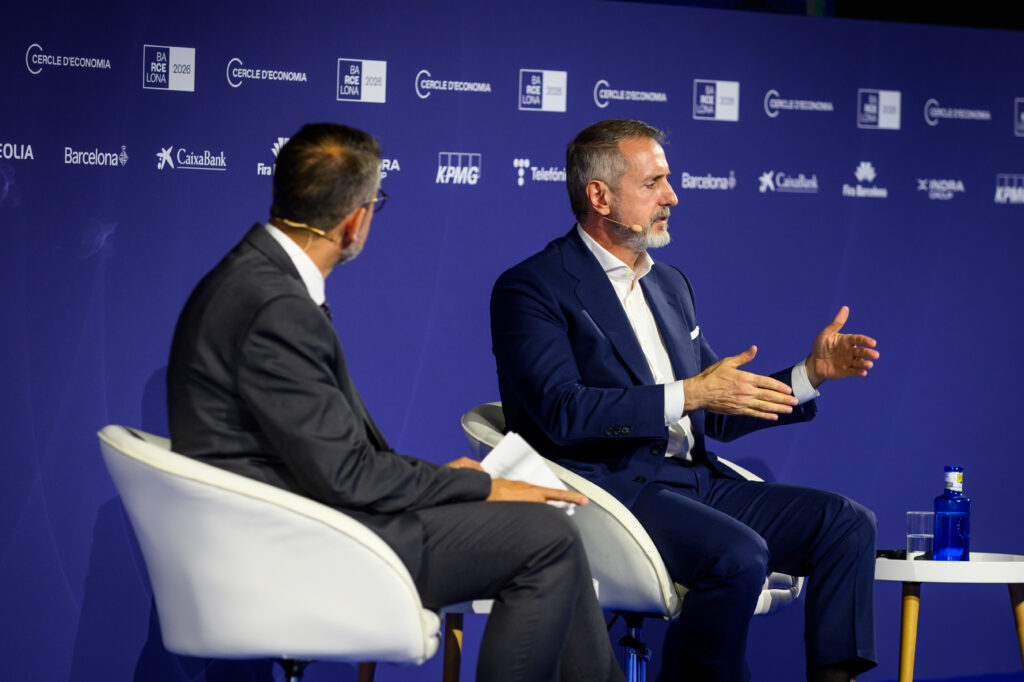
The growing technological rivalry between the United States and China is forcing Europe to rethink its position in strategic sectors such as telecommunications, advanced computing, and AI. In this context, companies like Telefónica have taken on a role that transcends the business realm. Their ability to deploy critical infrastructures, manage sensitive data, and participate in pan-European technological projects places them at the center of the new strategic autonomy policies driven from Brussels.
This vision is integrated into a broader agenda. Telefónica also participates in EURO-3C, an initiative promoted alongside more than seventy European entities to develop a sovereign pan-European infrastructure that combines telecommunications capabilities, edge computing, cloud, and artificial intelligence. The project reflects an increasingly widespread conviction among governments and companies: future competitiveness will depend on the ability to control strategic digital infrastructures just as, in another time, it depended on ports, rail networks, or energy resources.
Telefónica’s international actions show, ultimately, an evolution that transcends the traditional realm of telecommunications. From the consolidation of its strategic markets to its technological expansion in the United States, through its prominence in debates on artificial intelligence and digital sovereignty, the company seeks to occupy a relevant space in the new international economic architecture. It is not just about connecting territories, but about participating in the construction of the digital infrastructures on which the competitiveness of the coming decades will be based.