


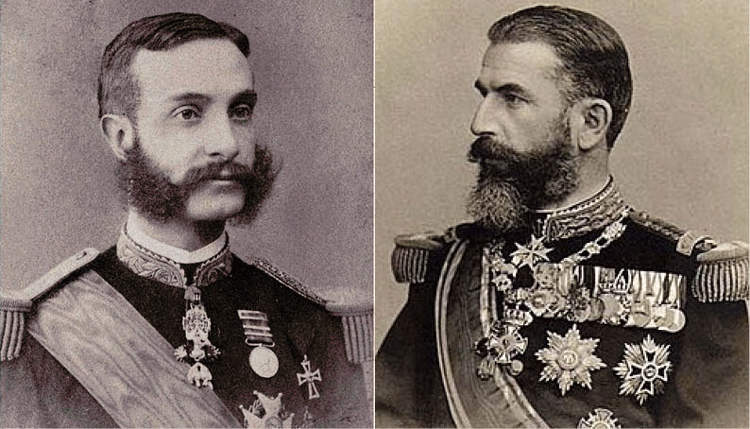
On June 23, 1881, during the reigns of Carol I of Romania and Alfonso XII of Spain, the two countries established diplomatic relations at the legation level, with the presentation in Bucharest of the credentials of Pedro de Aladro and Kastriota, chargé d’affaires, a.i., of Spain. That event marked the beginning of a solid bilateral relationship based on dialogue, mutual respect, and cooperation.
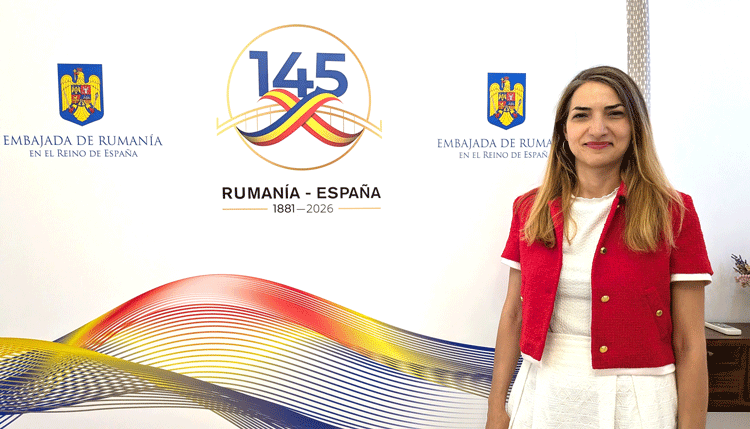
145 years of diplomatic relations between the two countries are being celebrated, and Diplomacy News has spoken with Raluca Mihaila, chargé d’affaires a.i. of the Romanian Embassy in Spain.
– 145 years of diplomatic relations between Spain and Romania. After a few years of a break in diplomatic relations, in February 1977, following the death of dictator Franco, both states fully normalized their relations and opened resident embassies in Madrid and Bucharest. How has the relationship between the two countries been since then?
If we had to look back, I think the Romania-Spain relationship demonstrates precisely that with dialogue, mutual respect, and if there are also common values, the lessons of the past can be transformed and the future can be built, and now we can indeed talk about how historical transformations have transcended, gone beyond collective memory. In 1989, when Romania began the democratic transition with the fall of the communist regime, there was a rapprochement with Spain and the other countries of the European Union, and therefore with Romania’s democratic transformations in the following years, our bilateral relationship has also transformed, which has been constantly consolidated, also with our country’s accession to NATO and then with Spain’s constant support for Romania’s accession process to the European Union.
The bilateral relationship today with Spain is a solid partnership, based on common values, on our common membership in the European Union, in NATO, in a European trust and solidarity that we share. We must highlight three aspects of these relations between the two countries, from the commercial, cultural, political. I would start with the political, diplomatic, and defense part, which is the basis for the development of the bilateral relationship. We have an intense, dynamic bilateral dialogue, with a strategic partnership since 2013 and then with the first summit of the Romanian and Spanish governments on November 23, 2022, at which time a political declaration was adopted.
In this framework and with the current geopolitical context, Romania and Spain now share a common vision, a vision based on European solidarity, the consolidation of European security, support for Ukraine, also the strengthening of NATO’s eastern flank, the promotion of a more competitive and more resilient European Union. It is also important to highlight the high-level contacts, the most recent being the visit of King Felipe VI to Romania on June 10, 2025, when together with the President of Romania, Nicușor Dan, they visited the Spanish troops deployed in Romania at the Joint National Training Center Getica located in Cincu, in the Brașov district, where they participate in the NATO battle group. And this visit highlights the exemplary cooperation between Romania and Spain in the field of defense and security.
Spain is for us a trusted ally that contributes, as I mentioned earlier, to the consolidation of the deterrence and defense posture of the alliance in our region and in the Black Sea region.
In the economic field, Spain is one of the main foreign investors in Romania. According to data from the National Office of Trade Registry at the end of 2025, it was the eighth country of origin for foreign investments. We are talking about sectors such as infrastructure, energy, construction, financial services, telecommunications, and food industry.
And also, on its part, Romania is consolidating in Spain as an increasingly dynamic economic partner. At the end of last year, we can already say that in 2025 we had a new record of trade exchange that reached 6.88 trillion euros. Our Embassy contributes with support initiatives for economic cooperation and we try to support the consolidation of the Romanian community of entrepreneurs here in Spain, which is growing larger.
Regarding the cultural dimension, we have a very dynamic bilateral relationship, on one hand very focused on Latin affinities, on the community, the presence of the Romanian community here in Spain, and on the other hand on the ever-increasing interest of Spaniards in contemporary Romanian literature, in Romanian cultural heritage in general. And, for example, at the Madrid Book Fair, Romania has always had a constant presence for years thanks to the Romanian Cultural Institute, which this year celebrates 20 years of activity. With each edition, we have a lot of Romanian literary presence, this year we had exceptional presences of Mircea Cărtărescu, Ana Blandiana, who is the 2024 Princess of Asturias Award for Literature, Matei Vișniec, Radu Paraschivescu or Ioana Pârvulescu, important names that have attracted a large audience.
Still talking about the cultural part, I wanted to mention some initiatives like that of the Madrigal Choir, with which last year we opened the anniversary year. The Nacional Chamber Choir Madrigal, Marín Constantín, had an exceptional concert here, in the Cathedral of Almudena, and also in the Cathedral Mosque of Córdoba. And, more recently, we had the great Romanian violinist Alexandru Tomescu, here in Madrid this year, and the guitarist Dragoș Ilie, and I could continue. And to finish, through the exhibition we inaugurated last Tuesday in the Carriage Walk of Retiro Park in Madrid (The Romania-Spain relationship reflected in the press), we want to highlight all the dimensions of this privileged bilateral relationship. The presence of Secretary of State Clara Staicu and Secretary of State Fernando Sampedro at the opening of the exhibition gives this celebration a special significance, symbolizing not only the strength of our bilateral relationship, also the shared vision that continues to guide the partnership between Romania and Spain.
– The Romanian community in Spain currently amounts to around 609,000 people, about 30% less than in 2012. What reasons could be the cause of this decline? The improvement of working conditions in Romania, the increase in the cost of living in Spain?
I would say that the causes lie in the transformation of Romania, which is no longer the country it was 15 or 20 years ago. The improvement of working conditions and the economic context in general have made emigration no longer seen as a necessity. And also, data from the INE shows us that most Romanians leaving Spain have done so to return to Romania.
The movement of people also depends on where professional opportunities arise. Therefore, perhaps we can talk more about European mobility and not so much about unidirectional migration. But what is important is that here in Spain there is a Romanian community that is one of the largest, is highly valued, very appreciated, and very well integrated.
And this, whether they continue here or are between the two countries, will continue to be this community a fundamental pillar in our relationship.
– And what do you think is the reason for this good adaptation and how would you describe the profile of the Romanian citizen residing in Spain?
There are linguistic affinities because we have common Latin roots. In general, there is a good capacity for adaptation among Romanians, who are also young here in Spain. The average age of the Romanian community is around 35 years and the vast majority, we are talking about around 75%, are of working age.
It is a community that works, that has a great contribution to economic and social life. The Romanian community is the second largest foreign community contributing to Social Security here in Spain and the first among European communities. It is a community that adapts quickly, as I said, thanks to linguistic affinities, but also to traditions, and also thanks to the Christian religion that unites us.
From the perspective of economic contribution, I also wanted to highlight the increasing number of companies, Romanian entrepreneurs, and freelancers who contribute to economic life. And for that reason, two years ago, on May 2, 2024, the government of the Community of Madrid, where the largest community of Romanians resides, with 145,000 Romanians, decided to award the Grand Cross of the Order of May 2 to the Romanian community, precisely to recognize this role from an economic perspective and the number of established companies.
– Iberia inaugurated a new route to Bucharest at the beginning of last June that will have two weekly frequencies from Adolfo Suárez Madrid-Barajas Airport until September 30, with an offer of more than 12,700 seats throughout the summer. What is the tourism balance between the two countries?
I would say it is a very dynamic tourism balance because Romanians are increasingly attracted to Spanish tourism, to its cultural, gastronomic heritage and the coastal towns that always attract more tourists.
But also on the other side, Romania, which is perhaps a less known destination, surprises more and more with its authenticity. There are always more Spaniards choosing Bucharest or another Romanian city for a city break (short urban getaway, generally lasting 2 to 4 days).
Regarding natural heritage, the Carpathians or the Danube Delta also receive many visits. It is also important to highlight Romanian cultural heritage, such as the monasteries in northern Romania.
Air connections help a lot to promote tourism, which is why we welcome the resumption of Iberia flights that add to the air connections, to the flights operated by Tarom, which is the Romanian company, and also to the other companies that make several direct connections between the two countries possible and that allow for a very good exchange from the tourism and also economic perspective. Spain is one of the top countries of origin for foreign tourists in Romania. And of course, our presence since the beginning of FITUR also helps, Romania has always participated.
– Last May, Oana Toiu, Romania’s Foreign Minister, stated that “pressure must be maintained on Russia to bring it to the negotiating table.” Your country is being terribly influenced by this occupation of Ukraine. Can you detail how Romania is suffering from this influence?
The truth is that what Minister Oana Toiu said represents the consensus at the European level. That is to say, peace in Ukraine cannot be a peace achieved by capitulation or by conditions that are taken as a fait accompli. Rather, it must be the result of negotiations that must take place within a framework based on international law and the UN Charter. And precisely for this reason, we are providing strong support to Ukraine precisely to create these conditions and thus be able to reach a solution that is fair, that is also lasting.
Romania, for years now, has been and will continue to be a security provider in the region. Among some initiatives that have received concrete support from our country, it is worth mentioning the one concerning the export of cereals, which has allowed the circulation of world markets access to Ukrainian cereals. Also the development of EU solidarity routes, demining activities in the Black Sea with our partners. These are just a few examples, but it should be emphasized that we will continue to focus on consolidating the deterrent posture on the eastern flank, in support of Ukraine. And speaking of the effects of the war, as we are among the member countries of the European Union, of course we are talking about the border of Romania, but also the border of the EU and NATO.
Our efforts are aimed at ensuring the security of our citizens, but it is also a common responsibility, as far as the EU and the Alliance are concerned, because, as I said earlier, it is a common border. Of course, this reality puts Romania close to the effects of war, but it also makes our country more resilient and strengthens its capacities to support efforts to achieve more goals.