


“Tangier is more New York than New York.” The famous phrase, popularly linked to Paul Bowles, summarizes Morocco’s historical ability to position itself at the intersection of different worlds. Just fourteen kilometers from the Spanish coasts, the Alaouite Kingdom has been playing the role of a bridge between Europe, Africa, and the Middle East for centuries. Few countries concentrate such extraordinary cultural, monumental, and landscape diversity in their geography.
The Throne Festival, celebrated every July 30, also reflects one of the distinctive features of contemporary Morocco: the coexistence of a deep historical continuity and an ambitious commitment to modernization.
For the Spanish traveler, and also for international diplomacy and economy, Morocco is much more than a nearby destination. It has established itself as Spain’s main trading partner in Africa and one of the most relevant destinations for Spanish investment outside the European Union. It is a strategic partner, a cultural melting pot, and a stage where migration, logistics, energy, and heritage converge. Understanding Morocco through a journey through its cities and history implies, in a way, deciphering its true Mediterranean essence.
A country in deep transformation
The stereotypical image of souks, medinas, and old caravans is now incomplete. Morocco has firmly committed to modernizing its infrastructure to establish itself as one of the major economic connectors between Europe and Africa.
One of the symbols of this transformation is Al Boraq, the first high-speed railway line on the African continent, inaugurated in 2018. This train connects Tangier, Rabat, and Casablanca, drastically reducing travel times and allowing easy access to the country’s main arteries. Today, the experience of exploring Morocco combines the timeless charm of its medinas with a network of highways, cutting-edge trains, and first-class international airports.
Tangier: the cosmopolitan myth and the logistical power
Few cities better summarize the history of the Strait than Tangier. Coveted over the centuries by Phoenicians, Romans, Portuguese, British, Spaniards, and French, its status as an international city for much of the 20th century turned it into a refuge for diplomats, artists, and writers. From Paul Bowles to Tennessee Williams, passing through Jean Genet or Truman Capote, Tangier nourished much of the literary imagination of the past century.

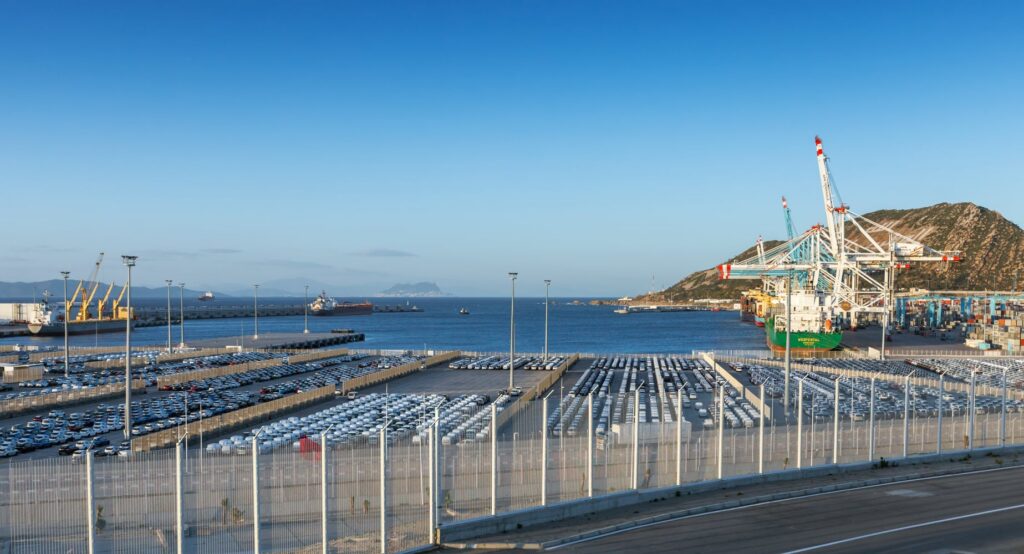
But the contemporary city also looks to the future. A few kilometers from the historic medina stands Tangier Med, the main container port in Africa and one of the largest logistical platforms in the Mediterranean. From the nearby Cabo Espartel, where the Atlantic and the Mediterranean converge, it is easy to understand the geopolitical and commercial significance of this enclave situated between two continents.
However, Tangier cannot be explained solely through economics or strategy. Its medina, the Kasbah, and the lively Grand Souk retain the cosmopolitan character that has defined the city for generations. The legendary Café Hafa, open since 1921 on the cliffs overlooking the Strait, remains one of the most evocative places to contemplate the profile of the Spanish coast. Nearby, Cabo Espartel and the Caves of Hercules, wrapped in legends and mythology, complete some of the most emblematic visits in northern Morocco.
From the Andalusian heritage to the intellectual heart of the Maghreb
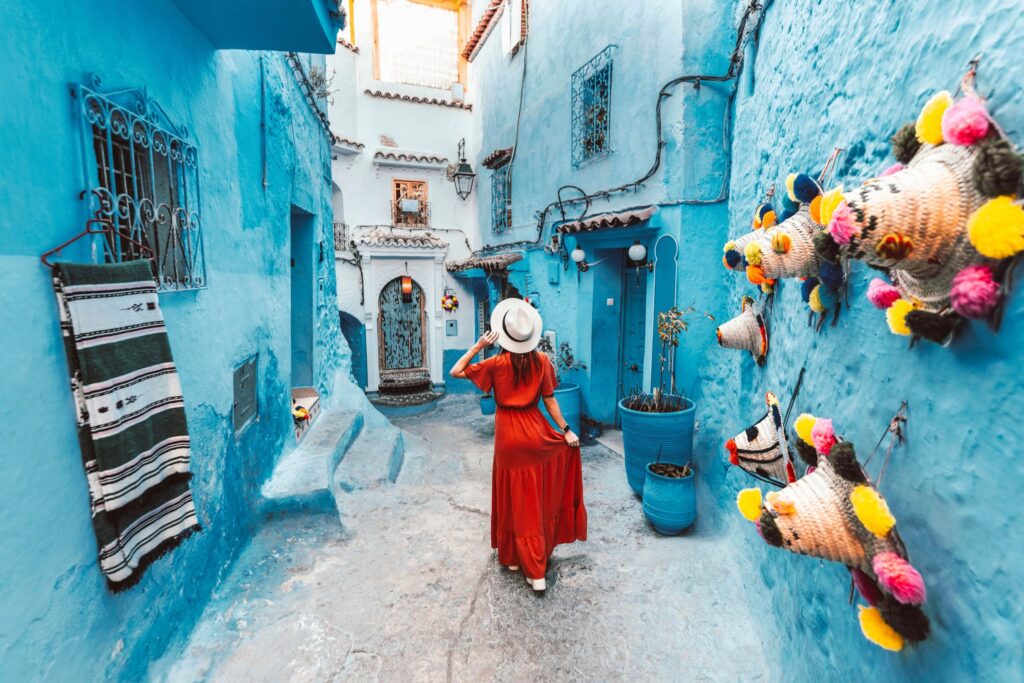
As one ventures into the Rif mountains, Chefchaouen emerges, the famous blue city founded in the 15th century and linked to the Muslim and Jewish communities that arrived from the Iberian Peninsula after the fall of Granada. The Andalusian footprint is still present in its streets and coexists with the deep Amazigh legacy, one of the pillars of Moroccan cultural identity.
Further south lies Fez. The city is divided into three well-defined spaces: Fez el-Jdid, which houses the historic Mellah; the New City, born during the French protectorate and dotted with cafes and wide avenues; and Fez el-Bali, the medieval medina, declared a World Heritage Site by UNESCO, which constitutes the soul of the city, protected by a walled enclosure of more than 15 kilometers in length and home to the University of Al Qarawiyyin, founded in 859 by Fatima al-Fihri and considered one of the oldest continuously operating higher education institutions in the world. Crossing Bab Bou Jeloud, the famous Blue Gate that gives access to the medina, means entering one of the best-preserved urban spaces in the Islamic world.
Rabat and Casablanca: the two faces of modern Morocco
If one wants to understand contemporary Morocco, it is essential to stop in Rabat and Casablanca. The former represents the institutional stability of the Kingdom and houses the main centers of political and diplomatic decision-making. The latter embodies economic and financial dynamism, concentrating much of the country’s business activity.

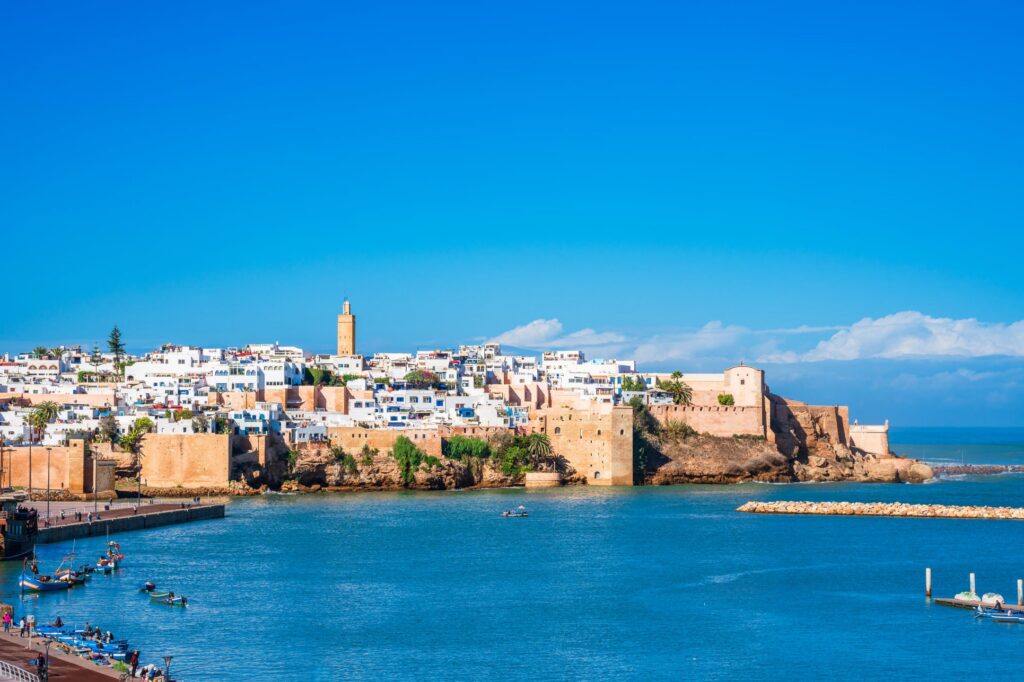
Rabat combines historical monuments such as the Hassan Tower, the Mausoleum of Mohamed V, or the Kasbah of the Udayas with wide avenues, trams, and modern administrative neighborhoods.
Casablanca, on the other hand, is the headquarters of Casablanca Finance City, one of the main financial platforms in Africa for companies and international investors. Its great icon is the Hassan II Mosque, partially built over the Atlantic and considered one of the most impressive works of contemporary Islamic architecture.
But Casablanca also retains a dimension linked to popular imagination. The city inevitably evokes the cinematic myth that immortalized it in Hollywood. Although the famous Rick’s Café of Humphrey Bogart and Ingrid Bergman was a film set, the real replica erected in the coastal medina today attracts diplomats, travelers, and cinephiles from all over the globe, synthesizing that fusion between romantic imagination and real cosmopolitanism that defines the Atlantic metropolis.
From Roman legacy to the Sahara
Near Meknes, the Roman ruins of Volubilis remind us that Morocco has been part of Mediterranean history for over two thousand years.

Further south emerges Marrakech, an ancient crossroads of trans-Saharan trade routes and one of the most emblematic cities in the country. Its Jemaa el-Fna square, with storytellers, musicians, and artisans, continues to be one of the most recognizable cultural symbols of the Kingdom.
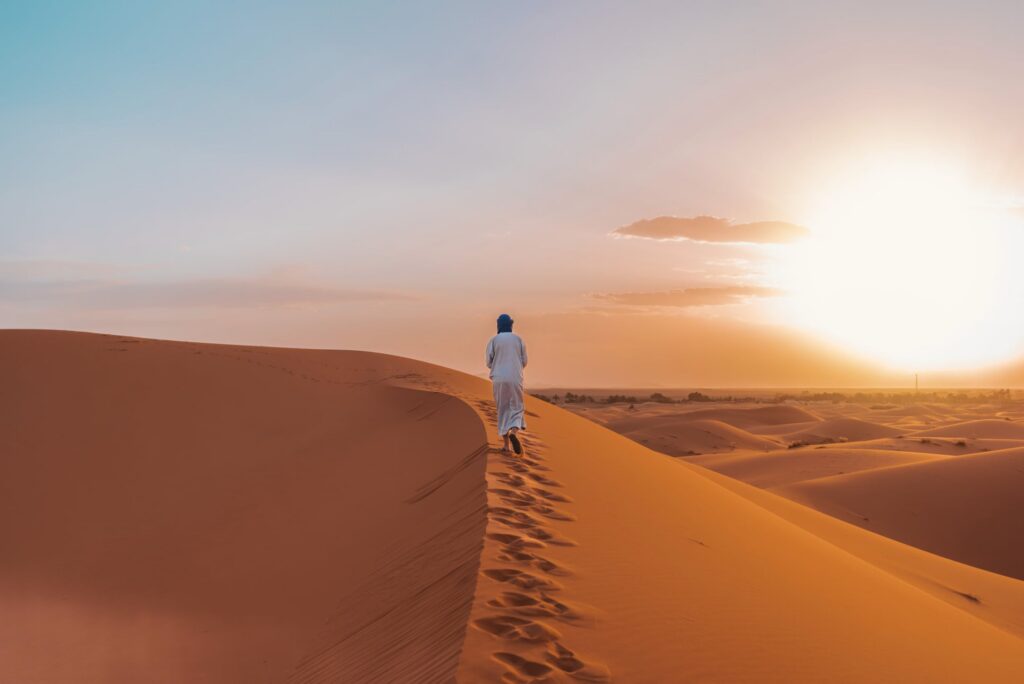
After crossing the Atlas, Aït Ben Haddou and Ouarzazate appear, historically linked to caravan routes and now turned into references of the African film industry. Beyond, the dunes of Merzouga announce the arrival at the Sahara, one of the most fascinating landscapes in North Africa.
Essaouira and the Atlantic horizon
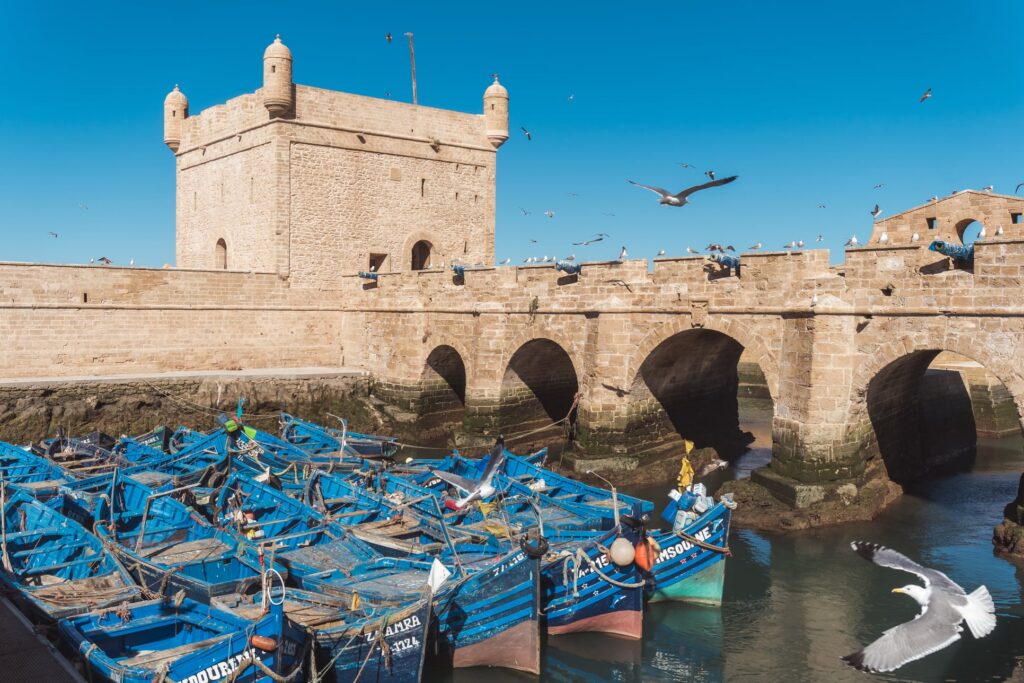
The route can conclude in Essaouira, the ancient Mogador. For centuries it was an important port of exchange between Europe, Africa, and America, and still retains a unique personality marked by its maritime heritage, its walls, and its artistic atmosphere. Among the most attractive corners of the city are the Grains Square, the entrance to the Souk Jdid market; the Clock Tower, and the Moulay Hassan Square, one of the best places to stop and observe the slow rhythm of the city while enjoying a traditional mint tea.
Much more than a tourist destination
Reducing Morocco to a mere catalog of picturesque postcards would ignore a dynamic country that combines tradition, modernization, and industrialization. Infrastructures like Tangier Med, the Al Boraq train, or the Noor solar complex illustrate the ambition of a Kingdom that aspires to strengthen its role as a logistical, energy, and economic platform between Europe and Africa.
At the end of the journey, the traveler understands that the Mediterranean has never been a border, but a meeting space. Spain and Morocco share centuries of history, common challenges, and an intense economic and cultural exchange. Perhaps that is why traveling through the Alaouite Kingdom is also a way to better understand the neighbor with whom one shares a horizon from both shores of the Strait.