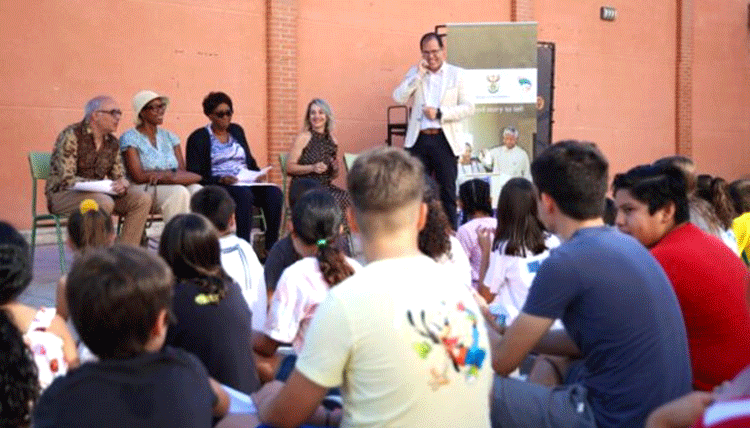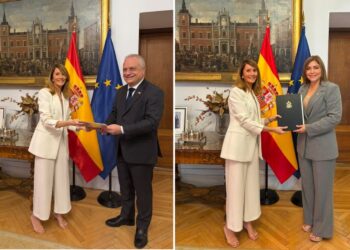
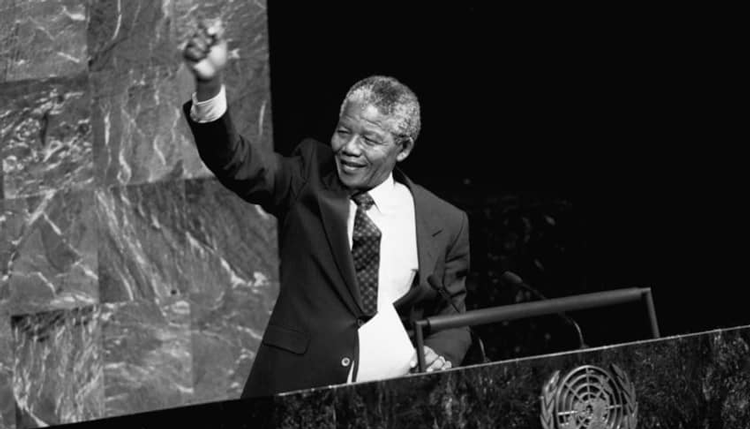
Under the slogan ‘It is still in our hands to combat poverty and inequality’, on July 17, the ambassador of South Africa, Sankie Mthembi-Mahanyele, celebrated International Nelson Mandela Day 2026 at the Garcilaso De la Vega College in the city of Toledo.
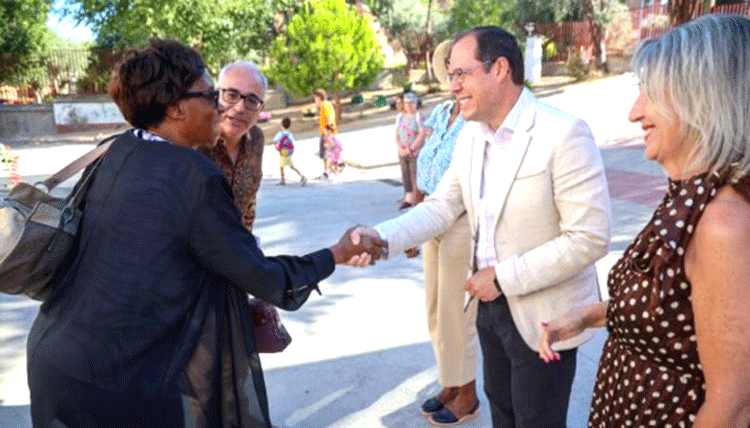
The event consisted of storytelling in collaboration with the City Council of Toledo, where the story of former South African president Nelson Mandela was told to school children in the city of Toledo aged between 7 and 12 years.
The South African ambassador was accompanied by the deputy mayor of Toledo, Inés Cañizares, and the councilor of Education, Daniel Morcillo; and narrated the story of Nelson Mandela’s life to two groups of school children, one of children aged between 10 and 12 years and another of children aged between 7 and 9 years. After the presentation by ambassador Sankie Mthembi-Mahanyele, the children enthusiastically responded to questions about the life of former president Mandela. At the same time, a large group of younger children, aged between 3 and 6 years, was invited to make colorful drawings representing Nelson Mandela and the South African flag.
The deputy mayor of Toledo expressed her gratitude to the ambassador for choosing Toledo to commemorate International Nelson Mandela Day, “a date so significant for humanity as a whole,” while the councilor of Education also thanked the Embassy for contributing to making President Nelson Mandela better known as “a global icon for all those who fight for justice and freedom in the world.”
On July 18, 2013, the Plenary of the City Council of Toledo approved a proposal to change the name of the street “July 18” in Toledo to “Nelson Mandela Street,” in homage to the former South African president’s struggle for justice and equality.
President Nelson Mandela (July 18, 1918 – December 5, 2013), addressing the scourge of poverty, suffering, and deprivation, said: “Education is the most powerful weapon which you can use to change the world.”
After being imprisoned for 27 years (1962-1989) on charges of conspiracy to overthrow the government and sentenced to life imprisonment, numerous international campaigns advocating for his release followed, and he was released in 1990 amid social upheaval in South Africa. Nelson Mandela presided over the government of his country from 1994 to 1999, dedicating himself to dismantling the social and political structure inherited from apartheid through the combat of institutionalized racism, poverty, social inequality, and the promotion of social reconciliation.
After a drastic social work and in favor of equality in South Africa and a very influential work internationally in various political conflicts, after retiring from public life, he dedicated himself to charity work and combating the AIDS pandemic through the Mandela Foundation.
Former president Mandela meant for Africa emancipation and dignity, as the highest exponent of the struggle against colonialism and institutionalized racism of apartheid. Likewise, he represented continental pride by raising the voice and historical relevance of African and Afro-descendant peoples on the global stage. And he demonstrated that a continent wounded by artificial divisions and systemic violence could self-govern under the principles of democracy and social justice.
“No one is born hating another person because of the color of their skin, their background, or their religion. People learn to hate. They can also be taught to love. Love comes more naturally to the human heart than its opposite,” emphasized the former South African president on one occasion.
South Africa changed radically under his presidential mandate. Not only did he end the racism of apartheid (which was allowed by everyone for economic reasons and then condemned by those who looked the other way knowing what was happening). His social reforms in favor of citizenship, in general, without distinctions of race or color were reflected, for example, in his social protection policy, which increased by 13% in the 1996/97 period and was maintained in 1997/98, although it was reduced by 7% in 1998/99. At the same time, the government implemented equal benefits for communities, which included people with disabilities, child maintenance, and pensions for the elderly, which had been granted based on racial groups before his administration.
“A nation should not be judged by how it treats its citizens of higher position, but by how it treats those who have little or nothing,” Mandela pointed out.
For the world, Mandela represented, and still does today, a symbol of human rights, a universal icon of peace awarded the Nobel Peace Prize in 1993, comparable to the greatest pacifist figures in history.
Forgiveness as a political tool and his ability to bridge with his former tormentors and avoid a racial civil war in South Africa established a new ethical standard for conflict resolution. For all this, the United Nations (UN) instituted his birthday, July 18, as International Nelson Mandela Day to remind that every individual has the duty to transform the world.
“The eradication of poverty is not a gesture of charity,” he asserted. “It is an act of justice. It is the protection of a fundamental human right, the right to dignity and a decent life. As long as poverty persists, there will be no true freedom.”
After 27 years of unjust imprisonment, his figure taught that personal and collective freedom cannot be bargained or sold in exchange for political concessions. His vision transcended resentment; he understood that the oppressor is also imprisoned by hatred and that liberating the oppressed ultimately means restoring humanity to the oppressor.
In 2015, two years after his passing, the UN Crime Prevention and Criminal Justice Commission adopted the Mandela Rules, an essential review of international standards on the treatment of prisoners. These rules, which reinforce the protection of human rights in prisons, include the absolute prohibition of torture and abuse, as well as restrictions on isolation and cruel treatment.