


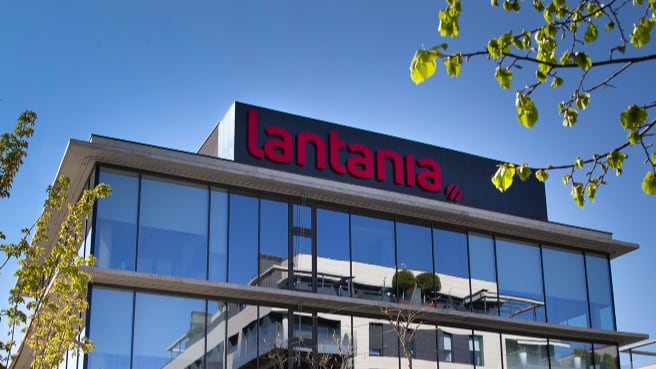
Lantania has entered a new phase of growth with its sights set on the international water market. The Spanish infrastructure, energy, and water group, founded in 2018 by Federico Ávila and José Luis Romero after the disappearance of Isolux Corsán, aims to exceed 1.1 billion euros in revenue by 2030, more than double the projected income for the end of 2026.
The company also expects to raise its gross operating profit, EBITDA, to 75 million euros, within a strategy focused on gaining scale, improving margins, and strengthening its position in higher value-added activities.
In just a few years, Lantania has developed activities in areas such as railway infrastructure, renewable energies, construction, and the integral water cycle. The group has a presence in 17 countries and a project portfolio that exceeds 1 billion euros, in a trajectory marked by diversification and internationalization.
Federico Ávila, current president of Lantania, has been one of the key figures in the construction of the group. A Telecommunications engineer, with business training and an EMBA from IESE, he developed part of his career at Isolux Corsán, where he held responsibilities in North America and later corporate positions in Madrid. After the group’s bankruptcy, he led a buyout operation by the management team that resulted in the creation of Lantania. Alongside him, José Luis Romero participated in the launch of the business project and has played a significant role in its development from the early years, bringing the technical and management experience accumulated during his career in the infrastructure sector.
One of the main levers of the new strategic plan will be the alliance with NMDC Group, one of the major engineering and infrastructure groups in the United Arab Emirates. The operation, formalized in January of this year, involved NMDC acquiring 51% of Lantania Aguas, while the Spanish group retains the remaining 49%. From this alliance, Lantania NMDC Water was born, a new company specialized in desalination, purification, reuse, and treatment of water, based in Seville and with a regional office in Abu Dhabi.
The first results of the alliance have already begun to materialize. Among them, the award, in May 2026, of a desalination plant in Fujairah, one of the seven emirates of the United Arab Emirates. The contract, awarded by Emirates Utilities Development Company, the project development and investment division of Etihad Water and Electricity, has an approximate value of 1.046 billion dirhams, about 260 million euros. The facility will produce around 272,000 cubic meters of desalinated water daily through reverse osmosis and will be located within the Port of Fujairah, in the Gulf of Oman, with an approximate area of 10 hectares and storage capacity equivalent to 18 hours of production.
Lantania will provide the engineering for the project and the main process equipment, while NMDC will take on the civil and marine works. The operation will be executed under the EPC modality, a model that integrates design, supply, and construction, and will strengthen the water supply to homes, businesses, and industries in Fujairah and the areas served by Etihad Water and Electricity, especially during periods of higher demand.
The Middle East and North Africa are among the regions with the highest water stress in the world. The World Bank has warned that, before the end of this decade, the annual availability of water per capita in the region may fall below the absolute scarcity threshold, set at 500 cubic meters per person per year. The same institution estimates that by 2050, an additional 25 billion cubic meters of water per year will be needed to meet regional needs, a figure equivalent to building 65 desalination plants the size of Ras Al Khair in Saudi Arabia, one of the largest in the world.
The company expects that its water activity will multiply its business volume by more than four times over the next few years, from about 145 million euros to around 600 million by 2030. This business is thus shaping up to be one of the main growth engines of the group over the next decade.
Eight years after its creation, Lantania is trying to position itself at a new business scale. The alliance with NMDC, the award in Fujairah, and the growing demand for water infrastructure in the Middle East provide the company with a platform to accelerate its internationalization. The challenge will be to convert that growth into sustained profitability, maintain its own technical capacity, and compete in a market where desalination, reuse, and treatment of water are experiencing increasing demand driven by the supply needs of numerous countries.