


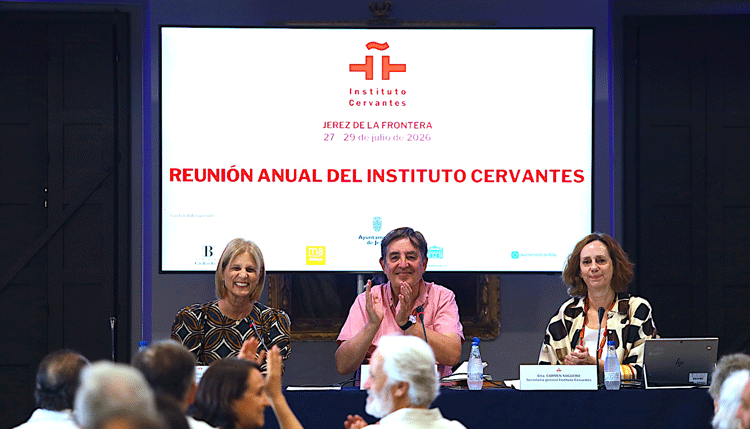
The Cádiz town of Jerez de la Frontera hosted the Annual Meeting of the Instituto Cervantes from July 27 to 29, a strategic meeting that brought together nearly a hundred executives, including the attendance of Queen Letizia, to define the future of the Spanish language in the international landscape.
The presence of the Crown at this forum reinforces the weight of Spanish in the international arena. Nearly 600 million Spanish speakers make the language an unparalleled vector of influence. The meeting addressed the urgent need to adapt the institution to new times, where digitalization and competition set the agenda for debate.
Luis García Montero, director of the Institute, summarized it clearly: “The language is Spain’s greatest intangible asset.” He also recalled that these meetings are part of “an institutional commitment in which everything is transversal” and, therefore, the relationship between the headquarters and the centers is “decisive.” Additionally, he defended the “commitment to external action while maintaining independence” as an institution.
The official inauguration was attended by the Secretary of State for International Cooperation, Eva Granados, as well as the director of the Instituto Cervantes, Luis García Montero, and the mayor of Jerez, María José García-Pelayo.
During the two days of meetings, the Institute’s leaders analyzed the expansion of Spanish and discussed the current challenges in the European Union, the post-Brexit impact in the United Kingdom, and the dynamics on the African continent.
The directors’ panel delved into how to promote Spanish culture in over 100 cities across 56 countries. García Montero moderated this crucial space to set the priorities for the upcoming academic year.
The program included recognition of fundamental figures in Spanish literature. On Tuesday, July 28, the Caballero Bonald Foundation held a special colloquium for the centenary of José Manuel Caballero Bonald, featuring Luis García Montero, Martín López-Vega and Juan Bonilla. Additionally, on Wednesday, July 29, the Casa de Iberoamérica de Cádiz hosted a legacy delivery event at the Caja de las Letras, in tribute to Fernando Quiñones, an essential author of the New Andalusian Narrative and a key figure for the Hispanic-American boom.
The afternoon of Tuesday was also dedicated to the impact of Spanish in the U.S. market in the town of Rota, with a specialized round table discussion. Francisco Moreno, from the Global Spanish Observatory, and Francisco Javier Pueyo, from Harvard, presented data and challenges regarding Spanish in the U.S.
The Instituto Cervantes has been holding annual meetings since 2005 (except in 2020 due to the pandemic) with the directors of its centers abroad and all its management team, where they discuss their lines of action for the international promotion of the Spanish language and culture.
This was the first time it was held in Jerez. So far, twelve autonomous communities have hosted these sessions: Andalusia, Catalonia, Castilla y León, Castilla-La Mancha, Madrid, Cantabria, Extremadura, La Rioja, Galicia, Basque Country, Valencia Community, the Principality of Asturias, Catalonia, and the Canary Islands.