


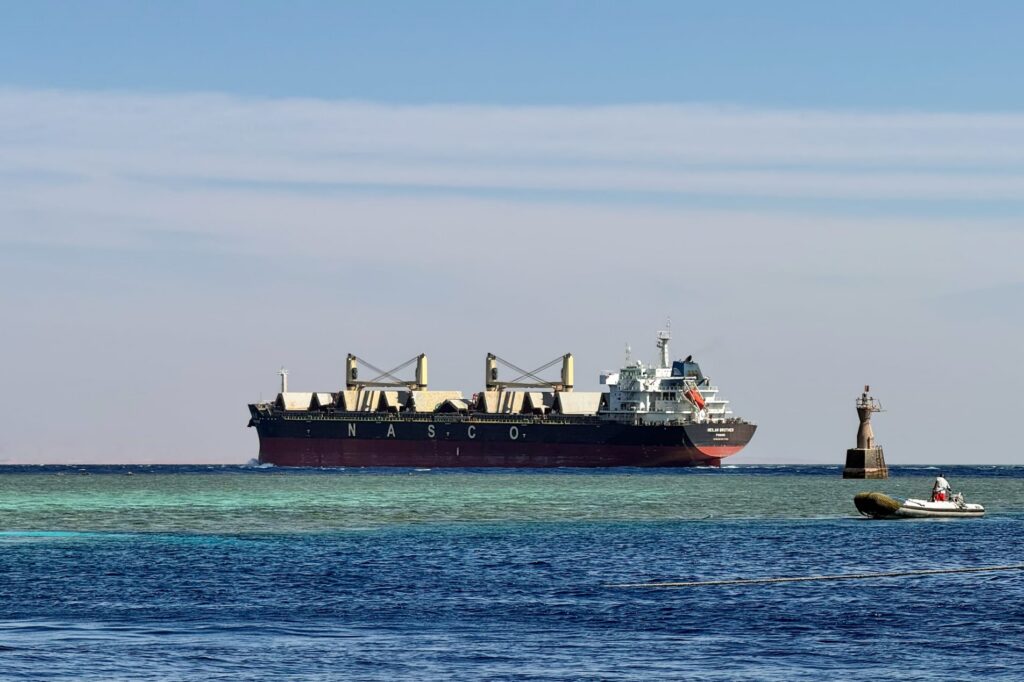
Essential southern gate to the Suez Canal, this passage of barely 30 kilometers wide connects Asia with Europe and depends on international naval presence to ensure navigation, whose volume continues to decline in the face of piracy and regional instability.
With a name whose meaning translates as “the gate of tears“, the Bab el-Mandeb Strait has historically been one of the most coveted and complex maritime routes in the world geography. Located between the Horn of Africa and the Arabian Peninsula, this enclave serves as the mandatory entry to the Red Sea for a significant part of the traffic from the Indian Ocean. Its value for the global economy is incalculable: over its waters transits more than 10% of the world’s maritime trade and millions of barrels of crude oil daily. Keeping this narrow passage open and free from threats is not only a matter of local security but an essential requirement to avoid the collapse of global supply chains.
The strategic value of Bab el-Mandeb cannot be understood without observing its position in the great maritime highway that connects Asia with the European continent. By linking the Gulf of Aden with the Red Sea, the strait constitutes the first major geographical funnel for ships heading towards the Suez Canal. If this passage is blocked or becomes unsafe, the alternative for merchants is to completely circumnavigate the African continent via the Cape of Good Hope, a detour that adds about 10 to 14 days of navigation, skyrockets fuel costs, and drastically increases freight and insurance rates worldwide.
For this reason, the waters of Bab el-Mandeb are the stage where commercial logistics and geopolitical tensions of the Middle East and East Africa intersect. Flanked by countries weakened by political instability or armed conflicts —such as Yemen, Djibouti, and Somalia—, the strait has historically been vulnerable to multiple asymmetric risks. The rise of Somali piracy in the early century, combined with attacks on cargo ships and oil tankers using drones, missiles, or unmanned vessels during times of regional crisis, has demonstrated the fragility of a corridor through which electronic products, raw materials, and energy resources that feed Europe flow.
In order to mitigate these risks and safeguard the principle of freedom of navigation enshrined in international law, the European Union deployed Operation Atalanta in 2008, the first maritime military operation in the history of the community bloc. Initially conceived as a direct response to the ongoing waves of hijackings of merchant vessels and World Food Program ships off the coast of the Horn of Africa, Atalanta has evolved into a fundamental pillar of the security architecture of the western Indian Ocean and the area surrounding Bab el-Mandeb.
The contribution of Operation Atalanta to the stability of this strategic artery has been decisive. Through the continued deployment of frigates, maritime action ships, and maritime patrol aircraft —with a prominent and constant participation of the Spanish Navy—, the European force conducts systematic patrols and provides armed escort to the most vulnerable ships. In addition to its primary deterrent mission against pirate groups, the operation combats the illicit trafficking of weapons and drugs that finances criminal and insurgent networks in the region, while gathering maritime intelligence to monitor the conditions of passage through the strait.
The EU’s work in Bab el-Mandeb highlights how diplomacy and defensive force must coordinate to sustain global trade. The international military presence not only protects the physical integrity of crews and cargo but also offers the predictability that financial markets and shipping companies require to maintain a steady flow of goods. In a hyper-dependent globalized world on maritime transport, initiatives like Operation Atalanta ensure that this strait continues to be a safe passage for the global economy.