
On this day, August 12, but in 1949, the Geneva Conventions were approved, four international conventions ratified today by almost all countries in the world (196), which regulate international humanitarian law aimed at protecting victims of armed conflicts.
The Geneva Conventions and their Additional Protocols are international treaties that contain the main rules aimed at limiting the barbarity of war. They protect people who do not participate in hostilities (civilians, medical personnel, members of humanitarian organizations) and those who can no longer participate in combat (wounded, sick, shipwrecked, and prisoners of war), transitioning from the category of combatants to victims of the conflict as well.
85 years before that August 12, 1949, in 1864, also during the month of August, the diplomatic conference held in Geneva (Switzerland) led by Henry Dunant, founder of the Red Cross, and convened by Switzerland, concluded, in which 12 countries signed a document committing to shelter and protect wounded soldiers, as well as the people and equipment dedicated to their care in a military conflict. That first treaty is known as the First Geneva Convention –followed by a Second and Third Convention in 1906 and 1929, respectively–. That First Convention of 1864 paved the way for an unprecedented normative work.
The arrival of the 20th century brought advances in numerous fields, but as society evolved, so did wars, which in the first half of the last century took on a global character. The II World War marks a before and after in a key aspect: it is estimated that around 65% of the victims were civilians. It was urgent to review the existing protection frameworks during conflicts.

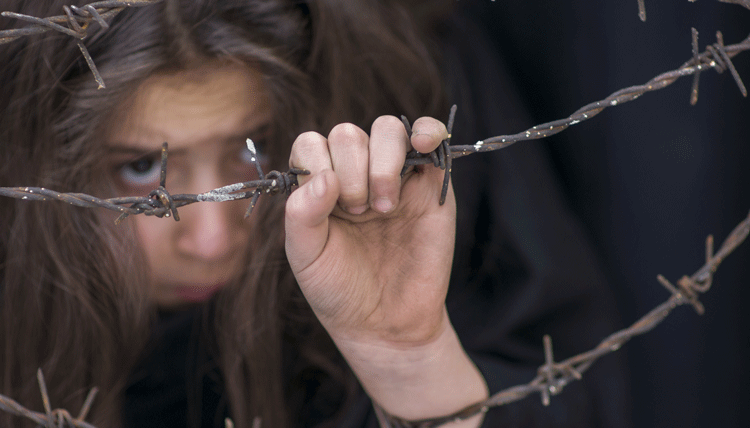
The Four Geneva Conventions
Before 1949, there were three Geneva Conventions. While all three provided extensive protection coverage, they did so exclusively regarding military victims, as they were, until almost the first half of the 20th century, the most frequent and numerous in armed conflicts.
In 1949, after World War II and with the fundamental impetus of the International Committee of the Red Cross, a series of conferences were held whose result was the updating of the first three Conventions and the approval of a fourth Convention, specifically aimed at protecting civilians in armed conflicts. They were signed on August 12, 77 years ago today.
– The First Geneva Convention: “to alleviate the fate of wounded and sick members of the armed forces in the field” was the fourth update of the original 1864 convention and replaced the 1929 convention on the same topic.
– The Second Geneva Convention: “to alleviate the fate of the wounded, sick, and shipwrecked of the armed forces at sea” replaced the Hague Convention (X) of 1907. It was the first Geneva Convention on the protection of victims of maritime warfare and imitated the structure and provisions of the First Geneva Convention.
– The Third Geneva Convention: “relative to the treatment of prisoners of war,” replaced the Geneva Convention of 1929 that dealt with prisoners of war.
– The Fourth Geneva Convention: “relative to the protection of civilian persons in time of war,” was the first Geneva Convention that did not deal with combatants, but rather had as its fundamental objective the protection of civilian persons.
The four Conventions have been universally ratified, that is, by practically all States that make up the International Community: 196.
This universal level of ratifications makes them Customary Law, which means that these norms bind universally, not only States but also non-state armed groups.
The Geneva Conventions constitute the basis of international humanitarian law (IHL), which protects people who do not participate or have ceased to participate in hostilities. IHL also regulates the conduct of armed conflicts by limiting the methods and means of warfare in order to preserve a certain degree of humanity in conflicts, save lives, and reduce suffering. According to the Geneva Conventions –and IHL in general–, the rights of all persons affected by armed conflicts must be protected and all persons, even enemies, must be considered in their dimension as human beings.
Although, historically, there were norms regarding how to protect affected persons during conflicts, the Geneva Conventions complement and strengthen previous legal traditions, becoming a common heritage of humanity and a first-order tool to protect, in times of war, the victims of armed conflicts.