


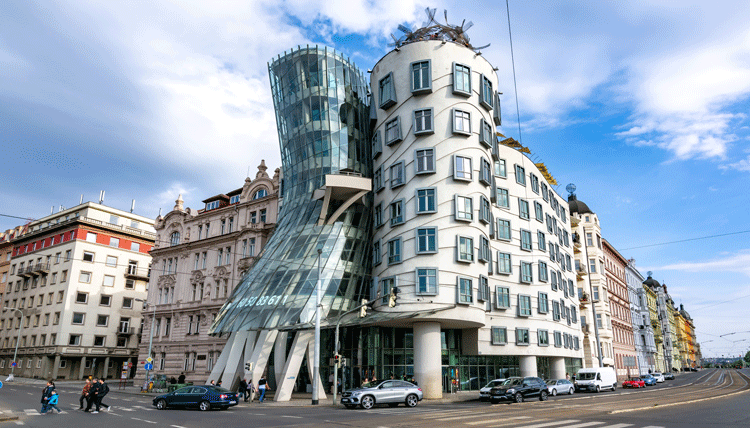
When the doors of the Dancing House opened on June 20, 1996, few expected that this bold new construction would become one of the most famous buildings in the Czech Republic. Today, thirty years later, it is part of the symbols of modern Prague as indispensable as its historical monuments.
In deconstructivist style, the Dancing House, known in Czech as Tančící dům, is composed of two intertwined buildings: the first is a glass tower that narrows in the middle; the second is easily recognizable by its misaligned windows and curved shapes, which contrast with the adjacent houses.
For three decades now, the Dancing House has been one of the most emblematic symbols of modern architecture in Prague. The building, designed by architects Vlado Milunić and Frank Gehry, was built on an abandoned lot after the war and, over the years, went from being a controversial project that divided public opinion to becoming an architectural icon and a very popular cultural space.
The Dancing House stands on a lot that remained undeveloped for many decades. The original residential building was destroyed during the bombing of Prague in 1945, and the corner lot remained empty for a long time. It was not until after 1989 that the opportunity arose to create something new there: a construction that reflected the transformation of both society and the city.
It was then that the idea of a house that was not just a filler for the empty space, but an architectural gesture of a new era, emerged.
The initial idea came from Milunić, who discussed the appearance of the building also with Václav Havel -who at the time lived in the neighborhood and supported the idea of a building of great cultural relevance-. Subsequently, Gehry, who was already a respected figure in the world of architecture, was invited to participate in the project.
The result was a building formed by two main towers: one conveys solidity and stability, while the other is dynamic and seems to ‘undulate’ at first glance. This is precisely where the nickname ‘The Dancing House’ comes from. Abroad, the building is also often referred to as ‘Fred and Ginger’, in reference to the dancing couple Fred Astaire and Ginger Rogers.
In the 1990s, the building sparked heated debates. Detractors argued that its modern shape altered the historical landscape of Prague. In contrast, its supporters claimed that the city needed contemporary architecture that did not merely copy the past.
However, over time, public opinion has changed. Today, the Dancing House is one of the most photographed buildings in Prague and is often cited as an example of a successful combination of modern architecture and the historical environment.
Nowadays, visitors can find in it a hotel, dining venues, a gallery, an observation deck, and offices. The building regularly hosts cultural events, exhibitions, and social gatherings. Additionally, the 30th anniversary is accompanied by a special exhibition dedicated to the history of the building and previously unpublished archival material.
There is still much ‘dancing’ to be done along the Moldova River for this iconic emblem of the precious Czech capital, Prague, a city declared a UNESCO World Heritage Site.