
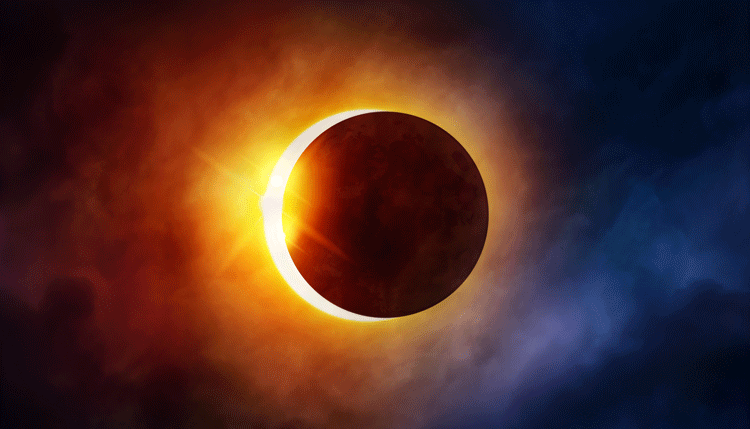
Tomorrow, August 12, around 19:46 h and until 21:25 h, Spain will once again be under the shadow of a total solar eclipse, with a maximum duration of totality of 2 minutes and 18 seconds. This phenomenon has not been observed in the country since 1912.
Beyond the astronomical spectacle, the event invites us to remember that these phenomena have influenced wars, negotiations, and political decisions throughout history. Today we know exactly why an eclipse occurs, but for centuries, no one could explain it. And that difference changed the course of events.
The sky as a tool of power
In the 6th century BC, the Medes and Lydians had already been embroiled in a bloody war for six years when, in the midst of battle, the light of day was completely extinguished. That sudden darkness —which the historian Herodotus would transform into legend— forced both sides to lay down their arms and sit down to negotiate. Beyond the historical accuracy of the account, the Battle of the Eclipse remains a powerful metaphor about the influence that eclipses exerted for centuries over politics and diplomacy.
If an eclipse could stop a war, could it also become a negotiation tool? One of the most well-known episodes featured Christopher Columbus during his fourth voyage to America. In late 1503, after being stranded in Jamaica, Columbus depended on the goodwill of the natives to feed his crew. However, as months passed, the relationship deteriorated and supplies began to dwindle.
However, Columbus had a decisive advantage: an astronomical almanac prepared by Abraham Zacuto, which included predictions of eclipses. And that changed everything. Thanks to that knowledge, he knew that a lunar eclipse visible from Jamaica was approaching and took advantage of the circumstance to communicate to the leaders that God was angry with them and would send them a visible sign in the sky.
When the Moon appeared tinted red during the lunar eclipse of February 29, 1504, the island’s inhabitants were impressed. According to later accounts, they resumed providing provisions to the expedition and requested Columbus’s intervention to appease the supposed divine wrath. Shortly before the end of the eclipse, the navigator announced that God had forgiven them and the Moon gradually regained its usual appearance.
Between superstition and knowledge
While the common people saw eclipses as divine punishments or bad omens, early astronomers began to decipher their mathematical patterns. In Greece, Thales of Miletus is remembered for predicting a solar eclipse —most likely the one from the aforementioned Battle of the Eclipse, which would have taken place on May 28, 585 BC—, while Hipparchus developed mathematical methods to calculate these events with remarkable precision. In ancient India, advances in trigonometry allowed for improved calculations of shadows and celestial movements.
However, even as knowledge advanced, mythical interpretations continued to hold enormous social and political weight. The Mayans, for example, achieved an extraordinary ability to predict eclipses, comparable to that of the Babylonians. Everything points to the Mayans interpreting eclipses as moments of special tension within their worldview. The Aztecs also considered eclipses a threat to the balance of the world.
In medieval Europe, while an enlightened minority preserved the astronomical knowledge inherited from antiquity, much of the population viewed eclipses as omens of wars, famines, or divine punishments.
Over the centuries, eclipses ceased to be instruments of fear and became scientific discoveries. Observations made during these phenomena have contributed to significant advances such as the confirmation of the General Theory of Relativity (the solar eclipse of 1919 allowed scientists to observe that the gravitational field of the Sun bends the light of stars, a key prediction of Einstein’s theory) or the identification of elements present in the solar corona.
When Spain darkens for a few minutes on August 12, no one will interpret the phenomenon as a divine sign. But to understand why our ancestors did, it will be enough to look up at the sky.
The Ministry of the Interior, led by Minister Fernando Grande-Marlaska, has issued some guidelines for the “curious” who will travel, which we reported in Diplomacy News last Sunday at this link.