The Israeli chargé d’affaires warns that Spanish citizens will be the ones to suffer the diplomatic crisis between both countries
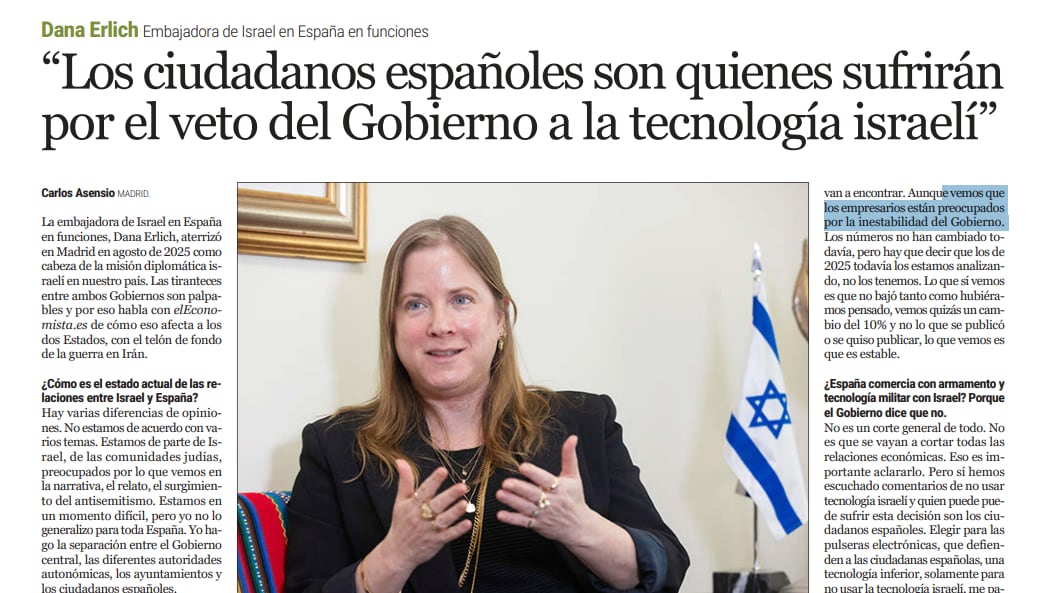
The Israeli chargé d’affaires in Spain, Dana Erlich, made headlines yesterday for two reasons. On one hand, the Ministry of Foreign Affairs summoned her to convey the Government’s protest for having prevented the Latin patriarch from accessing the Holy Sepulchre. On the other hand, due to her statements to the newspaper ‘El Economista’, in which she claims that “we see that businesspeople are concerned about the instability of the Government”.
In the interview, the Israeli diplomat downplays the economic consequences of the diplomatic clash that began during the war in Gaza. “What we see at fairs and in conversations we have with the business world here in Spain is that interest exists,” she assures.
Regarding the fact that Israeli investment in Spain has decreased by more than 90 percent in 2025, and although she acknowledges that she still does not have all the data —”we are still analyzing it”—, she assures that “it did not drop as much as we would have thought, we see perhaps a change of 10% and not the change that was published or wanted to be published, but what we see is that it is stable.”
Moreover, she emphasizes that despite the diplomatic crisis, economic exchanges were not completely cut off, as the Spanish Government claimed. But she warns that “those who suffer or may suffer this decision are the Spanish citizens” and cites as a “worrying” example the replacement of electronic bracelets for abused women of Israeli manufacture with others of inferior technology.
Erlich insists several times during the interview that “there is a lot of potential to expand those economic relations, because now a large part of Spain’s economy is based on low-tech, that is, tourism, agriculture… while in Israel and most international markets we focus on high-tech services.”
Regarding the summons from the Spanish Ministry of Foreign Affairs, it came after the Israeli Government approved a special authorization for the patriarch of Jerusalem, Pierbattista Pizzaballa. However, Erlich listened to the official protest from the Government whose reason, as Minister José Manuel Albares pointed out, was to “indicate that this cannot happen again, that Catholic worship must be able to be celebrated normally, as it has historically always been celebrated.”