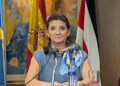
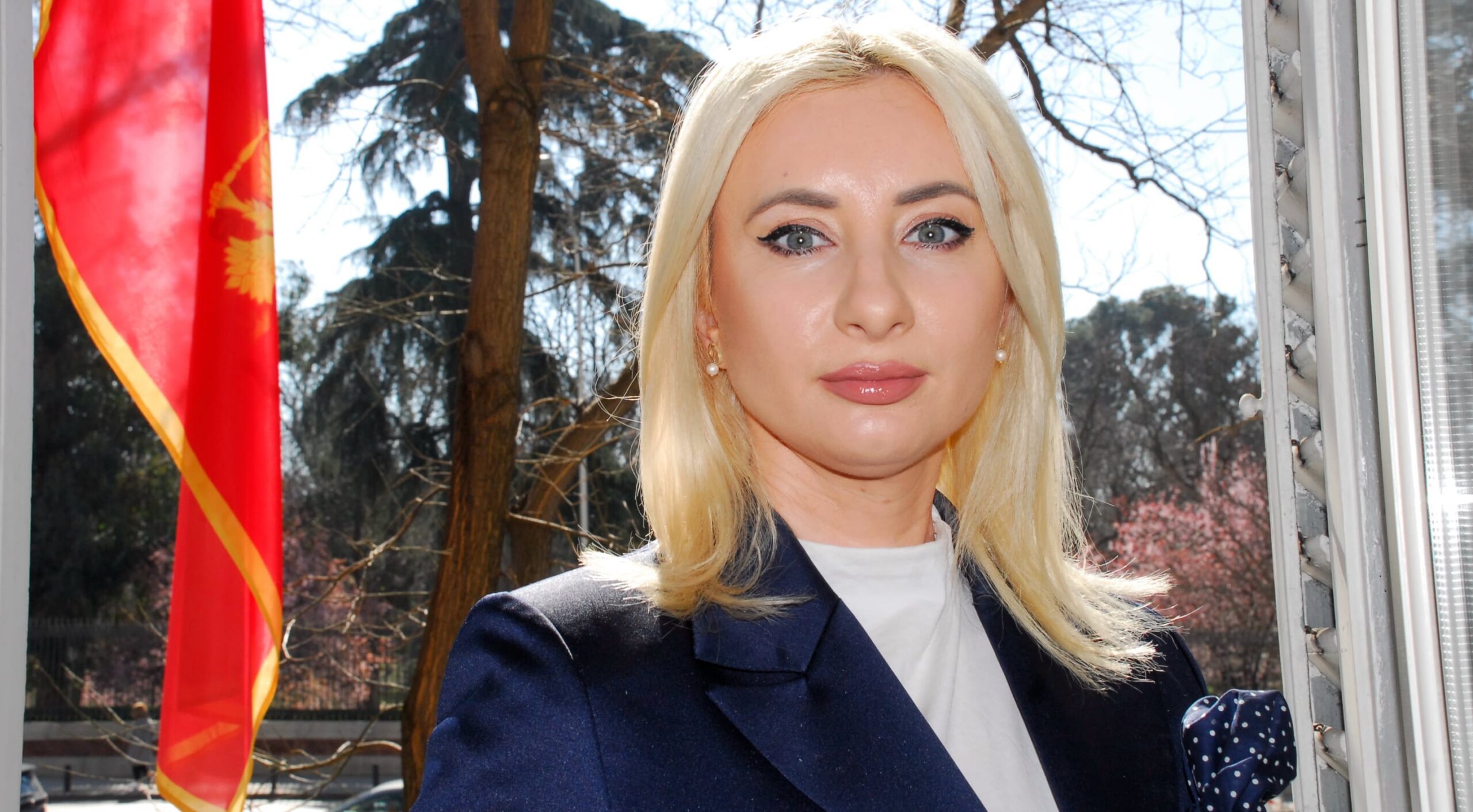
The Minister of European Affairs, Maida Gorcevic, is confident that her government will close negotiations with Brussels throughout 2027
She warns —when asked about the danger of Russia maintaining its influence over its former ‘backyard’— that while candidates for EU membership remain in the pre-accession phase, “they will be very vulnerable to malicious foreign influences.” The Montenegrin Minister of European Affairs, Maida Gorcevic, who visited Madrid last week, asserts without a doubt that her government “maintains a firm commitment to the goal set when taking office: EU membership in 2028.”
Will they be able to close the 20 chapters that remain to be negotiated throughout 2027?
We have closed a significantly larger number of chapters than in the first twelve years (2012-2023) of negotiations, we have obtained the IBAR, we have joined the SEPA payment area, and we have received confirmation that the drafting of the Accession Treaty is as secure as it is imminent. Montenegro is the candidate country that has made the most progress and has earned its place in the European Union.
Perhaps our plan for social, economic, and political reforms was not convincing to many at the beginning of this Government’s term. However, we have demonstrated that commitment and hard work lead to surprisingly significant results. Many of the twenty open chapters already present a sufficient degree of preparation. We believe they are ready for closure and await confirmation from the EU. The process is progressing according to the planned schedule. I do not foresee delays. Never before have so many people and institutions committed to the European path in Montenegro. I have great confidence that we will conclude negotiations in 2027.
The chapters related to the Green Agenda and Fundamental Rights are the least advanced. Which chapters are specifically proving to be more complicated?
The chapters in the Fundamental Rights group have always been the most demanding for any country in the accession process. Therefore, at the initiative of President Macron, a new methodology was introduced to group them into thematic blocks and ensure that this block is closed last, thus recognizing the importance of the rule of law, judicial independence, as well as civil liberties and media freedoms.
The most recent report from the European Commission indicates progress in these areas over the past year. Montenegro is the only candidate country in the entire history of the accession process that has received a Provisional Benchmark Assessment Report (IBAR) for chapters 23 and 24, which relate to the rule of law and the fight against corruption and organized crime.
Environmental chapters have historically required candidates to make significantly greater financial commitments than could be sustained without putting severe pressure on public finances. Therefore, transitional agreements can facilitate the accession process. And we anticipate that they will be applied in the case of Montenegro, whose progress is unequivocal.
The majority of the Montenegrin population supports EU membership, but there is still a part, perhaps small, that identifies as pro-Russian. Could this be a problem?
Not at all. Montenegro is one of the few countries, both candidates and EU members, that does not have any Eurosceptic party in Parliament. There is a strong consensus between the opposition and the ruling majority in passing the necessary legislation to close the negotiation chapters with the EU. European integration, therefore, is a goal that encompasses the entire society. It is not just a government or party agenda.
Could Montenegro at some point become a new Hungary within the EU?
I do not consider the comparisons between Montenegro and Hungary to be well-founded. Our historical trajectories, geostrategic characteristics, and cultural influences are very different.
The little skepticism that exists in Montenegro regarding EU membership, which is not significant, is better understood as a reflection of a particular relationship with certain periods of history, when Montenegro was on the margins of the Western values system; I do not believe it should be interpreted as a pro-Russian sentiment or as a permanent category.
Do you think that the Balkan countries should join the EU as a block?
We want to see all of the Western Balkans in the EU, but when they meet the economic and political criteria. We believe in the principle of ‘regatta’, meaning that each country accesses EU membership once the required criteria are met, which must be evaluated on a meritocratic basis, not through a political lens or based on bilateral relations. The true assimilation of European standards is the only path that truly benefits the citizens of candidate countries, as well as the internal stability of the Union itself.
Do you think Kosovo could join the EU at some point?
Kosovo, like all the countries of the Balkans, can one day become a member of the EU, as long as its citizens and politicians commit to implementing reforms and advancing democratization. In any case, Montenegro supports the dialogue between Serbia and Kosovo, hoping it will lead to regional stability and a European perspective for both countries.
How do you view the conflicts shaking the global economy from Montenegro?
I am deeply concerned that the awareness of the importance of peace seems to be fading on a global scale. This carries risks and makes the future unpredictable. The deterioration of global security is diverting attention from the goals of democratization, consolidation of human rights, freedoms, free trade, and cooperation towards issues of armament and self-sufficiency. It is not a positive trajectory. In relation to recent conflicts, Montenegro aligns its efforts with those of our NATO partners, aimed at de-escalation, dialogue, and long-term stability.