Diplomacy News
es Español en English
16 de May, 2026
No Result
View All Result
  • Current Affairs
    • Business
    • Diplomacy
    • Geopolitics
  • In Depth
    • Interviews
    • Reports
    • Research
  • Life
    • Culture
    • Gastronomy
    • Tourism
  • Opinion
  • Confidential
  • Agenda
  • Who is Who
NEWSLETTER
Diplomacy News
NEWSLETTER
Diplomacy News
No Result
View All Result

Helium and invisible science geopolitics also pass through the Strait of Hormuz

This noble gas is used to cool particle accelerators and synchrotrons, in addition to being essential for the manufacturing of semiconductors and aerospace systems

Natalia Martorell by Natalia Martorell
13 de May de 2026
in Geopolitics, Reports
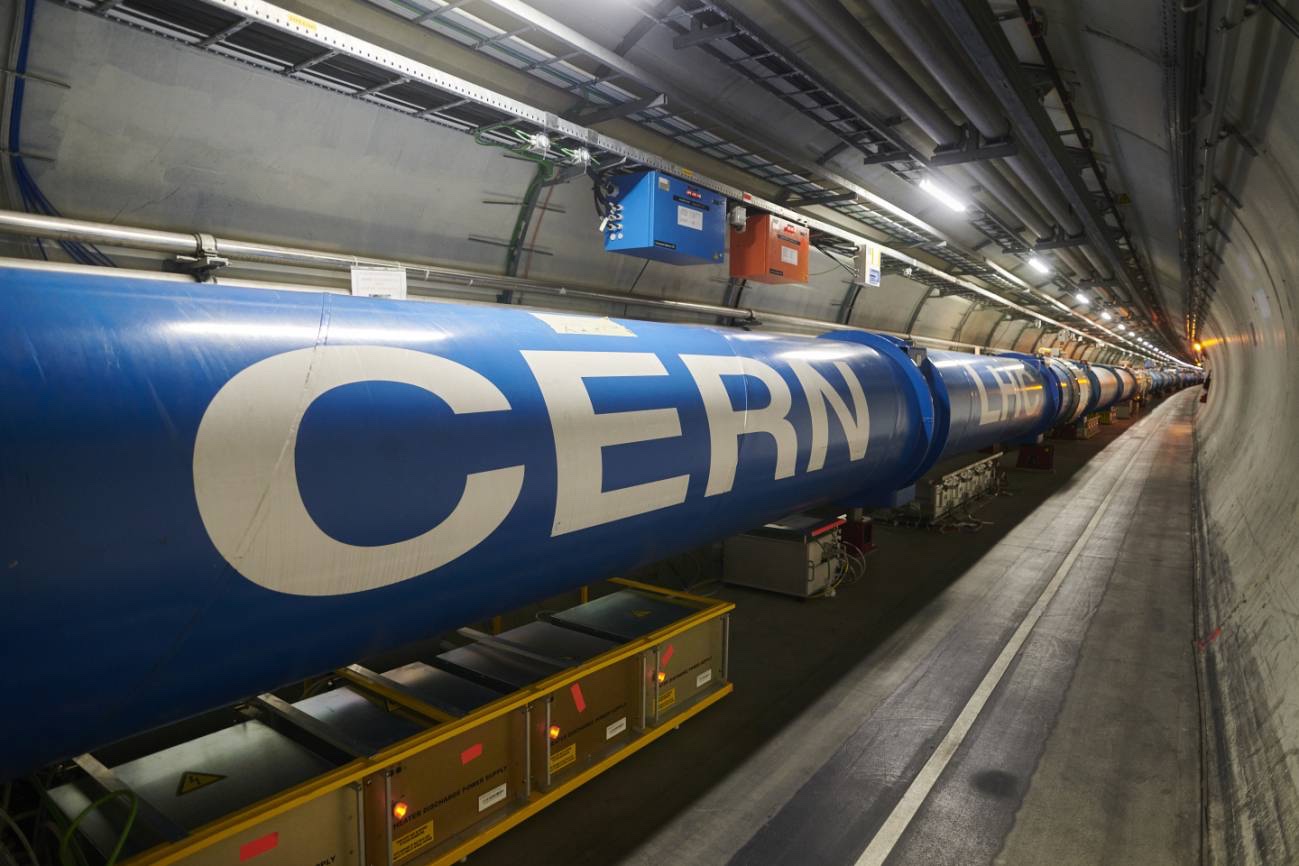
Tunnel of the Large Hadron Collider (LHC) at the European Organization for Nuclear Research (CERN) on the Franco-Swiss border./ Photo: CERN

Tunnel of the Large Hadron Collider (LHC) at the European Organization for Nuclear Research (CERN) on the Franco-Swiss border./ Photo: CERN

Beyond oil and gas, the Strait of Hormuz supports a less visible but critical part of the global economy. When the security of this strategic passage is compromised, the effects extend beyond energy markets, also exposing supply chains essential for the functioning of science, advanced technology industry, and health systems.

Through Hormuz transit derivative products and industrial gases that sustain highly specialized value chains. Among them, helium occupies a singular position. It is a noble gas, chemically inert and non-renewable, extremely light, whose value lies in its ability to liquefy at temperatures close to absolute zero —0 kelvin, equivalent to −273.15 °C—. This property makes it an essential resource for advanced cryogenics (the generation and maintenance of extremely low temperatures), where cooling levels that no other gas can provide stably are needed.

Helium is obtained almost entirely as a byproduct of natural gas. It must be separated and recovered during the gas treatment process itself, as if it is not extracted at the source, it disperses into the atmosphere and cannot be recovered later. With a significant portion of its production concentrated in Qatar, the transport of helium to international markets largely depends on maritime transit in the Gulf region.

This geographical concentration adds an additional complexity: helium is not easy to transport or store. To be used in its critical applications, it must be liquefied and maintained at extremely low temperatures, which requires specialized cryogenic infrastructures and high energy consumption. Its atomic size also facilitates leaks through micro-imperfections in materials, necessitating much more demanding containment systems than in other industrial gases. Additionally, its very low vaporization energy causes constant losses due to evaporation, even under controlled conditions, and limits storage capacity.

Despite these limitations, helium is difficult to replace in certain fields due to its exceptional properties. Its use is essential in large scientific and technological infrastructures that operate near absolute zero or require extremely stable operating conditions, such as particle accelerators, synchrotrons, or experimental fusion projects, where it is used to cool superconducting magnets. It is also indispensable in machines for performing magnetic resonance imaging, in critical stages of semiconductor manufacturing, as well as in certain aerospace systems. Although advances in efficiency and recovery have been made in recent years, these remain insufficient to replace helium in the short term.

In short, this combination of dependence and lack of quick alternatives makes the case of helium a particularly clear example of scientific diplomacy. Unlike other strategic resources, there is no specific international framework dedicated exclusively to its regulation. Its availability still depends on the production pace of natural gas and a few deposits, and cannot be quickly adjusted to the needs of hospitals, research centers, or advanced industry.

In practice, this forces continuous coordination of decisions among governments, regulators, large scientific infrastructures, health centers, and supplying companies, actors that rarely appear in public debate but are essential for critical infrastructures to continue functioning in contexts of increasing instability.


Sources: U.S. Geological Survey (USGS), reports Mineral Commodity Summaries: Helium (2025–2026); Centre for Materials and Resilience, Helium Supply and the Strait of Hormuz Crisis (2026); Chemical & Engineering News; manuals and technical literature in industrial cryogenics and applied physics.


Tags: destacadafeaturedHeliumScienceStrait of Hormuz
Natalia Martorell

Natalia Martorell

Related Posts

Bajo licencia https://creativecommons.org/licenses/by-sa/3.0/
In Depth

Spain in Central Asia: Tajikistan and Turkmenistan, stability and connectivity

by Natalia Martorell
16 de May de 2026

The growing relevance of the Central Corridor and the competition for critical minerals raises the advisability of opening new consular...

Read moreDetails
“danger mines / peligro minas” por lorena pajares, CC BY-NC-SA 2.0

The poisoned land: landmines, legacy, and international law

15 de May de 2026
The Minister of Industry and Trade, Jordi Hereu, together with the mayor of Viladecans, Olga Morales, at the IND+I Day held in the town of Barcelona, and other participants in the fair.

Jordi Hereu advocates for European industrial leadership in uncertain times

12 de May de 2026
Spain doubles Official Development Aid as world’s major economies cut it back

Spain doubles Official Development Aid as world’s major economies cut it back

12 de May de 2026
Foto: Alberto Rubio

How does the conflict in Iran affect the Spanish economy?

14 de May de 2026

Lo más leído de esta semana

  • Spanish Foreign Minister José Manuel Albares during his speech yesterday in Barcelona.

    Albares: “EU-Mercosur agreement is a giant step for an influential Europe”

    152 shares
    Share 61 Tweet 38
  • Italy in the Hormuz crisis: diplomacy, naval missions, and food security

    156 shares
    Share 62 Tweet 39
  • Ángel Asensio, re-elected president of the Chamber of Commerce of Madrid

    154 shares
    Share 62 Tweet 39
  • The poisoned land: landmines, legacy, and international law

    153 shares
    Share 61 Tweet 38
  • Andorra’s ambassador details the status of the Association Agreement with the EU

    154 shares
    Share 62 Tweet 39

Newsletter Diplomacy News

loader

El pulso de la diplomacia española y mundial, directamente en su correo. Suscríbete ahora.

  Acepto la Política de Privacidad

Lo último en Diplomacy News

Spanish Foreign Minister José Manuel Albares during his speech yesterday in Barcelona.

Albares: “EU-Mercosur agreement is a giant step for an influential Europe”

16 de May de 2026
Bajo licencia https://creativecommons.org/licenses/by-sa/3.0/

Spain in Central Asia: Tajikistan and Turkmenistan, stability and connectivity

16 de May de 2026

Sections

  • Business
  • Confidential
  • Culture
  • Current Affairs
  • Diplomacy
  • Gastronomy
  • Geopolitics
  • In Depth
  • Interviews
  • Life
  • Opinion
  • Reports
  • Research
  • Tourism

About Diplomacy News

  • Nosotros
  • Aviso Legal
  • Política de Privacidad
  • Política de Cookies
  • Contactar
Diplomacy News

© 2026 Diplomacy News.

No Result
View All Result
  • Current Affairs
    • Business
    • Diplomacy
    • Geopolitics
  • In Depth
    • Interviews
    • Reports
    • Research
  • Life
    • Culture
    • Gastronomy
    • Tourism
  • Opinion
  • Confidential
  • Agenda
  • Who is Who

© 2026 Diplomacy News.