
Diplomacy News
es Español en English
14 de Aug, 2026
No Result
View All Result
  • Current Affairs
    • Business
    • Diplomacy
    • Geopolitics
  • In Depth
    • Interviews
    • Reports
    • Research
  • Life
    • Culture
    • Gastronomy
    • Tourism
  • Opinion
  • Agenda
  • Who is Who
  • DiplomacynewsTV
NEWSLETTER
Diplomacy News
NEWSLETTER
Diplomacy News
No Result
View All Result

The Dancing House of Prague celebrates its 30th anniversary as a Czech emblem

For three decades now, this iconic building has been one of the most emblematic symbols of modern architecture in the capital of the Moldova River

Juan David Latorre by Juan David Latorre
14 de August de 2026
in Reports
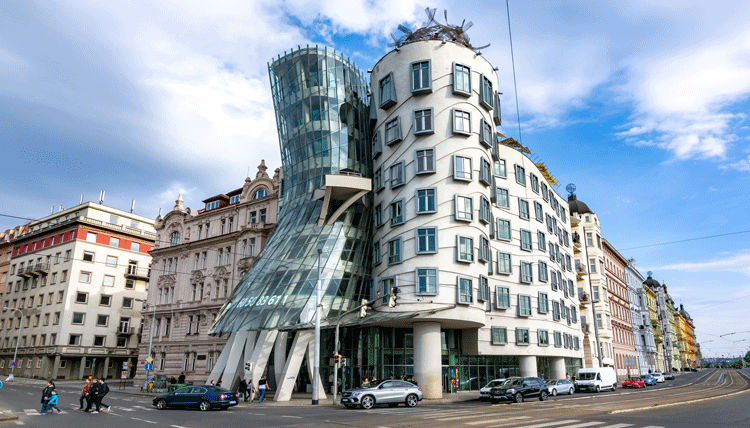
Dancing House of Prague. /Photo: IStockphoto. Vladislav Zolotov

Dancing House of Prague. /Photo: IStockphoto. Vladislav Zolotov

When the doors of the Dancing House opened on June 20, 1996, few expected that this bold new construction would become one of the most famous buildings in the Czech Republic. Today, thirty years later, it is part of the symbols of modern Prague as indispensable as its historical monuments.

In deconstructivist style, the Dancing House, known in Czech as Tančící dům,  is composed of two intertwined buildings: the first is a glass tower that narrows in the middle; the second is easily recognizable by its misaligned windows and curved shapes, which contrast with the adjacent houses.

For three decades now, the Dancing House has been one of the most emblematic symbols of modern architecture in Prague. The building, designed by architects Vlado Milunić and Frank Gehry, was built on an abandoned lot after the war and, over the years, went from being a controversial project that divided public opinion to becoming an architectural icon and a very popular cultural space.

The Dancing House stands on a lot that remained undeveloped for many decades. The original residential building was destroyed during the bombing of Prague in 1945, and the corner lot remained empty for a long time. It was not until after 1989 that the opportunity arose to create something new there: a construction that reflected the transformation of both society and the city.

It was then that the idea of a house that was not just a filler for the empty space, but an architectural gesture of a new era, emerged.

The initial idea came from Milunić, who discussed the appearance of the building also with Václav Havel -who at the time lived in the neighborhood and supported the idea of a building of great cultural relevance-. Subsequently, Gehry, who was already a respected figure in the world of architecture, was invited to participate in the project.

The result was a building formed by two main towers: one conveys solidity and stability, while the other is dynamic and seems to ‘undulate’ at first glance. This is precisely where the nickname ‘The Dancing House’ comes from. Abroad, the building is also often referred to as ‘Fred and Ginger’, in reference to the dancing couple Fred Astaire and Ginger Rogers.

In the 1990s, the building sparked heated debates. Detractors argued that its modern shape altered the historical landscape of Prague. In contrast, its supporters claimed that the city needed contemporary architecture that did not merely copy the past.

However, over time, public opinion has changed. Today, the Dancing House is one of the most photographed buildings in Prague and is often cited as an example of a successful combination of modern architecture and the historical environment.

Nowadays, visitors can find in it a hotel, dining venues, a gallery, an observation deck, and offices. The building regularly hosts cultural events, exhibitions, and social gatherings. Additionally, the 30th anniversary is accompanied by a special exhibition dedicated to the history of the building and previously unpublished archival material.

There is still much ‘dancing’ to be done along the Moldova River for this iconic emblem of the precious Czech capital, Prague, a city declared a UNESCO World Heritage Site.


Tags: Czech RepublicDancing Housedestacada2featured2newsletterPrague
Juan David Latorre

Juan David Latorre

Born in Madrid in 1961, graduated in Information Sciences at the Complutense University, he directed his first steps to the graphic arts and publishing sector. Finally, he stood out in the diplomatic world, loving culture and convinced that through it all countries can be united. jdlatorre@diplomacynews.com

Related Posts

Cargo ships anchored off the port of Singapore, at the entrance to the Strait of Malacca. / Photo: HIT1912 / iStock
Reports

Arteries of power: 25 strategic chokepoints that drive global geopolitics

by Raúl Pelegrín
12 de August de 2026

The freedom of navigation in these passages is not only a matter of international maritime law but the pillar on...

Read moreDetails
Photos: IstockPhoto

The Geneva Conventions: the protection of the victims of armed conflicts

12 de August de 2026
Foto: Chalabala

The diplomatic work that only those affected see after a tragedy abroad

11 de August de 2026
Total solar eclipse./ Photo: IstockPhoto

From Thales of Miletus to Einstein: eclipses in history, their political and scientific influence

11 de August de 2026
Spectacular entrance to the Astana Planetarium. / Photo: AR

Tourism in Kazakhstan: the Great Steppe, alpine landscapes and the cities of the future

10 de August de 2026

Lo más leído de esta semana

  • El Banco Mundial, MIT, UPM y UT Austin fundan el foro de las infraestructuras 

    The World Bank, MIT, UPM, and UT Austin establish the infrastructure forum

    156 shares
    Share 62 Tweet 39
  • Frontex launches Contingent 5 to improve migration control in Europe

    154 shares
    Share 62 Tweet 39
  • New appointments in the embassies of Colombia and the United Kingdom

    156 shares
    Share 62 Tweet 39
  • Everything is ready at the Ministry of the Interior for the solar eclipse on Wednesday

    155 shares
    Share 62 Tweet 39
  • Arteries of power: 25 strategic chokepoints that drive global geopolitics

    161 shares
    Share 64 Tweet 40

Newsletter Diplomacy News

NEWSLETTER

Lo último en Diplomacy News

Prime Minister Shri Narendra Modi, together with Prabowo Subianto, the president of Indonesia, visited the Temple Complex of Prambanan, a UNESCO World Heritage site, in Yogyakarta (Indonesia). /Photo: Courtesy of the Embassy of India

August 15: The living civilizational ties between India and Southeast Asia

14 de August de 2026
A cruise ship in Malaga./ Photo: Aitormmfoto / iStock

Diplomacy on the High Seas: Cruises as Stages of International Relations

14 de August de 2026

Sections

  • Business
  • Culture
  • Current Affairs
  • Diplomacy
  • DiplomacynewsTV
  • Gastronomy
  • Geopolitics
  • In Depth
  • Interviews
  • Life
  • Opinion
  • Reports
  • Research
  • Tourism

About Diplomacy News

  • Nosotros
  • Aviso Legal
  • Política de Privacidad
  • Política de Cookies
  • Contactar
logo diplomacy news

© 2026 Diplomacy News.

No Result
View All Result
  • Current Affairs
    • Business
    • Diplomacy
    • Geopolitics
  • In Depth
    • Interviews
    • Reports
    • Research
  • Life
    • Culture
    • Gastronomy
    • Tourism
  • Opinion
  • Agenda
  • Who is Who
  • DiplomacynewsTV
  • Español

© 2026 Diplomacy News.