There are weapons that kill twice. The first, when they explode. The second, when the conflict ends and the land that harbors them remains unwalkable, uncultivated, and uninhabitable for decades. Landmines are, in this sense, a form of war that survives the war.
In the last year, the debate over the use of landmines has returned to the center of the international diplomatic scene with a force not seen since the 1990s, when the international community believed it had definitively resolved the issue by signing the Ottawa Convention.
That was not the case. In the last year, at least four countries on NATO’s eastern flank have formalized their exit from the treaty. On December 27, 2025, Latvia, Estonia, and Lithuania officially withdrew from the Ottawa Convention, the international instrument that prohibits the use of landmines, after depositing their withdrawal instruments with the Secretary-General of the United Nations on June 27. Finland, for its part, notified the United Nations of its withdrawal from the treaty in July 2025, effective from January 2026. Poland completed the same coordinated process that culminated in February 2026. On March 18, 2025, the defense ministers of Estonia, Latvia, Lithuania, and Poland jointly announced their recommendation to withdraw from the Convention, citing the escalation of tensions with Russia and growing security concerns on the eastern flank of the Atlantic Alliance. To these five countries, we must add the case of Ukraine, where the pressure to resist a large-scale invasion has dissolved, on the ground, any formal commitment to the treaty since 2022.
The reaction of a large part of the international community was one of rejection. But that condemnation, as understandable as it may be from the perspective of international humanitarian law, suffers from a blind spot that is hard to ignore: none of the countries that signed it share a border with Russia, except for those mentioned in the previous paragraph. The Lithuanian Minister of Defense, Robertas Kaunas, was direct in justifying the exit: “The decision to leave the Ottawa Convention was motivated by the need to strengthen deterrence and defense capabilities.” The common argument of the exiting countries was clear: the deteriorating security situation in the region, in light of the growing military threat from Russia and Belarus, made adherence to the treaty compromise their defense strategies for their sovereignty.
There is, at its core, a tactical reality that the humanitarian debate tends to overlook. The landmine, whose mass popularization was consolidated during World War II when both sides systematically adopted it as an area denial instrument, has demonstrated a defensive efficiency that no technological substitute has fully matched. Its ability to channel enemy troop movement, protect extensive border strips, and compensate for numerical inferiority makes it a strategically valuable tool, especially for relatively small armies with long borders to defend. Its low production cost, which ranges from three to seventy-five dollars per unit, allows them to be deployed in large quantities, making them particularly attractive for countries that must cover hundreds of kilometers of border against an adversary with vast conventional resources. It is very easy to judge Estonia, Latvia, Lithuania, Finland, or Poland from the comfort of a capital far from the front. It is much more difficult to maintain that judgment when looking at the map and accepting that, in the face of the real threat of a belligerent superpower, the landmine ceases to be an abstract ethical dilemma and becomes a matter of national survival.
And yet, history has an irrefutable answer to that logic, and that answer is written with the victims that remain when the armies leave.
The case of Azerbaijan illustrates this with painful precision. After 35 years of a conflict that spanned the first and second Karabakh wars, the Azerbaijani government found itself with reclaimed territory but sown with silent death. From 1991 to May 2024, the number of victims from landmines in the region approaches 3,500 people, including 358 children and 38 women. Only in the last three and a half years, 359 people, half of them civilians, stepped on a mine; 67 of them died and the rest were seriously injured, with multiple amputations in many cases. The victims are the people displaced by the war who returned to their ancestral lands, the farmers who tried to reclaim their fields, the children who played in the same grounds where their parents had played during their youth. Despite the millions of euros invested by the government and its international partners, the National Mine Action Agency (ANAMA) has only cleared 3.3% of the existing mines, a modest amount considering estimates that 12% of Azerbaijan’s territory is contaminated with unexploded ordnance. Journalist Gervasio Sánchez, who has specialized for four decades in the consequences of wars and is a direct witness to the effects of landmines on the communities of Karabakh, summarizes it with an image that makes the scale of the problem tangible: if the Santiago Bernabéu stadium were mined in one day, it would take between three and four months just to clear it.
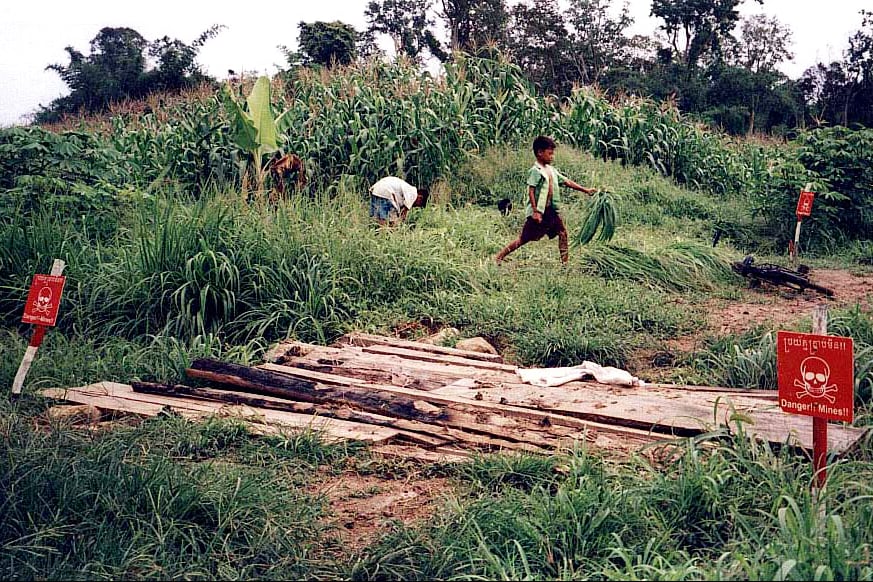
Azerbaijan is not an exception. In total, 58 countries and territories around the world remain contaminated by landmines, and among them at least seven are considered “massively contaminated”: Afghanistan, Bosnia and Herzegovina, Cambodia, Ethiopia, Iraq, Turkey, and Ukraine. These are countries that share one characteristic, and that is that decades after their conflicts have subsided, the land continues to kill. In 2023, there were 5,757 victims of landmines and explosive remnants of war worldwide, with 2,426 dead and 3,331 injured. Civilians accounted for 84% of those victims, and children made up a third of the total. This is not an exceptional year: that proportion of civilian victims has remained above 84% for nine consecutive years.
The economic cost of reversing this legacy is equally overwhelming. Safely removing a mine costs between 300 and 1,000 dollars, compared to the few dollars it costs to produce it. In Ukraine, where it is estimated that approximately 174,000 km² of territory, a surface area larger than that of Greece, equivalent to almost a third of the country, is contaminated with landmines and explosive remnants of war, it is estimated that demining operations could cost up to 29.8 billion dollars and extend over decades. Agricultural exports, one of the pillars of the Ukrainian economy, have fallen by 4.3 billion dollars annually since the start of the war, and a significant part of that reduction is directly linked to the disruptions caused by landmines. And that is just the direct and quantifiable cost. The cost in prolonged displacement, in communities that cannot reconstitute themselves, in agricultural lands that remain abandoned for generations, escapes any clean calculation.
Not all the picture, however, is desolation. The case of Mozambique demonstrates that reversal is possible, although it requires decades of sustained effort. It is the only country in the world that has gone from being severely contaminated in 1992 to declaring itself free of landmines in 2015. Studies on its demining process reveal that the economic recovery of the liberated areas was significant and extended far beyond the areas directly cleared, restoring access to markets, trade routes, and agricultural lands. Cambodia, for its part, illustrates both the magnitude of the problem and the right direction: the country had more than 800 landmine victims in the year 2000; today that number has dropped to less than 30 per year, thanks to decades of sustained demining funded by the international community. Since the entry into force of the Ottawa Treaty, 33 States have completed the total clearance of their contaminated territory, and member countries have collectively destroyed more than 55 million stored landmines.
We live in a moment of accelerated rearmament. The war in Ukraine has redrawn military doctrines across Europe and defense budgets are rising in almost all NATO countries. The exit of five States from the Ottawa Treaty is not an anomaly: it is the most visible symptom of a profound revision of the balances between the logic of security and that of international humanitarian law, a revision that has real and non-negligible reasons. But precisely because the world is rearming, it is more urgent than ever to think about the legacy left by conflicts.
Wars end. Sooner or later, they all end. And what remains on the ground always endures much longer: in the fields that cannot be plowed, in the towns that the displaced cannot return to, in the communities that cannot reconstitute themselves because the land that sustains them remains deadly.
The debate over whether the Baltic countries or Finland are right to reclaim the mine as a deterrent instrument is legitimate and does not have an easy answer. What should not be subject to debate is that any military doctrine that contemplates the use of these weapons must incorporate from the very first moment the planning of post-conflict demining as an obligation and not as a secondary consideration; with measures such as comprehensive mapping of mined areas and mine designs with self-destruction or automatic deactivation systems after a certain period. Because at its core, the fundamental thing is that the reflection on landmines does not end when the conflict ends. That on the day peace is signed, there is already someone thinking about how to unearth what the war left behind. That the legacy of the land, that land that survives armies, treaties, and the politicians who sign them, is a central part of any contemporary military doctrine.