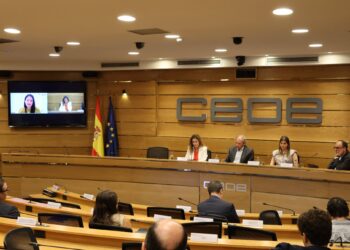
“Europe has lost conventional capabilities and has fallen behind in new defense technologies,” emphasized the director of the Coordination and Studies division of CESEDEN, Brigadier General Paulino Garcia, yesterday during the presentation of the report ‘A More Autonomous Europe’, prepared for the Fundación Alternativas by independent consultant Carlos Martí.
As the author explained during the discussion —in which the president of Alternativas, Diego López Garrido also participated— the report provides an integrated analysis of the elements that condition the continent’s autonomy: political, institutional, operational, economic, technological, and industrial, highlighting weaknesses, vulnerabilities, and needs, as well as the reasons or obstacles that may hinder its improvement.
The changes that have occurred in recent years in the global landscape —the invasion of Ukraine by the Russian Federation, Brexit, the rise of China, conflicts in the Middle East, or the new national security strategy of the US— pose a new and very complicated context for the action of the European Union.
According to Carlos Martí, “the new defense commitments require the United States to pay more attention to the Indo-Pacific and to ‘lighten the load’ in Europe, which forces us Europeans to take charge of our own defense.”
So, the main conclusion of the presentation is that the EU must invest more in defense in the face of a hypothetical Russian attack, which requires greater investments that will have to be financed by cutting other items or with greater borrowing.”
Therefore, all participants agreed that it is necessary for the European Union to be able to establish a European defense industry that coordinates resources to make better use of them. Diego López Garrido provided an example that illustrates this problem: “the industries of European countries produce 179 different types of weapons while the United States has 33 categories,” which gives an idea of the dispersion and waste of resources that comes with separate arms production.
The director of CESEDEN, Lieutenant General Miguel Ballestilla, summarized this widespread opinion when presenting the session, highlighting the “enormous difficulties we Europeans have in reaching an agreement and advancing a security and defense project to which we all contribute on equal terms.”
You can watch here the full session of the presentation in video.