


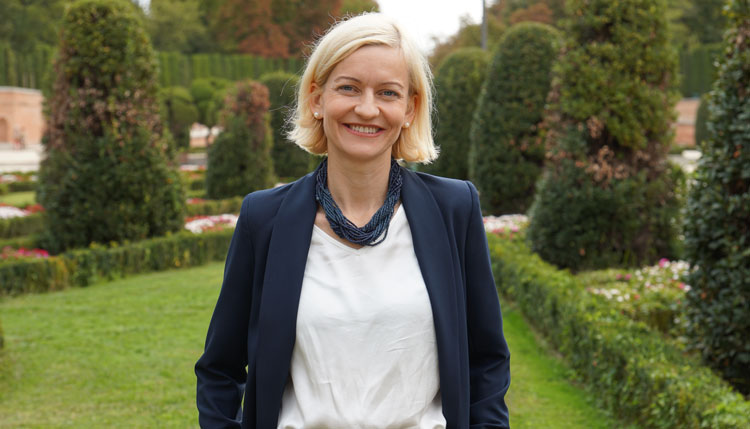
The diplomat Maria Ślebioda has been the director of the Instituto Polaco de Cultura since the end of 2024. She has a professional background of over 20 years in the Polish Ministry of Foreign Affairs, where she has been head of the Strategic Projects Section of the Department of Cultural and Public Diplomacy (2018-2023), Second Secretary of the Polish Embassy in Lithuania (2012-2017), deputy director of the Eastern Department (2011-2012), and head of the Section of Ukraine, Belarus, and Moldova in the Eastern Europe Department. In 2002, she enjoyed and learned equally from an Erasmus scholarship at Carlos III University in Madrid.
How would you define cultural diplomacy today?
Cultural diplomacy is a term that has become very popular in recent decades. For centuries, traditional diplomacy was the domain of a small group. Today, however, in an international world marked by social media and visual communication, we increasingly perceive the role of other elements that contribute to building a positive image of a country and, consequently, close and cordial relationships not only between governments but simply among people. And it is precisely in this area where cultural diplomacy operates: not so much through political facts and decisions or economic indicators, but by inviting people to discover the culture of the other country: its literature, its art, its music, its language… In other words, to delve into a new world, to meet new people and realities. To know and understand! In this way, a stronger bond is created between societies. In today’s turbulent times, this type of action aimed at uniting nations is very important.
Unlike traditional diplomacy, where the signing of an agreement or treaty constitutes an end in itself, cultural diplomacy has a much longer-term character. It is a process that builds an increasingly deep image and knowledge of a country and its culture. Its results are not immediate or easy to measure in statistical terms. For this reason, I am especially pleased that the work of the Instituto Polaco de Cultura in this area was recognized last year with the Cultural Diplomacy Award in the first edition of the International Awards The Diplomat in Spain 2025 in recognition of our cultural program linked to Poland’s presidency in the EU.
From your experience, how would you describe the cultural relations between Spain and Poland today?
It is incredible how societies that seem geographically distant understand each other so well. The Instituto Polaco de Cultura organizes around a hundred events a year. And I must point out that, with few exceptions, these events are usually filled, which demonstrates not only the interest in Polish culture in Spain but also the existence of shared cultural codes that facilitate mutual understanding between both countries.
We frequently organize meetings with public participation, especially after theatrical performances or book presentations. In them, it is clear to see how Polish culture connects with the Spanish audience.
We often also try to pair artists: when a Polish writer or director comes, we try to find a Spanish artist who works on similar themes or has a similar sensitivity. It always brings me great joy to see how these relationships are created almost immediately and how well they understand each other. And the result of these bonds are co-productions and joint projects from which more and more exchanges arise. Often, even without the participation of the Instituto Polaco de Cultura. I believe that is the best answer to your question.
Of course, if we talk about the knowledge of culture among society in a broad sense, without limiting ourselves to cultural circles, there is a certain disproportion in this area. I have the impression that Spanish culture in Poland is, in general, more recognized. For example, Pedro Almodóvar, Pérez Reverte, flamenco, or Don Quijote are clearly associated with Spain. From this perspective, Polish culture in Spain may be less known, but when someone becomes interested in it, they usually acquire a deep understanding. Fans of Szymborska’s poetry, Kapuściński’s prose, or Sapkowski’s, Wajda’s cinema, Lupa’s shows, or Penderecki’s music could easily catch the attention of more than one Pole with their level of knowledge.
On the other hand, the Polish language is perceived as an obstacle for the average Spaniard: our surnames, titles of works, and words may seem like genuine tongue twisters at first glance. However, every year there are more Spaniards traveling to Poland to study or work and even learning some Polish. And practically all of them are surprised by Poland: its level of development, its landscapes, its history, and its culture. I believe that the old stereotypes about Poland from the second half of the 20th century fall very quickly when confronted with reality.
What part of Polish culture excites you the most to share outside your country?
Being so closely linked to culture, I would like to show everything to the Spaniards, and every action promoting Polish culture excites me! But I think what I like most is presenting young, brave, and sometimes provocative creators who tackle current and difficult themes. And thus they show a creative and dynamic image of Poland.
For example, every year we organize CinePOLSKA (https://www.cinepolska.com/), a showcase of new Polish films that are often by debut directors. Last year we focused on female directors.
The cinema that can be seen there does not leave one indifferent: one leaves moved, whether by the strength of the message or by the sensitivity of the director. Themes such as violence against women, workplace harassment, ecology, trauma after a rape, but also such important and beautiful issues as the integration of people with disabilities into society are addressed. Just this month we screened for a special school the beautiful and moving film by Kinga DębskaFiesta de fuego and last year, in Madrid, at the Teatro Amaya, a professional Polish theater company that employs people with Down syndrome performed. It is situations like these that bring the most joy: when one sees that art has a real impact and, even if only in a small way, changes the world. This year we are resuming the cycle in the fall and I also promise a great dose of emotions!
Within our feminist spirit, on May 2 and 3, at Réplika Teatro, Ewa Dziarnowska will perform with a contemporary dance show; at the end of May, an exhibition by one of the most popular contemporary artists from Poland, Ewa Juszkiewicz, will open at the Museo Nacional Thyssen-Bornemisza. And in Barcelona, at the Centre d’Arts Santa Mònica, a group exhibition with the participation of Aneta Grzeszykowska. But I would also add that in June, as part of PHotoESPAÑA, we will inaugurate an exhibition by Marcin Milach. Each of these artists works in a different aesthetic, but they all share something in common: they are committed artists whose work invites reflection.
But, personally, I am more linked to music: I studied piano and sang in a choir. Therefore, I could not fail to mention Polish music. I love bringing jazz to Spain, in which Poles are masters, and it is not a coincidence: during communism it was a language of protest and opposition. We had 44 years to perfect ourselves in this genre! (haha). By the way, you cannot miss the concert of Włodek Pawlik, Grammy award winner, in Pamplona in May and in Valencia in July! But we have gone further, and the musical experiments -including electronic music- of the young generation are excellent.
I struggle to hold back tears of emotion when, after a cello concert by Witold Lutosławski, the entire Auditorio Nacional de Música in Madrid stands up to applaud the musicians, or when, after the successive arias performed by Jakub Józef Orliński, the audience at the Teatro Real not only applauds but cheers enthusiastically. Undoubtedly, music is one of our strong points.
What is the mission of the Instituto Polaco de Cultura and how is it reflected in your daily work?
Our mission is to promote Polish culture in the broadest sense of the word: literature, music, theater, dance, visual arts, cinema, history, science, language… everything that is part of our heritage and also of our present. Of course, all this in collaboration with cultural institutions in Poland, but especially here in Spain. Because our work does not consist solely of promoting our cultural milestones, but also of building bridges between people, artists, and institutions and, so to speak, whetting their appetite, so that they themselves want to continue developing projects along the same lines, without us necessarily being in the middle.
An institution like ours cannot aspire to have exclusivity in cultural promotion. We are here to open paths, participate, collaborate, and continue sharing things, but without the interested public and without our Spanish collaborators, our work would not make much sense.
Poland will be the guest country at the Eñe Festival. What kind of authors, themes, or approaches can we discover?
This year, the central theme of the Festival is poetry and poeticity in a broad sense, as a response to an increasingly brutal reality and, at the same time, as a form of escape from it. And so will be the literature presented in Madrid and Málaga, as the festival takes place in these two cities.
We will present poets and poetesses, as well as excellent reportage authors who cultivate the legacy of Ryszard Kapuściński, who, although they work in non-fiction, handle language in an extraordinarily poetic way.
Let us remember that the Eñe Festival is not only literature but also other artistic disciplines. We will present monodramas about two extraordinary poetesses, performed by one of the best Polish actresses at the Teatro de La Abadía. Even the Spanish audience will be able to see poetic films by such renowned directors as Paweł Pawlikowski or Agnieszka Holland. Before announcing the program, I do not want to reveal names, but undoubtedly November will be a great celebration of Polish culture in Madrid.
You have already revealed a lot about the plans to promote literature, visual arts, and cinema. Is there any other event we should mark on the calendar?
I have talked a lot about contemporary and avant-garde creators. But the classics are also priceless: they are, after all, the reference point. So please mark the date of November 10, when Rafał Blechacz, winner of the International Fryderyk Chopin Piano Competition in 2005, will perform at the Auditorio Nacional de Música.
I also invite you to reserve the fall for a retrospective of films by Andrzej Wajda at the Spanish Film Archive in Madrid and in several other cities in Spain to commemorate the centenary of his birth.
And also, on June 7 in the Town Hall Square, as part of ValenciaPhoto, an exhibition of photographs by Kazimierz Nowak, the Polish traveler who cycled across the African continent in the 1930s, will be presented. There are many more events, but for now, I will stop here.
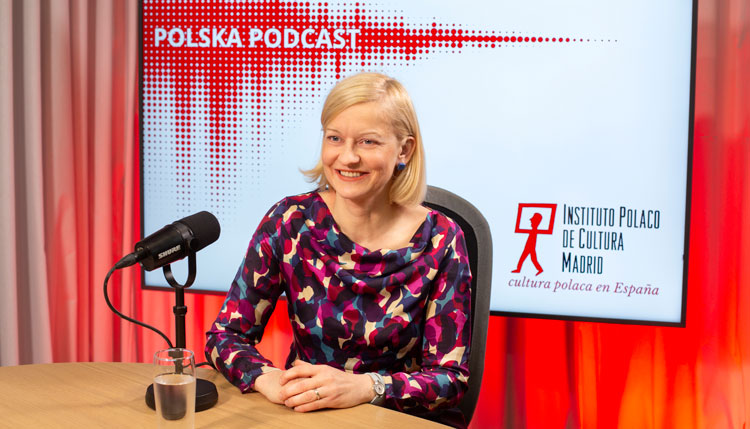
You have recently launched “Polska Podcast.” What led you to bet on this format and what kind of stories do you want to tell?
Well, at this point, it is evident: podcasts are everywhere. We listen to them on the way to work, at home, while walking… and they have become a very direct way to connect with people. That is why we were clear that we wanted to be there, but to do it our way.
Thus, Polska Podcast was born, with the idea of being a meeting point for curious people: readers, listeners, cultural travelers… People eager to discover and be surprised. More than talking about Poland as a destination, we want it to be a conversation. The format also goes along those lines. We did not want something rigid, but a living space that breathes. Each episode, of about an hour, mixes in-depth interviews with lighter chats, cultural recommendations, and small stories that bridge Poland and Spain. Literature, music, cinema, art, or theater… everything fits into that journey. And to present and conduct it, we have Antonio Martínez Asensio, a voice more than recognizable in cultural journalism, who brings that balance between rigor, closeness, and good vibes.
By the way, the podcast, which has a monthly frequency, can be listened to on Spotify, Apple Podcasts, iVoox, and also on YouTube. I recommend it to everyone reading this interview.
Looking to the future, what projects or cultural lines do you want to promote in the coming months?
I have already revealed quite a bit about our plans; perhaps now I will respond in a more general way. For me, an extremely important function of culture, and also of the Instituto Polaco de Cultura, is to address relevant issues and foster social engagement. I believe that art should excite, invite reflection, and pose difficult questions. And that is how I try to build the program.
We constantly promote Polish female artists and discuss the role of women; we address issues such as the war in Ukraine, disinformation, or artificial intelligence. Our projects tackle issues like depression, the crisis of relationships and family, as well as such universal -and always current- themes as death.
We also dedicate a lot of space to ecology and the relationship between humans and nature, as well as to excluded groups. Undoubtedly, this is the line around which we will continue to build our program in the coming months. I invite everyone to the events of the Instituto Polaco de Cultura!