


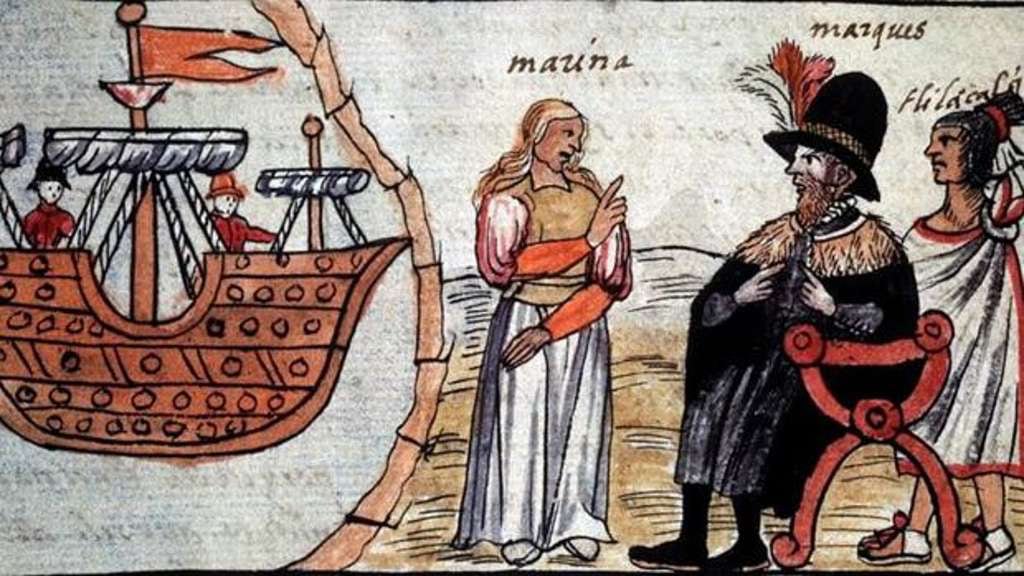
It is not good for Mexico and Spain to be at odds over a ‘get that Cortés away from me’. Both countries have much more important things to deal with than the political agendas of Presidents Sheinbaum and Díaz Ayuso, and by extension, all their respective opponents. However, this is what we are currently wasting time on.
Look, whether Cortés was or was not, whether he was a genocidal or not, whether he is the father of modern Mexico or not, and whether we should build him a monument or behead him in the public square are already minor, minimal issues compared to what is coming our way. Do not forget that Ormuz is still there, that the war in Israel in Lebanon is not over, that the Russian aggression against Ukraine is also ongoing, that Cuba could be next, that China’s expansion in Africa continues to advance quietly, that Trump could impose new tariffs on anyone at any moment… should I continue?
However, in Spain and Mexico we have the feeling these days that the definitive nuclear bomb has exploded simply because Ayuso has defended Hernán Cortés’s role in the formation of modern Mexico and Sheinbaum has taken the opportunity to reclaim the indigenous legacy. But there is no bomb. Just political tactics, and mediocre ones at that, in both cases. Blunt strokes. Nothing new under the sun.
The polls, the real ones, tell us that Mexicans and Spaniards, those of us on the ground, are concerned about more important things. We are worried about making ends meet, enjoying our lives, our families, our team winning… ordinary things. We are busy with anything but whether Sheinbaum and Ayuso can agree on something that, to begin with, happened over 500 years ago and has surprisingly become, now, a political weapon available to both.
Do they really believe in the Madrid government and its opposition that the flow of votes will substantially change because Cortés —who would love to be left alone— was an evil murderer or an excellent statesman? Does the Mexican president also believe she will be more popular among her fellow citizens by blaming all her ills on a guy who died almost five centuries ago? Test it out, go down to Puerta del Sol and Zócalo. And ask.
Surely Cortés was neither one nor the other, he was a man of his time with mistakes and successes. But above all, Cortés is a part of our common history that, at this point, we can neither erase nor should we. It has to stay there, so we will have to manage it well, both sides, or no one should be offended.
The problem, which does not seem to concern our politicians, is that diatribes like these will end up damaging the image and relationship of two countries, Spain and Mexico, that are much more alike than we believe. Not for nothing, Mexico, I remind you, was called New Spain for over 200 years. And, in case you forgot, it was socially, educationally, and economically much more important, more vibrant, and more advanced than the metropolis for a large part of that time.
Mexico and Spain, already I mentioned it in a previous article, should stop poking each other in the eye and focus on what matters, which is the Ibero-American Summit next November. The two countries that invented the Ibero-American System have the opportunity, after the failure of the Cuenca (Ecuador) Summit, to forge a more solid and operational framework in Madrid, also taking advantage of the support they can obtain from a CELAC that is beginning to speak with one voice across Latin America.
In these times —with China, the United States, and Russia defining their respective ‘backyards’— Latin America and Europe are facing the opportunity to strengthen their own political and economic autonomy —certainly linking one to the other— or fall into the sphere of the powerful.
Building that framework will not be a matter of a day, but both regions on either side of the Atlantic must start calculating the benefits of combining their respective economies and their own needs, managing the manufacturing of their natural and agricultural resources and the extraction and processing of their minerals. Being able, in short, to control the wealth that, currently, one part exports without adding value and the other buys at prices controlled by others.
Any other option will leave Europe isolated or dependent on one of the ‘superpowers’. And the same will happen with Latin America, which will continue to be a supplier of raw materials to the highest bidder.
The Foreign Minister himself, José Manuel Albares pointed out on Friday the need to ‘advance together’ to deepen cooperation in the face of the ‘strategic competition’ among great powers that question multilateralism.
The possibility of an America Latina-Europe agreement, therefore, not only exists but steps are being taken in that direction, although they are still very slow. The Ibero-American Community can accelerate that process. But first, it will have to reorganize its own house, which means reinventing itself at the Madrid Summit.
So we return to the earlier point. Spain not only needs Mexico. It also needs Argentina, Brazil, Chile, Peru, everyone, even several African countries that want and could join as full members. That community would have much to say in a new world order. We just need to get to work. And make it happen.