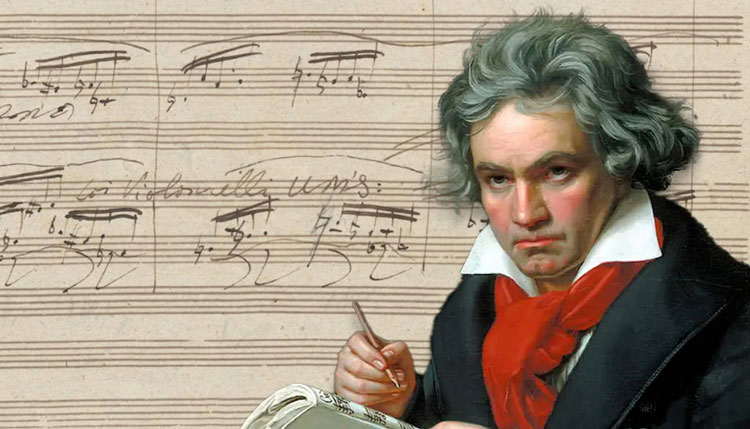
The theme finally adopted by Beethoven to sing the Ode to Joy by Schiller, a text with such expressive weight aimed at valuing fraternity among humans, was adopted as an anthem by the Council of Europe in the seventies of the last century, and the European Union made it its official anthem in 1985.
In both cases, the anthem is merely instrumental -without text-, to guarantee its universality and, like any anthem, presents sparse and simple characteristics, suitable for fulfilling its anthemic function, but, from these lines, we are going to approach the conception of the complex fourth movement of Beethoven’s Ninth Symphony, of which the ‘simple’ and effective European anthem is a very brief extract.
In mid-1822, ten years after having interrupted his symphonic cycle after the premiere of the Eighth, Ludwig van Beethoven (1770-1827) began composing what would be his Ninth and last Symphony, one of his most transcendent musical legacies. To this day, far removed from the effects of the first audiences of the work, overwhelmed by the dimensions and the novelty of the piece; having overcome the consideration of the score as unplayable (a judgment particularly emphasized by the singers of the 19th century); assimilated, on the other hand, the musical contents by such brilliant minds as Berlioz, Liszt or Wagner, the truth is that, for more than a century, the interpretation of Beethoven’s Ninth Symphony at any moment and in any place gives the concert act a special aura of musical event and, even more, of ‘spiritual event’, as Federico Sopeña frequently pointed out.
The work, on which Beethoven had been meditating and taking notes for many years, would be ready in February 1824, and it premiered in Vienna, under the direction of the composer himself, on May 7 of that same year. It did not reach Spain until well into the century, when, in 1882, it was conducted in Madrid by Maestro Mariano Vázquez.
At the moment when Beethoven considered it the right time to use the verses of the Ode to Joy by Friedrich Schiller (1759-1805) incorporating them into a great symphony as explicit text, he was giving way to his old idea of using the human voice combined with the great symphonic orchestra. These new elements, the verses and the voices that would sing them, were reserved for a colossal Finale, the fourth movement, the last and most extended of the Ninth Symphony, a page without historical precedents and with such a load of novelty in its aesthetic and expressive approaches that for decades no one would dare to continue such an idea. Near the end of the century, Gustav Mahler would do so with his Second Symphony.
In the generation of the colossal Beethovenian Ninth, the choice by Beethoven of the melodic theme with which the anthem or Ode to Joy would be sung acquired singular prominence. That musical idea, simple and therefore effective, that theme which, not always aware of its origin, millions of beings around the world sing, hum, whistle, or try to intone with the recorder in music class at school, had a long process of decantation. Indeed, the idea appears in germ, with modifications, in several drafts and notebooks of Beethoven, but it also appears as ‘tested’ by him in several different and distant compositions: thus, the ineffable theme of the Ode to Joy is recognizable in a youthful Lied, Gegenliebe, on a poem by Bürger, which Beethoven composed between 1794 and 1795; it reappears, already in full Beethovenian maturity, in the Choral Fantasy, op. 80 for piano, male choir, and orchestra, from 1808; and reappears in 1810, in the Lied on verses by Goethe titled Keine Blumen, keine Blätter, op. 83, nº 3…
The Finale of the Ninth bursts in, uncontrollable, after the state of poetic and elevated emotion in which the purest music of the previous Adagio has left us. Indeed, without time for breath, the tutti orchestral launches, in terrible fortissimo, a breathtaking peroration of eight measures after which the low strings outline the recitative motif with which the solo bass will later enter; but this new proposal is soon interrupted by the tremendous reappearance of the initial tutti. A new attempt to establish the theme by cellos and double basses before entering an original and even surprising passage in which different sections of the orchestra proceed to recount the main themes of the three previous movements, as thematic counterproposals offered to the impetuous recitative of the low strings: successively, we hear the first measures of the first movement, the first motif of the Scherzo (second movement) and a recollection of the melody of the Adagio, all three proposals rejected by the low strings that abort them reiterating their first recitative theme each time. Finally, the woodwinds sound a new theme, melodically well-defined, in Allegro, which will be the one to prevail: it is one of the most universally disseminated motifs in the history of music, the one that will serve for the singing of the Ode to Joy, a theme whose long genesis we have referred to above. The same low strings that previously aborted up to three proposals, joyfully accept this one and even appropriate the theme to present it, intact and with great breath cantabile, in an excited pianissimo that is energized with the progressive incorporation of the entire orchestra until reaching the exalted intervention of the winds.
But, once the theme is established, the climate becomes restless and the violent initial peroration resonates again. Not all the elements foreseen by the composer for his ambitious expressive plan are yet established: the voice is missing, and this finally arrives with the solo of the singing bass: a recitative in which he cries out: ‘Friends, let us not insist on these sounds! Let us rather sing something pleasant and full of joy!’ and, indeed, he then intones the anthem or Ode to Joy by Schiller: ‘Joy, divine light, daughter of Elysium!’… to which the choir will join. Once the expressive climate is established and the essential melodic material is exposed, the music proceeds to delve into one and another content through an admirable, brilliant exercise of free variation. The anthem is recreated by the soloists and the choir in two formidable variations that culminate in a tense calderón. Then comes the surprising alla turca episode (due to the use of exotic percussion and its peculiar rhythm), a passage led by the tenor, in a march-like and heroic breath, from which the full orchestra embarks on a fugue development that will culminate in the joyful explosion of the anthem to joy interpreted jointly by the choir and the orchestra.
Accompanied in parallel by the trombones, the men of the choir (and immediately the full choir) intone the exhortation to fraternity from the Ode of Schiller: ‘Seid umschlungen, Millionen’, that is, ‘Hugs, millions’ (referring to millions of beings…, that is, to humanity), in a wide suspensive section from the agogic point of view and of great emotional depth. The tempo returns to be fast for the next intervention of the solo quartet, to which the choir soon joins to alternate with them. The vocal demands of the score are at times of relentless difficulty. A Presto overwhelms the ensembles to a peak of sound and expressive tension interrupted by Maestoso measures that immediately precede the explosion of a Coda cathartic, exalted, and exultant.