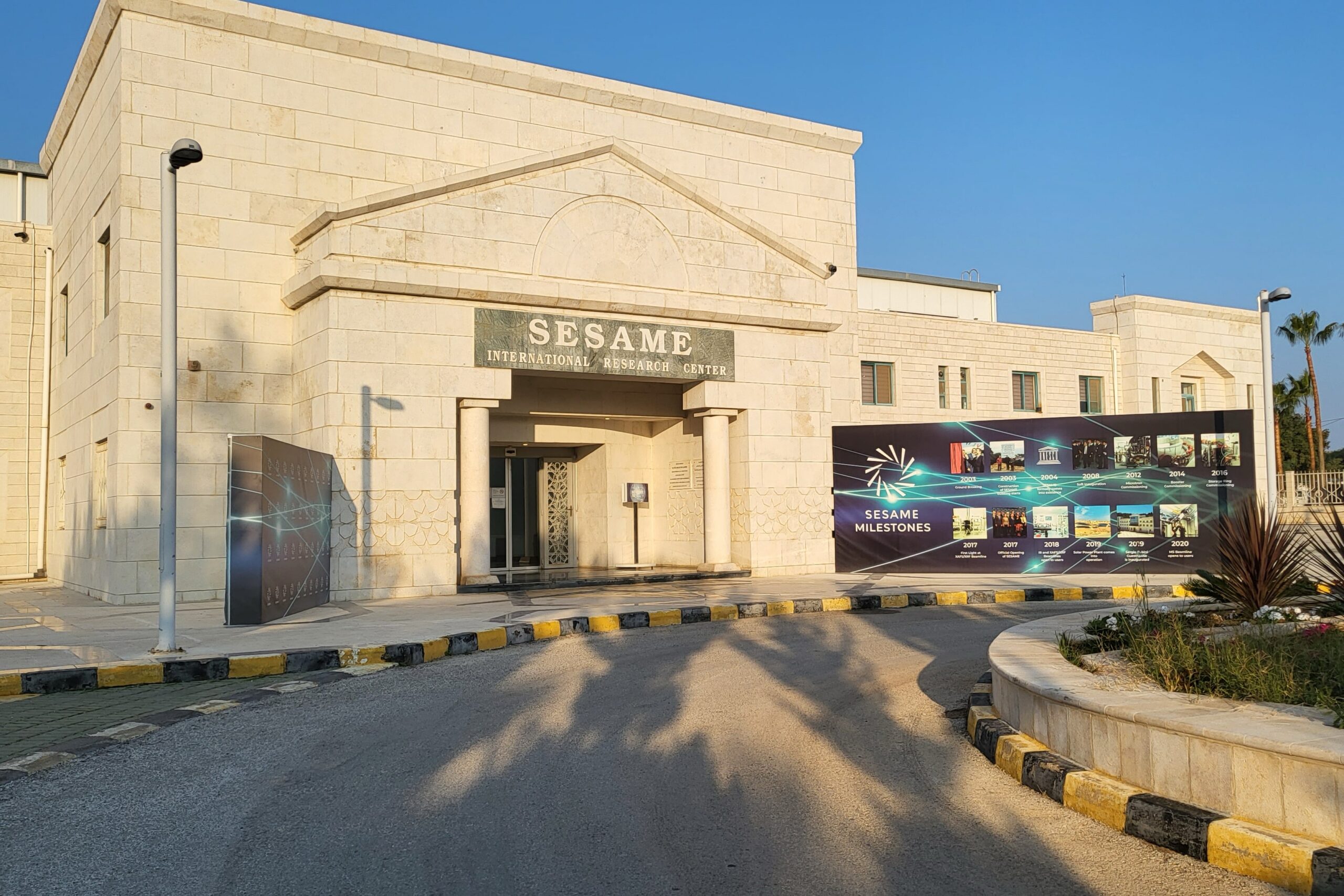
On the outskirts of Amman, Jordan, one of the most unique scientific infrastructures of the international system has been operating since 2017. SESAME, the only synchrotron in the Middle East, regularly brings together scientists from countries whose political relations oscillate between permanent tension and total absence of dialogue. Israel, Iran, Palestine, Pakistan, Egypt, Turkey, and other states share a stable workspace there, with common protocols and joint scientific governance that has withstood successive political crises in the region.
The basis of this cooperation is the synchrotron itself, a large scientific facility that produces extremely intense and precise light for research in multiple disciplines. This shared infrastructure imposes clear rules, stable procedures, and a logic of continuous collaboration, creating common ground that transcends political divisions.
Conceived under the auspices of UNESCO and following the institutional model of the European CERN, SESAME was born with a dual ambition: to offer excellent science and to demonstrate that technical cooperation could be sustained even when traditional diplomacy failed. To this end, the project was designed as a long-term bet on operational normality, based on experimental shifts, scientific committees, shared budgetary decisions, and peer evaluation.
For years, this routine allowed the center to function as a stable exception in a highly fragmented environment. While diplomatic relations deteriorated or froze among some of its member states, scientific activity continued, and belonging to a shared scientific community became a practical rule of institutional coexistence.
Since 2024, SESAME has made a qualitative leap. It has ceased to be perceived solely as a regional initiative to become an infrastructure with intercontinental projection. UNESCO and the European Commission have begun to explicitly present it as a bridge platform to Africa, the only continent that still lacks its own synchrotron.
This change of scale is concretized in an operational proposal: the creation of a beamline within SESAME, designed with a priority focus on African scientific communities and with specific programs for access, training, and project development. In a synchrotron, beamlines are the experimental lines that channel light and allow for specialized research; directing one of them to African users means offering real access to an already fully operational environment. In contrast to the immediate construction of a large synchrotron in Africa—a costly and long-term option—this solution serves as an intermediate step that allows for the formation of scientific communities, accumulation of experience, and reduction of barriers, without renouncing future continental deployment. The proposal was debated and supported in high-level meetings held at UNESCO’s headquarters in Paris in December 2025, where SESAME was presented as an operational instrument of international scientific policy.
This broadening of horizons has been accompanied by a tangible strengthening of European support. Projects funded by Horizon Europe, such as SUNSTONE, active between 2024 and 2027, formally integrate SESAME into the European architecture of large research infrastructures, aligning it with strategic priorities of the European Union’s external scientific policy.
The consortium itself has also evolved. In 2023, Iraq joined as an associated member, with a view to future full membership, at a time of great regional political fragility. This decision reinforces the perception of the synchrotron not only as a scientifically useful tool but as a safe and predictable institutional space.
Although the scientific results of the center remain relevant—from materials physics and structural biology to cultural heritage— today the value of SESAME goes beyond academic production. The project serves as a practical case of how to sustain and expand operational multilateral institutions in adverse geopolitical environments, and how science can become a strategic asset in a context of increasing international fragmentation.
Sources: SESAME Organization, institutional information; UNESCO, documentation on scientific diplomacy and African access to scientific infrastructures; European Commission, Horizon Europe projects linked to SESAME (SUNSTONE); CERN Courier and Science|Business, coverage on the incorporation of Iraq and the evolution of the consortium.