


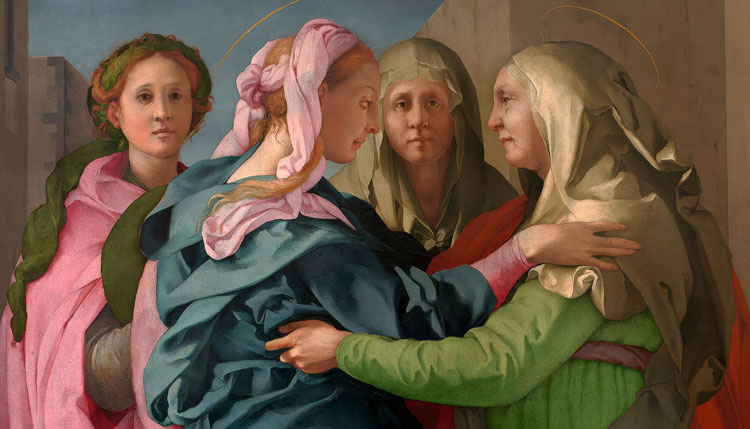
Until June 18, the Museo Nacional del Prado, in collaboration with the Fundación Amigos del Museo del Prado, is exhibiting in room 49 of the Villanueva building, The Visitation, by Jacopo Carucci, known as Pontormo (1494–1557).
Painted around 1528 and exceptionally lent by the parish church of San Michele Arcangelo in Carmignano (Prato), Diocese of Pistoia, its exhibition is a unique opportunity to see for the first time in Spain a key work of early mannerism, shown outside its place of origin on rare occasions.
The loan is part of the program “The invited work,” sponsored by the Fundación Amigos del Museo del Prado since 2010, aimed at enriching the visit and encouraging comparative readings with the Museum’s collections, within its policy of collaboration with national and international institutions.
In 2026, this exchange takes on special significance with L’Aquila as “Italian Capital of Culture” because the Prado will contribute to this anniversary with the loan of The Visitation by Raphael.
Painted around 1528–1530, The Visitation is a sophisticated visual interpretation of the encounter between the Virgin Mary and her cousin Elizabeth, narrated in the Gospel of Luke (1, 39–56). Despite its relevance within Pontormo’s production, Giorgio Vasari does not mention it in his Lives (1568), and there are barely any references to it in the documentation of the subsequent centuries, which contributed to it being practically unnoticed until the early 20th century.
Both the commission of the work – frequently linked to the Pinadori family, Florentine pigment merchants – and its original destination remain subjects of debate. Everything points to the altarpiece having remained for a time in a private setting before being definitively installed in the church of Carmignano, where it is documented with certainty from the 18th century.
Pontormo proposes a very personal interpretation of the evangelical episode. The four monumental and elongated female figures are articulated in a scene that unfolds in an ambiguous space. The arrangement of the anatomies has been related to the engraving Four Naked Women (1497) by Albrecht Dürer, while the gesture of the embrace refers to the dextrarum iunctio, a symbol of union used in Roman reliefs and also employed by Raphael in his Visitation preserved in the Museo del Prado.
The presence of the two figures in the background, as well as the small characters that animate the urban background – two men conversing, a donkey peeking around a corner, and a woman at a window – reinforces the character of the scene. The space, conceived as an architectural set close to the representations of the città ideale, functions as a theatrical curtain that intensifies the feeling of suspension and movement.
Jacopo Carucci, known as Pontormo, was one of the central figures of Florentine mannerism. Trained in the artistic environment of Florence and a disciple of Andrea del Sarto, he soon developed a personal language characterized by innovative compositions, stylized figures, and intense emotional expressiveness.
Pontormo’s painting had a great influence on Italian painting in the decades that followed, breaking with the principles of classical balance and paving the way for new forms of expression based on formal tension, color, and spatial ambiguity.