


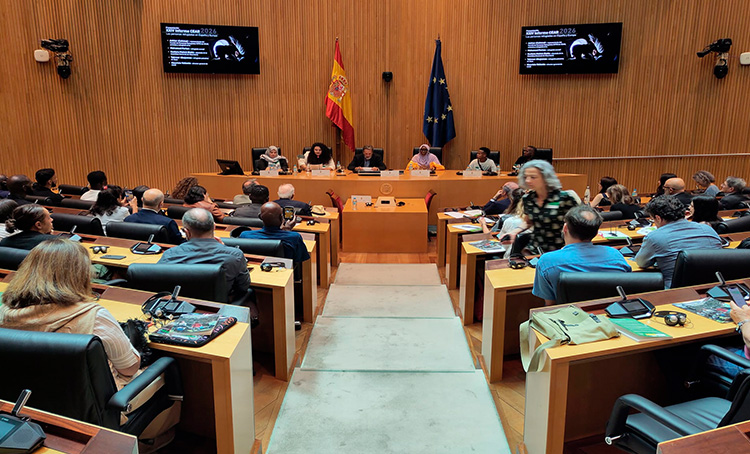
Last Monday, the presentation of the Report of the Spanish Commission for Refugee Aid (CEAR) took place in the Congress of Deputies, which includes an analysis of the data and trends of the current situation of refugees in Spain and Europe, as well as the policies implemented and the challenges still pending in the field of refuge and asylum.
CEAR denounced at the presentation of the report on the situation of refugees in Spain and Europe that the increase in hostile policies of border externalization and forced returns caused the first decline in a decade of displaced persons globally: 117.5 million, 5% less than the previous year. However, the organization points out that this decline is not accompanied by fewer needs for international protection, but rather the opposite, as conflicts, violence, political instability, the climate crisis, and human rights violations continued to intensify worldwide.
Among those hostile policies, CEAR highlights the European Pact on Migration and Asylum that came into force on June 12, which poses significant challenges for the rights of migrants and refugees. The organization particularly draws attention to the common list of countries considered safe, “since among them,” CEAR points out on its website, “are included some with serious deficits in human rights such as Turkey, Colombia, Egypt, or Tunisia. In addition, it warns about the future Return Regulation, which poses serious risks to human rights by providing for prolonged detention or expulsions to deportation centers in third countries, without a prior link between the person and the country being necessary. A measure that follows the Italy-Albania model, halted by the Italian Justice and the Court of Justice of the European Union (CJEU).
Afghanistan, Syria, Venezuela, Ukraine, Sudan, the Sahel region, the Democratic Republic of the Congo, Somalia, and Palestine represented the main crises of forced displacement in 2025, according to the CEAR Report. Again, the majority of forcibly displaced persons were within their own country, and those who had to cross borders were mostly welcomed by neighboring countries with medium and low income.
With the assistance of the Ombudsman, Ángel Gabilondo, the presentation was attended by the president of CEAR, Carlos Berzosa; the general directors, Mónica López and Mauricio Valiente; Ashtar Alahmad, representative of the Committee of Refugees (CPR) of CEAR, a Syrian refugee and activist; Kadiata Malick Diallo, deputy of the National Assembly of Mauritania; Mohamed Farhan, Somali refugee, and Tahreer Abujumaa, Palestinian refugee from Gaza.
The event, which was also attended by the second deputy of the Ombudsman, Patricia Bárcena, also saw the participation of the deputy, Enrique Santiago; the professor of Constitutional Law, Diego López Garrido, and the lawyer Manuel de la Rocha, among others.