


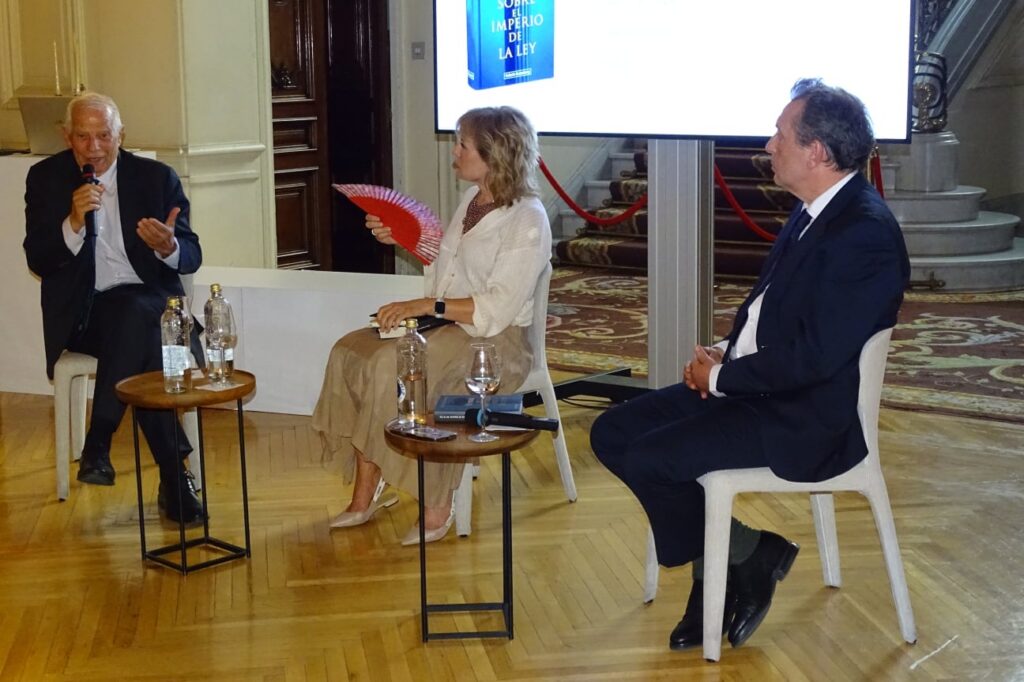
The Ambassador of Italy in Spain, Giuseppe Buccino Grimaldi, hosted the presentation of the book «On Rule of Law», by the Spanish jurist Javier Cremades, president of the World Jurist Association, at the residence of the Embassy. The event was inaugurated by the president of the Spanish Constitutional Court, Cándido Conde-Pumpido, and consisted of a dialogue between the author and Josep Borrell, former High Representative of the European Union for Foreign Affairs and Security Policy, moderated by María Rey, president of the Madrid Press Association.
The meeting was attended by numerous heads of mission accredited in Madrid, prominent figures from Spanish society, and representatives from the institutional and legal world.
In his welcome speech to the attendees, the ambassador, after pointing out that the primacy of law is never a definitive achievement, but requires solid institutions, a constitutional culture, and respect for common rules, recalled that constitutional democracies establish, in defense of the dignity of the person, a core of fundamental principles that escape the mere will of the majority.
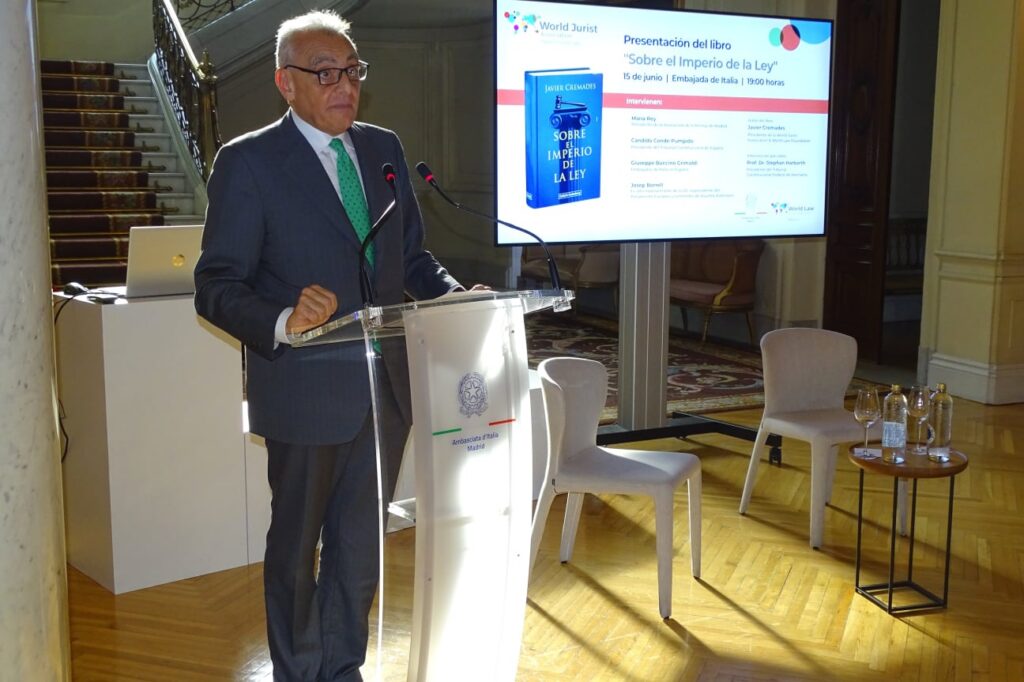
Next, the ambassador referred to the European dimension of the topic, the balance between the primacy of EU law and the constitutional traditions of the member states, and, referring to the book, highlighted a particularly current aspect: the relationship between political power and jurisdiction, emphasizing that the true test of the State of law is not to accept the rulings one agrees with, but to also respect those one disagrees with.
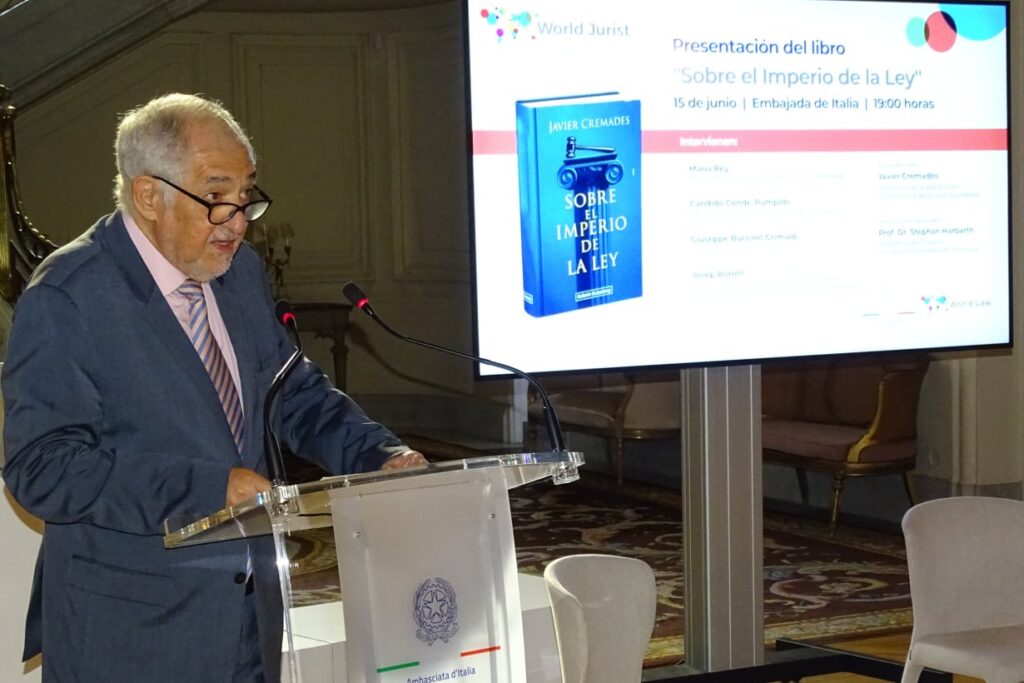
Next, the president of the Spanish Constitutional Court, Cándido Conde-Pumpido, spoke, recalling the value of the Spanish Constitution of 1978 —the longest-lasting in the history of the country— and the will, expressed in the preamble, to establish a rule of law that guarantees the rule of law as an expression of the popular will. Although he acknowledged that, as current events demonstrate, sometimes the rule of force may prevail, he pointed out that the law, democratically approved and applied impartially, is the only possible response.

In a video message, the president of the German Federal Constitutional Court, Stephan Harbarth, referred to the widespread feeling of fear in contemporary societies and described Cremades’ work as particularly relevant in a world marked by increasing threats to democratic states. He recalled the responsibility to defend and protect the rule of law, without which there can be neither freedom nor democracy.
In the debate about the book, Cremades highlighted the drift towards dictatorial states and authoritarian democracies, from which people once fled and towards which they now tend to go, one of the greatest challenges for contemporary democracies, and Borrell recalled the emblematic example of El Salvador. In this regard, Cremades, after expressing his concern about the loss of citizens’ trust in democratic institutions, recalled that the constitutions of the main Western democracies, from Spain to Italy and Germany, are relatively recent and should still be considered, in many respects, as experiments.
For his part, Josep Borrell emphasized the importance of law and its antithesis, the relationship of forces, stressing that only the former allows one to live in a free and democratic world. Referring to the gap between the power to establish norms and the power to enforce them, evident in various international scenarios, the former high representative of the EU pointed out that there can be no effective law without the capacity to ensure its application.
Finally, Borrell and Cremades focused on the weight of interpretation in the application of the law and the fallibility of human judgment, highlighting, through cases of jurisprudence, how the evolution of social sensitivity can influence court decisions.