


Casa de América commemorates the 250th anniversary of the formation of the United States, a milestone that recalls the foundational process that led to the birth of the country in the late 18th century.
The celebration of this 250th anniversary offers an opportunity to reflect on the historical, political, and cultural construction of the United States, as well as its relationship with the rest of the American continent.
The three exhibitions that open tomorrow, Thursday, are part of the activities surrounding this event, with which Casa de América will serve as a platform for meeting, reflection, and artistic creation of the different realities of America.
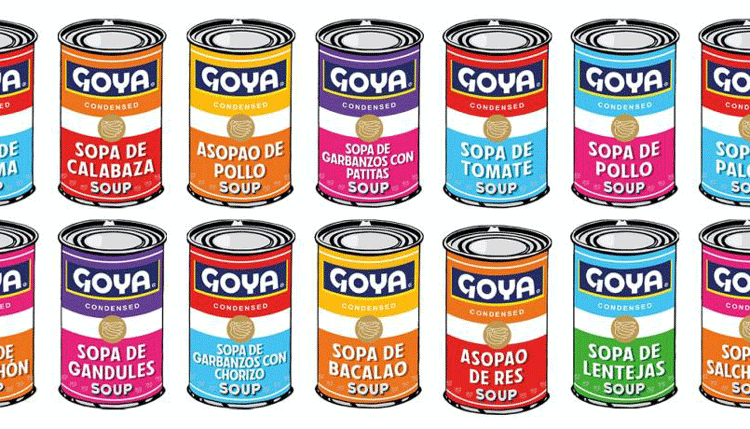
The exhibition I Have a Coconut with You (in the photo), by Bernardo Medina, proposes an incisive reflection on the complex relationship between the United States and Puerto Rico. The title, taken from a Puerto Rican popular expression that alludes to a dead-end obsession, condenses the conceptual core of the exhibition.
Through a set of works that incorporate the colors of the Puerto Rican flag —shared, not by chance, with the American one—, the artist invites a reconsideration of notions of identity, belonging, and cultural dependence. Among the pieces, the bananas stand out, emblematic of Puerto Rican culture, as well as a Caribbean reinterpretation of the iconic ‘Campbell’s soups’, a symbol of American consumer culture. The ‘pícaro little horses’ also appear, a traditional element that introduces a note of humor and rootedness.
The collective PSJM presents the exhibition American Geometry, which in turn consists of two shows: American Colors (Guayasamín Room. Ground floor) and American Democracy (Torres García Room. 1st floor). These two projects are key in their plastic procedure, called ‘social geometry’, through which PSJM generates minimalist compositions based on statistical data or electoral recounts.
American Colors (2009-2010) is the series with which the collective began its ‘social geometry’. It consists of different works that use the 5 colors conventionally applied to races and subject their composition to the censused percentage of population, prison population, and poverty index by ethnicity in the USA. The formalist language is rethought, surpassing intuitive compositions or those conditioned by arithmetic or geometric progressions devoid of all meaning, so that here it is the statistics, nothing abstract, although equally mathematical, that dictates the percentage of each color used in the painting.
American Democracy (2022) is a large installation composed of 59 historical paintings: a pictorial portrait of the political history of the United States interpreted in a geometric key. With this project, PSJM continues the development of that own language within the field of abstraction that the collective has called ‘social geometry’ in which geometric compositions are generated from statistical data or counts.
The immersive exhibition American Latinos 1935-1945, by Alberto Ferreras, brings together nearly 300 portraits of Hispanic communities in the United States, preserved in the Library of Congress.
Filmmaker Alberto Ferreras —creator of the documentary series Habla for HBO, and of the video installation Somos for the National Museum of the American Latino— articulates a set of images that document the lives of Spanish families in New Mexico, Mexican farmers in California, Canary hunters in Louisiana, Puerto Rican farmers, and Basque shepherds in Idaho and Nevada, in a key decade of American history.
Through photography, music, and narration, the exhibition proposes a journey through the United States of the 1930s and 1940s, with works by fundamental photographers such as Dorothea Lange, Jack Delano, Russell Lee, John Collier Jr., Marion Post Wolcott, and Arthur Rothstein.