


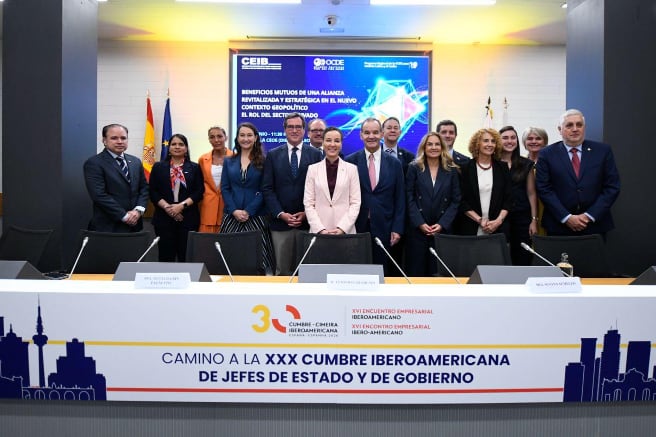
Latin America is a region with essential resources for the energy transition, enormous growth potential, and a young population, according to the Secretary General of CEOE, José Alberto González-Ruiz, during the opening of the Meeting with the Private Sector within the framework of the OECD-LAC Ministerial Dialogue ahead of the Ibero-American Summit in November.
Therefore, González-Ruiz emphasized that both CEOE and CEIB maintain a strong commitment to the region and are “strong advocates for the private sector to be part of the major conversations and agreements that will define its economic future.”
The Secretary General of CEOE outlined the major topics that would focus the day’s panels —critical mineral value chains; formalization of economies; strategic investment; and regional integration— and framed the day in the path towards the upcoming XXX Ibero-American Summit and the Ibero-American Business Meeting on November 4 and 5.
The event, held on Tuesday, was attended by more than 50 ministers, deputy ministers, ambassadors, representatives of organizations and international banks, European institutions, and businesspeople, whose goal was to strengthen public-private collaboration between Latin America and the Caribbean (LAC) and the Organization for Economic Cooperation and Development (OECD).
The working session —under the motto “Mutual benefits of a revitalized strategic partnership in the new geopolitical context”— took place at the headquarters of the Spanish business confederation in Madrid, and it was clear from the institutional opening that Latin America is no longer asking for a place, but claiming prominence, as later emphasized in the closing by the president of CEOE, Antonio Garamendi.
The president of CEOE stated that “this is the moment for Ibero-America” arguing that the region “is part of the response to some of the major challenges that will shape the global economy,” from the energy transition to digitalization, food security, sustainability, or the development of critical minerals.
Garamendi added three key messages: that countries advance when they consider the private sector part of the solution, when they recognize business organizations as legitimate interlocutors, and when they create favorable environments for investment.
The commitment to multilateralism focused the intervention of Jordi Colgán, Director General of Economic Diplomacy at the Ministry of Foreign Affairs, who claimed the support of the Spanish Government for the OECD with the aim of opening the relationship between the organization and Latin America.
The Executive Director of Business at OECD (BIAC), Hanni Rosenbaum, emphasized the strengthening of the OECD’s relationship with a region “very open to the outside” and highlighted the role of the LEO report as a key tool to improve the business climate and bring the countries of the region closer to international standards.
The session was closed by José Antonio Ardavín, head of the OECD’s Division for Latin America and the Caribbean, who described the process of integration of the region with this organization as “unfinished, but in the process of revitalization.”
After the institutional opening, the day was structured around four high-level panels that addressed, among other topics, the role of the private sector in critical mineral value chains; in the formalization of the economies of Latin America and the Caribbean; their commitment to strategic investment in the region; and regional integration and trade blocs in the current geopolitical context.
Among the participants in the panels were ministers and deputy ministers from Peru, Bolivia, Panama, Costa Rica, Honduras, Jamaica, and Uruguay, representatives from the IDB, the European Commission, and CAF, and executives from companies such as Iberia, Mapfre, Banco Santander, Visa, Mastercard, Telefónica Hispam, and the Spanish Banking Association (AEB), among many others.
Finally, the meeting concluded with a high-level conversation about regional integration and trade agreements in the current geopolitical context, highlighting the importance of strengthening relations between the European Union and Latin America and the Caribbean as a way to increase competitiveness, facilitate trade, and consolidate new investment opportunities, leveraging the great economic growth potential of the region.
In the debate, the Ibero-American Secretary General, Andrés Allamand; the Deputy Ministers of Foreign Affairs of the Dominican Republic, Hugo Rivera; of Administration and Public Affairs of Paraguay, Miguel Ángel Aranda; of Foreign Affairs of Uruguay, Valeria Csukasy; of Foreign Trade of Costa Rica, Arianna Arce; of Foreign Affairs of Honduras, Pamela Handal; and of Foreign Affairs of Panama, Carlos Hoyos.
Sumelzo: the value of Spanish as a working language
The closing of the meeting was led by the president of CEOE, Antonio Garamendi; the Secretary of State for Ibero-America, Susana Sumelzo; and the Director of the Secretariat of the Council and the Executive Committee of the OECD, Silvia da Rin Pagnetto.
Pagnetto argued that companies must be part of the design of public policies and warned that high labor informality is one of the main obstacles to attracting investments, and announced the promotion of a specific plan to address this challenge.
The Secretary of State for Ibero-America, Susana Sumelzo, valued the role of Spanish as a working language, inclusion, and access to knowledge, advocating for strengthening its presence in OECD publications.
During the meeting, the eighteenth edition of the report Economic Perspectives of Latin America (LEO), jointly prepared by CAF, the OECD Development Center, ECLAC, and the European Commission under the title “Driving and Financing Productive Transformation.”