


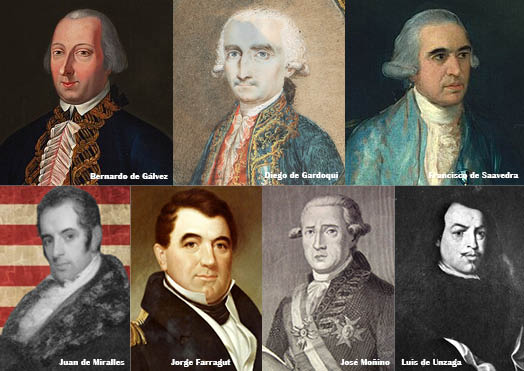
The 250th anniversary of the independence of the United States of America is celebrated tomorrow, Saturday, July 4, a significant date not only in the history of the colonists and the founding fathers of the North American nation but also in the lives of many Spaniards who decisively participated in this process.
Between 11,000 and 17,000 Spanish soldiers, sailors and militiamen actively participated in the American Revolutionary War (1776-1783). This Hispanic force represented about one-third of all combatants on the patriotic side. The Spanish contribution included peninsular troops, but was mainly fed by Novohispanics, Cubans, Puerto Ricans and Creoles.
To commemorate such an important anniversary in history from that time to the present, we highlight the role played by seven Spaniards during that decisive time for the future of humanity.
1.- Bernardo de Gálvez (1746–1786), born in Macharaviaya (Málaga)

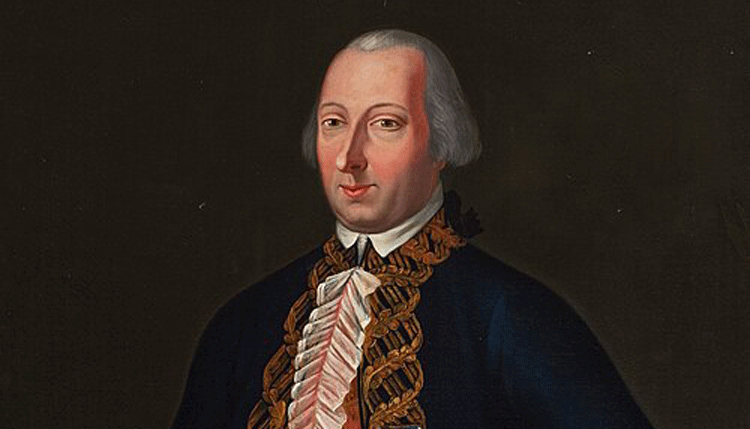
A key figure in the process of independence of the United States, Bernardo de Gálvez was governor of Louisiana and captain general of Cuba, and probably the Spaniard with the greatest direct military impact in the war.
In 1779, declared war on Great Britain, he launched a lightning offensive and took Fort Bute and Baton Rouge in 48 hours. The following year, 1780, he conquered Mobile, cutting off British supply from the south, and another year later, 1781, he achieved a decisive victory at the Siege of Pensacola (2 months), taking all of West Florida from the British and forcing them to disperse forces they needed in the north. Defying the orders of his superiors, who considered the port impassable, he entered alone with his brig Galveztown under enemy fire, which earned him the motto “Yo Solo” on his coat of arms.
In 1785 he succeeded his father as viceroy, promoting enlightened reforms and public works, such as the reconstruction of Chapultepec Castle.
Although his figure was ignored for a long time, in recent years he has regained his place as a transatlantic hero. Since 2014, a portrait of him hangs in the Capitol of the United States, fulfilling a promise from the Continental Congress of 1783. President Barack Obama posthumously granted him honorary citizenship in 2014, an honor he shares with only seven other people (such as Winston Churchill or Mother Teresa). The U.S. Navy will name one of its future frigates, the USS Gálvez, in his honor.
On June 12, the Fundación Consejo España–Estados Unidos awarded the XI Bernardo de Gálvez Award, its highest honor, to the city of St. Augustine (Florida), in recognition of its commitment to the conservation and dissemination of the shared historical and cultural legacy between both countries. The event was held in Avilés, Asturias, the birthplace of the founder of St. Augustine, Pedro Menéndez de Avilés. The award was received by the mayor of St. Augustine, Nancy Sikes-Kline.
2. Diego de Gardoqui (1735–1798), born in Bilbao (Vizcaya)
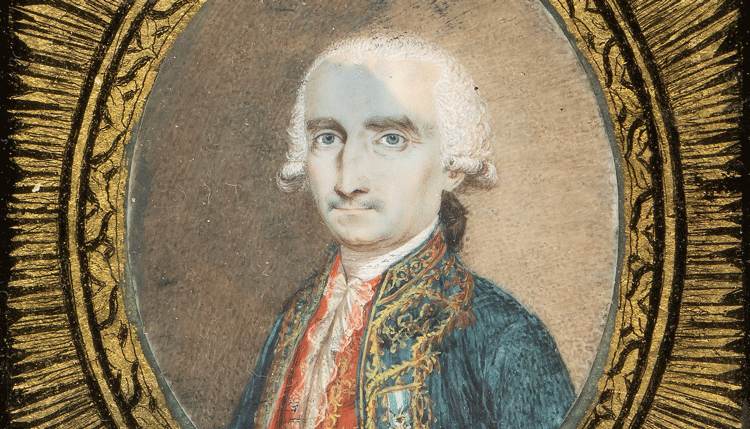
A Basque merchant and diplomat, he was the great shadow financier of independence. Since 1776, his family business, Gardoqui e Hijos, channeled military supplies (gunpowder, fabrics, medicines) to the colonists, financed by the Spanish Crown. He also coordinated with American agent Arthur Lee the covert shipment of over 1 million reales in war material before Spain officially entered the conflict.
It should be noted that he was the first ambassador of Spain to the U.S. (1784–1789), among other things due to his perfect knowledge of the English language learned during his youth in the British Isles. This fact served him to offer important diplomatic and economic services to the Spanish Crown, negotiating the first bilateral trade treaties. He represented the Spanish Crown before the young U.S. Congress, managing critical issues such as the territorial limits of Louisiana and Florida, and navigation on the Mississippi River.
Diego de Gardoqui had close ties with figures such as George Washington, John Adams and John Jay. In fact, he was one of the few foreigners invited to Washington’s inauguration in 1789.
After his time in America, he returned to Spain where he held high-profile positions such as secretary of the Council of State and general superintendent of the Royal Treasury under the reign of Charles IV.
Gardoqui is remembered as an exceptional mediator who harmonized the interests of Spain and the nascent American nation. His work is highlighted today by institutions such as the Fundación Consejo España-EE.UU. and the Instituto Franklin-UAH to make visible the Spanish contribution to the independence of North America.
3. Francisco de Saavedra (1746–1819), born in Seville

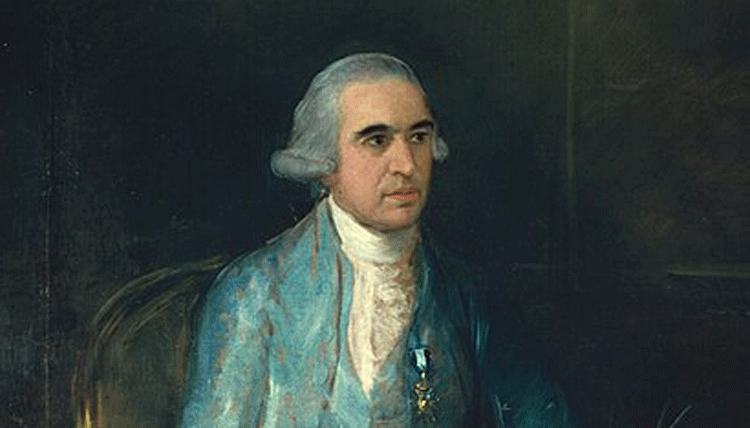
Intendant and imperial coordinator, he is considered the financial architect of the Franco-American coalition. He was a prominent military, official, and Spanish diplomat, an example of an enlightened minister.
Close to the Gálvez family of Macharaviaya, in 1778 José de Gálvez y Gallardo, minister of the Indies and uncle of Bernardo de Gálvez, appointed him fifth official of the Universal Secretariat of the Indies that he presided over, a position from which he rose in the Public Administration, highlighting his work in drafting the Free Trade Regulation with America in 1778.
In 1781 he undertook a crucial mission in Havana: in a few weeks he raised 500,000 pesos among Cuban merchants to finance the Yorktown campaign when France had no liquidity. Without that money, De Grasse’s fleet would not have been able to operate and the battle of Yorktown – which sealed independence – would have been impossible. He also simultaneously coordinated Spanish naval operations in the Caribbean to keep the British occupied. He was the architect of the Grasse-Saavedra Convention, alongside French Admiral De Grasse.
In 1814 King Ferdinand VII tasked him with making the Guadalquivir River navigable again to the capital of Seville. He dedicated great efforts to this task, displaying great enthusiasm and even writing: “If Seville had had a company like the one now projected for the last two centuries, the Guadalquivir would be another Thames and Seville perhaps an emulation of opulent London.”
For the numerous positions he held throughout the three reigns of Charles III, Charles IV, and Ferdinand VII, he was granted recognition as a knight of the Royal and Distinguished Order of Charles III.
4. Juan de Miralles (1713–1780), born in Petrel (Alicante)
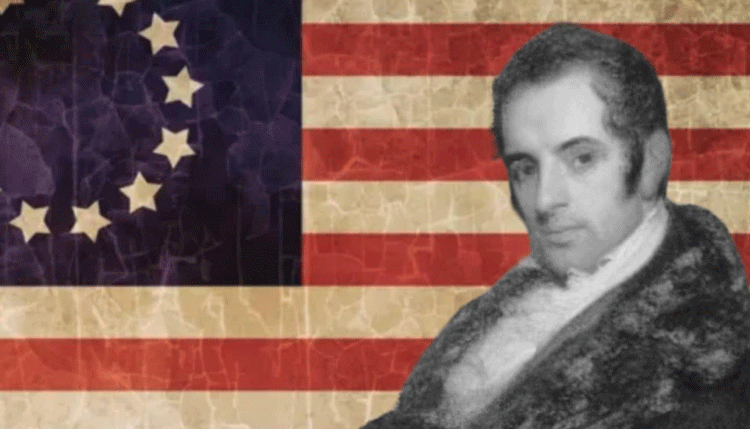
A Spanish merchant established in Havana in 1740, diplomat in the United States, and messenger of the Continental Congress. Juan de Miralles was a Spanish unofficial agent before the Continental Congress and the first de facto representative of Spain before the U.S. From 1778 he acted as a confidential link between Havana and Philadelphia, earning the trust of George Washington, with whom he maintained close correspondence.
Miralles provided military intelligence information and negotiated supplies of food, medicine and money. Juan de Miralles died in 1780 of pneumonia at the home of George Washington, where he was receiving medical care from his wife, Martha, while the war of independence was still being fought. The burial of the Spaniard was attended by the entire U.S. Congress, as a sign of gratitude for the help provided by the Alicantine during the armed conflict, which continued until 1783.
5. Jaime Rigau (Jorge Farragut) (1755–1817), born in Ciudadela (Menorca)
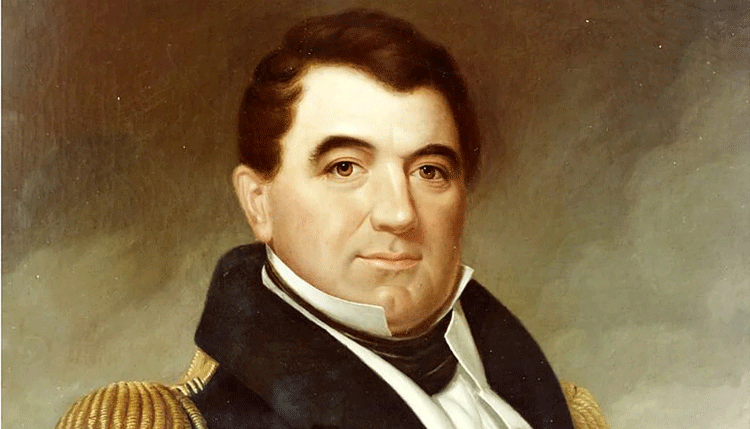
A Mallorcan naval officer and father of David Farragut, when the North American War of Independence began, he joined the revolutionaries in the Navy in South Carolina, as a lieutenant in the war Vixen.
He fought against the British in the battle of Savannah, where he did not leave the deck of the ship he was living on until it was “overflowing with dead and dying” and which turned out to be one of the greatest defeats for the Americans. George Washington described him as “a short and stocky man; very brave and a funny genius.” When the war ended, and thanks to his merits, he retired from the United States Army with the rank of senior commanding officer.
His son, David Farragut, would be the first admiral in the history of the U.S. Navy.
6. José Moñino, Conde de Floridablanca (1728–1808), born in Murcia
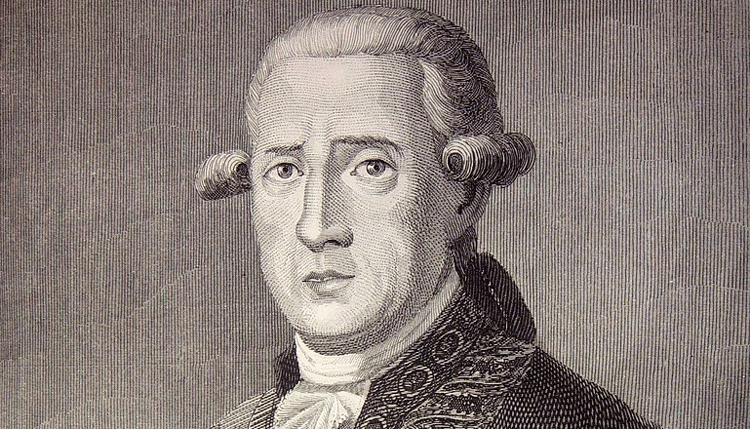
A Spanish political strategist who served as secretary of the State Department from 1777 to 1792 and presided over the Supreme Central Board, created in 1808. In 1773, King Charles III granted him the title of Count of Floridablanca in recognition of his services.
He designed the policy of covert support to the colonists from 1776, before the formal declaration of war, and negotiated with France the Convention of Aranjuez (1779), which coordinated the joint entry of both powers against Great Britain, changing the balance of the war. He also imposed the condition of recovering Gibraltar and Florida as the price of the alliance, which kept Great Britain in a war on multiple fronts.
The objectives of his intervention on American lands were to drive out the British from settlements in Central America, the Gulf of Mexico and the banks of the Mississippi. Floridablanca ordered the dispatch of 11,000 soldiers to fight under Bernardo de Gálvez in the Florida campaign of 1780-81, which resulted in the capture of La Mobila and the decisive triumph of Pensacola, actions for which the English were expelled from the area. These victories, together with all the help received during the war, favored a few months later Washington’s success at Yorktown and the final triumph of the revolution.
7.- Luis de Unzaga (1717-1793), born in Málaga
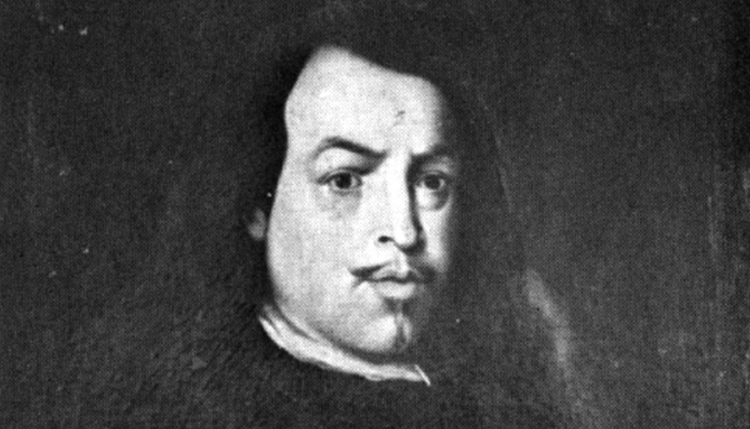
In 1776, the Malagueño Luis de Unzaga, governor of Spanish Louisiana, wrote a letter addressed to the “General of the United States of America.” That letter, read by George Washington, was the first time a European authority recognized the new nation.
Centuries later, historians Frank Cazorla and Rosa García Baena, from the University of Málaga, rediscovered this episode after their research in their work The Governor Luis de Unzaga. Precursor in the Birth of the United States and in Liberalism, highlighting his conciliatory vision, his defense of bilingual education, and his support for American independence.
He helped several of the founding fathers of the U.S. and American leaders achieve their birth as a country in various ways: with tons of gunpowder, flour, medicines, keys to the first North American victories, through the Mississippi River and its tributary the Ohio, and also by allowing free trade, with his diplomatic skills with the English royalty and his espionage networks.
Luis de Unzaga was the first to announce the end of the war or peace through the Spanish governors and ambassadors across the American continent and even to various cities in the U.S. He collaborated in the implementation of the dollar as a cross-border commercial currency, before it became the official currency of the United States, and in 1771 created the first public bilingual education system in the world in New Orleans.
In 2022, the City Council of Málaga honored him with a commemorative plaque at his residence on Alameda Principal, indicating that he was the inspirer of the name of the U.S. by using it for the first time in 1776 in Spanish.